
The T.C. Jacoby Weekly Market Report Week Ending September 24, 2021
Soaring temperatures in much of the country and unusually humid conditions in the Southwest added up to a lot of stress. National average milk yields fell short of year-ago levels, an exceptionally rare occurrence.
Global milk production is slowing down. Milk output in Australia and Europe fell short of the prior year in July, more than offsetting advances in New 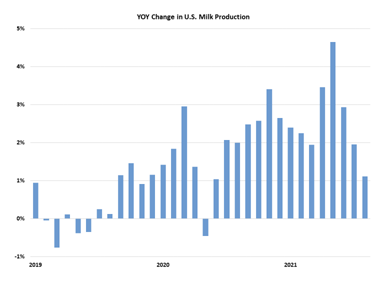 Zealand and Argentina. Combined milk collections among these four major exporters dropped into the red for the first time in two years.
In the U.S., milk production totaled 18.8 billion pounds in August, up 1.1% from last year. That’s the smallest year-over-year growth since June 2020, when the pandemic crippled processors and some dairy producers were forced to slam on the brakes. Soaring temperatures in much of the country and unusually humid conditions in the Southwest added up to a lot of stress. National average milk yields fell short of year-ago levels, an exceptionally rare occurrence.
The dairy herd remains large, driving the modest gains in milk output. There were 9.48 million cows giving milk in the United States last month, 106,000 more than there were in August 2020.
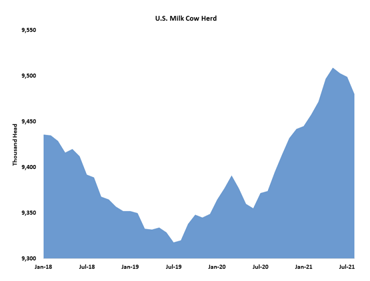 But dairy producers are quickly sizing down the herd. They milked 19,000 fewer cows in August than in July, the steepest month-to-month decline in nearly three years. Slaughter volumes suggest that the contraction continues as poor margins and high beef prices incentivize dairy producers to cull aggressively.
Slower growth in milk output on both sides of the Atlantic will support dairy product prices in the long run, particularly if cow numbers continue to decline. But now that fall has arrived, it would be foolish to expect milk yields to remain depressed. In the Upper Midwest, spot milk prices are starting to slip, signaling that milk is not as tight as it was a couple weeks ago.
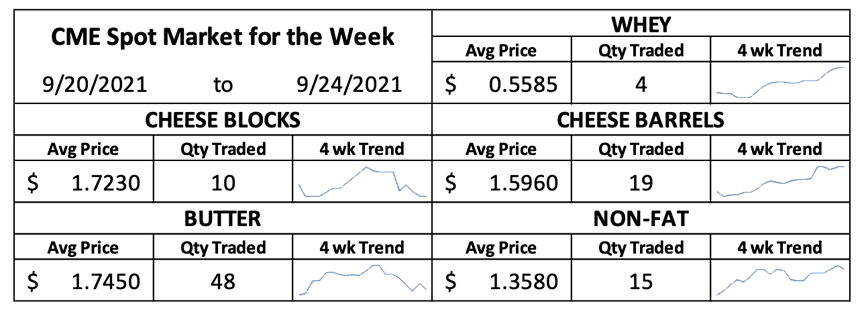
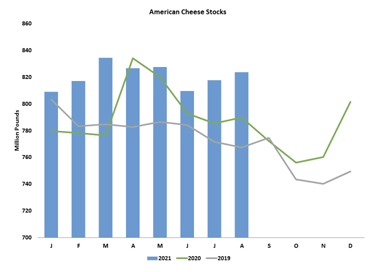 Even at the height of the summer heat wave, there was clearly plenty of milk for cheese vats. Cheese stocks typically decline from July to August, and this year they dropped 21 million pounds. But that’s less than the typical August decline, and stocks are extremely high. There were just shy of 1.43 billion pounds in cold storage warehouses at the end of last month, 4% more than in August 2020 and the highest August tally on record. Inventories of American-style cheeses climbed from July to August, as expanded Cheddar production capacity in Michigan and the Northern Plains caused cheese to pile up in those regions. At the CME spot market, Cheddar barrels shrugged of the news of the surplus stocks. They jumped 9ȼ Monday to $1.60 per pound and held their ground. Blocks, on the other hand, succumbed to the pressure. They fell 8.5ȼ this week and closed at $1.7075.
Butter supplies are less burdensome. There were 367 million pounds in cold storage at the end of last month, nearly 30 million pounds less than at the end of July. The butter drawdown season got off to an early start this year, with stocks falling by a larger-than-typical margin in both July and August. Last month, butter inventories dropped 1.2% below year-ago levels. However, they remain much higher than they were 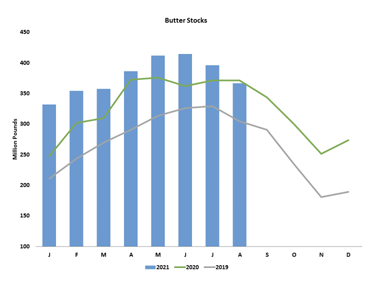 before the pandemic, and there is plenty of butter to keep bakers well supplied through the holidays. Traders at the CME spot market certainly aren’t worried about scarcity. They exchanged 48 loads this week and pushed prices down 6.25ȼ to $1.7275.
The powders moved higher. CME spot dry whey jumped 3.75ȼ to 57.25ȼ, the highest value in nearly three months. Demand for high-protein whey concentrates remains formidable, which is keeping dry whey inventories in check.
Spot nonfat dry milk climbed to $1.37 on Thursday, the highest price in nearly seven years. It closed today at $1.36, matching the previous 2021 high and up a penny from last week. USDA’s Dairy Market News reports that demand from Latin American buyers is firm, and that cheesemakers continue buying NDM to fortify production. But Dairy Market News also notesthat some foreign buyers are less enthusiastic with prices at these heights.
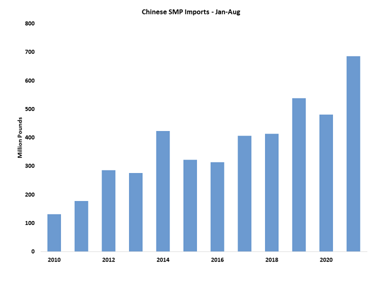 Perhaps the most important factor in the milk powder markets is whether – or when? – China will stop buying. China has been importing skim milk powder (SMP) in unusually large volumes for a year, and stocks are climbing. But they haven’t slowed yet. In August, China brought in 74.5 million pounds of SMP, an all-time high for the month. They also imported 163 million pounds of whole milk powder (WMP), 70% more than the previous August record. China is ravenous for dairy of all sorts. So far this year, they have imported more WMP, SMP, ultra-high temperature milk, whey powder, and cheese than in any January to August in history. Butter imports aren’t record high, but they’re still quite good. U.S. dairy producers benefit from China’s healthy appetite, but not nearly as much as their peers. Aside from whey, U.S. dairy products face stiffer tariffs at Chinese ports than goods from most of our competitors due to our lack of free trade agreements and punitive taxes left over from the trade war.
The corn market is trapped in a trading range. End users are quick to bid whenever December corn futures slip toward $5.15 per bushel. Farmers seem ready to sell when the market tops $5.30. December corn settled today at $5.2675, just a half-cent lower than last Friday. Soybeans were similarly stoic. The November contract closed at $12.85, up a penny for the week. December soybean meal finished at $339 per ton, down $3.20.
As the harvest accelerates, the feed markets could be pushed out of their comfort zones if yields disappoint or impress. Barring that, things could stay quiet until the trade can better assess crop prospects in South America, where farmers are just getting ready to plant.
Original Report at: https://www.jacoby.com/market-report/global-and-u-s-milk-production-slows-down/


Be the first to comment