
The T.C. Jacoby Weekly Market Report Week Ending November 12, 2021
Higher operating expenses and feed bills have significantly raised the cost of production for dairy producers, eating deep into milk checks. Like every industry, dairy producers must also absorb the intangible expense of increased inefficiencies caused by product shortages and logistics headaches.
Pretty much everything – except cheese – costs more than it did a year ago. Last month the average price of a basket of consumer goods jumped 6.2% year over year, the steepest increase in inflation since the days of neon tracksuits and acid-washed jeans. Shoppers are paying a little more for everyday items like food (5.3%), clothing (4.3%), and household furnishings (6.1%).
Meanwhile, on the farm, expenses are soaring. Labor is hard to find and commands a premium. Energy costs 30% more than it did a year ago, and freight expenses are on the rise. Fertilizer prices are at least twice as high as they were last year, and they’re still climbing. Like every industry, dairy producers must also absorb the intangible expense of increased inefficiencies caused by product shortages and logistics headaches.
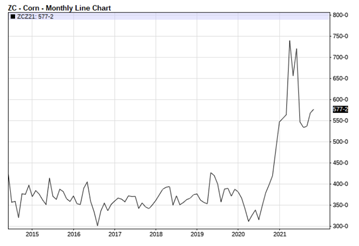 Feed costs are also sharply higher. December corn futures settled today at $5.7725 per bushel, up 25.25ȼ this week. Soybean meal rallied nearly $30 per ton to $362.10, the highest price in nearly three months. USDA gave the bean market a boost early in the week when it unexpectedly lowered its estimate of the national average bean yield from 51.5 bushels last month to 51.2 bushels per acre. USDA raised its assessment of the corn yield to a record-high 177 bushels per acre, which was bearish in theory. But in reality, the bulls ruled the grain pits. Chicago wheat values leapt to their highest price in nearly nine
 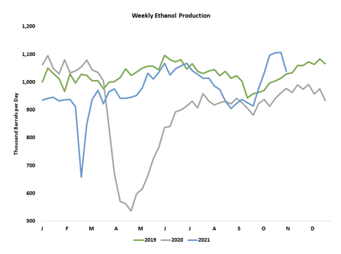 years this week, as Russia hinted at limits on exports and European prices reached all-time highs. Amid rising valuesfor competing crops, overall commodity inflation, and formidable ethanol demand, the corn market bears were pushed into hibernation.
Higher operating expenses and feed bills have significantly raised the cost of production for dairy producers, eating deep into milk checks. Those dairy producers who recently suffered from depooling and low Class IV values can find some comfort in the fact that October milk checks will be much, 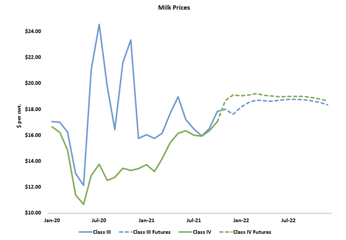 much better than last year. And the futures promise continued improvement. Most Class IV contracts added a few cents this week, and the December through May contracts stand north of $19 per cwt. Class III futures moved higher as well. 2022 contracts posted double-digit gains and range from $18.17 to $18.76. Although these are historically lofty values, profits remain ephemeral. In the long run, higher costs will support dairy product prices by discouraging overproduction. But in the short run, they can really bite.
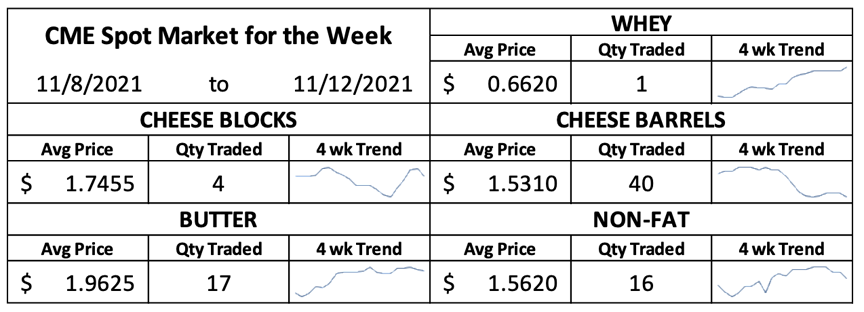
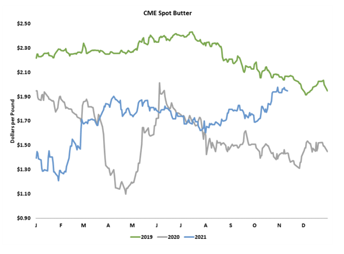 The spot market posted a mixed performance. CME spot butter inched closer to the elusive $2 mark. It advanced 1.5ȼ this week to $1.95 per pound. In a world with very few bargains, grocers are putting butter on sale for the holidays, and product is moving. Meanwhile, “cream is reportedly tight and getting tighter,” according to Dairy Market News, as cream cheese and other Class II manufacturers are feeling festive. Between labor issues, delivery delays, and tighter cream supplies, butter output has slowed in the central and eastern United States.
Cheese prices diverged. After a big setback last week, spot Cheddar blocks rebounded and then some. They closed today at $1.75, up 16.5ȼ from last Friday. But barrels slipped 0.5ȼ to $1.4975. Supplies are heavy, and manufacturers unloaded 40 trailers in Chicago this week. Retail cheese demand is reportedly strong, but output is formidable.
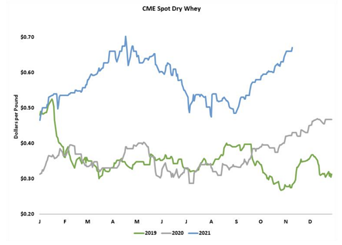 Whey values climbed once again. CME spot whey added another penny and reached 67ȼ, a six-month high. Thanks to firm whey prices, dairy producers’ Class III revenue is $1.27 per cwt. higher than it would have been if whey prices languished at last year’s levels. Asian buyers continue to lap up U.S. whey, and U.S. consumers are hungry for performance protein products, which has helped to keep commodity whey stocks low and prices high.
U.S. milk powder prices took a small step back this week. Spot nonfat dry milk slipped 2ȼ to a stilllofty $1.55. Foreign skim milk powder (SMP) prices are still climbing, but the currency markets are starting to eat into the American advantage in the export market. Accelerating inflation is likely to pressure the Federal Reserve to raise interest rates sooner than it would
USDA also reports that milk collections in Australia and New Zealand continue to lag, as the wet spring drags on. Eventually, these rains will likely result in greener pastures and better milk yields, perhaps extending the dairy season. But they have already hampered output in some crucial months, and odds are growing that milk collections for the 2021-22 season will fall short of last year. Around the globe, milk output is growing very slowly or not at all, which bodes well for dairy product prices as long as demand holds.
Original Report at: https://www.jacoby.com/market-report/expenses-are-soaring-on-the-farm/

Be the first to comment