
Giving oral calcium supplements to cows after calving is a practice adopted by many dairy farms. However, its value remains uncertain. Statistical analyses from eight studies, a meta-analysis, suggests that a blanket treatment approach for all postpartum cows would not result in increased milk production or enhanced reproductive performance(1) . Furthermore, limited scientific evidence suggests that, at most, a subpopulation of postpartum cows might benefit from prophylactic oral calcium supplementation(2,3 ). This article will review the classification and preventive strategies of subclinical hypocalcemia in dairy cows.
Definition and classification of hypocalcemia
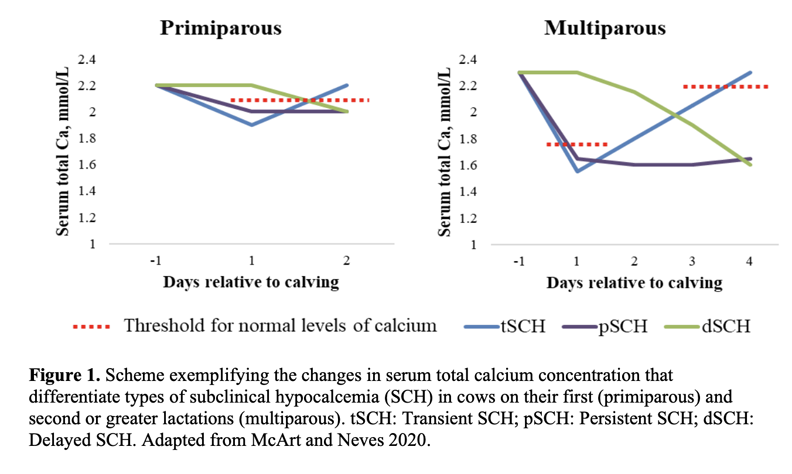
Compared to a couple weeks prior to calving, calcium requirements of cows increase more than threefold and feed intake decreases by 30% after calving(4,5). Consequently, there is a negative calcium balance due to a lower consumption and increased secretion of calcium by mammary glands resulting in reduced blood calcium concentration. The severity and persistency of this decline in blood calcium concentration will determine if cows develop clinical or subclinical hypocalcemia. Clinical hypocalcemia is a metabolic disease characterized by severe low blood serum calcium concentration (<5.5 mg/dL), tetany, recumbence and, if untreated, death(6). Subclinical hypocalcemia (SCH) is characterized by low blood serum calcium (between 5.5 to 8 mg/dL) concentration without the presence of clinical signs(7).
Transient SCH is not detrimental to cow performance
Subclinical hypocalcemia could be further classified as transient, persistent and delayed(8). Transient SCH occurs when blood calcium concentration drops below its normal level on the first day of lactation and recovers to its normal level two to four days after calving. Transient SCH doesn’t impair health and is correlated with increased milk production compared to cows that don’t have SCH (9) . Persistent SCH occurs when blood calcium concentration drops on the first day after calving and remains below normal levels at two and four days in milk, for cows on their first and second or greater lactations, respectively. Delayed SCH is when cows have normal blood calcium concentration on the first day after calving but below normal two or four days after calving for cows on their first and second or greater lactations, respectively. Compared to transient SCH, persistent and delayed SCH are associated with increased risks of developing diseases and leaving the herd early in lactation, and reduced milk production and reproductive performance (8-10) .
Preventive strategies
Clinical hypocalcemia has been successfully controlled with pre-partum feeding strategies such as supplementation with anionic salts or the use of mineral binders(11,12) . However, a successful strategy to prevent SCH and the overall value remain unclear. One strategy is to supplement calcium through bolus administration after calving. Calcium is added to boluses in the form of salts. Calcium chloride (CaC(l2)) and calcium sulfate (CaSO(4)) are the most common ones and are proven to increase calcium blood concentration within an hour after supplementation. However, 48 hours after supplementation, calcium levels do not differ from cows that were not supplemented1 . In the rumen, the salts are dissolved into calcium and chloride or sulfate. Thus, through bolus administration, we are also supplementing acidogenic ions and acidifying the blood(13) . Potentially, this can be why only a group of animals benefits from calcium bolus supplementation at calving. Thus, it’s essential to identify and supplement only cows that would benefit.
Limited evidence suggests that lame cows may benefit from oral calcium bolus supplementation(14) . Finding lame cows is not difficult and is routine in dairy operations. Another group that might benefit are animals at risk of experiencing delayed or persistent subclinical hypocalcemia(15) . Nevertheless, identifying animals at greater risk of having SCH is much more difficult and currently impractical. The use of activity monitors might help find cows at risk of SCH but warrants further investigation(16) .
Conclusion
Overall, blanket calcium supplementation through administration of a bolus to cows after calving does not improve milk yield or herd health. Limited evidence indicates that targeted treatment of calcium bolus supplementation to some cows, such as lame cows or cows at greater risk for persistent or delayed subclinical hypocalcemia, might be beneficial. Nevertheless, managing to treat only a specific group of cows is challenging in a commercial setting, and the value of this target-group treatment approach warrants further investigation.
References
1. Valldecabres, A., Branco-Lopes, R., Bernal-Cordoba, C., and Silva-del-Rio, N. 2022. Production and reproduction responses for dairy cattle supplemented with oral calcium bolus after calving: Systematic review and meta-analysis. JDS Communications. 4:2022-0235.
2. Oetzel, G.R. and Miller, B.E., 2012. Effect of oral calcium bolus supplementation on earlylactation health and milk yield in commercial dairy herds. J. Dairy Sci. 95:7051-7065.
3. Menta, P.R., Fernandes, L., Poit, D., Celestino, M.L., Machado, V.S. and Neves, R.C., 2021. A Randomized Clinical Trial Evaluating the Effect of an Oral Calcium Bolus Supplementation Strategy in Postpartum Jersey Cows on Mastitis, Culling, Milk Production, and Reproductive Performance. Animals, 11:3361.
4. NASEM (National Academies of Sciences, Engineering, and Medicine). 2021. Nutrient Requirements of Dairy Cattle. 8th rev. ed. The National Academies Press.
5. Grummer, R.R., D.G. Mashek, and A. Hayirli. 2004. Dry matter intake and energy balance in the transition period. Vet. Clin. North Am. Food Anim. 20:447-470.
6. Horst, R.L., J.P. Goff, T.A. Reinhardt, and D.R. Buxton. 1997. Strategies for preventing milk fever in dairy cattle. J. Dairy Sci. 80:1269-1280.
7. Reinhardt, T.A., J.D. Lippolis, B.J. McCluskey, J.P. Goff, and R.L. Horst. 2011. Prevalence of subclinical hypocalcemia in dairy herds. Vet. J. 188:122-124.
8. McArt, J.A.A. and Neves, R.C. 2020. Association of transient, persistent, or delayed subclinical hypocalcemia with early lactation disease, removal, and milk yield in Holstein cows. J. Dairy Sci. 103:690-701.
9. Neves, R.C., Leno, B.M., Bach, K.D., and McArt, J.A.A. 2018. Epidemiology of subclinical hypocalcemia in early-lactation Holstein dairy cows: The temporal associations of plasma calcium concentration in the first 4 days in milk with disease and milk production. J. Dairy Sci. 101:9321-9331.
10. Caixeta, L.S., Ospina, P.A., Capel, M.B., and Nydam, D.V. 2017. Association between subclinical hypocalcemia in the first 3 days of lactation and reproductive performance of dairy cows. Theriogenology. 94:1-7.
11. Santos, J.E.P., Lean, I.J., Golder, H., and Block, E. 2019. Meta-analysis of the effects of prepartum dietary cation-anion difference on performance and health of dairy cows. J. Dairy Sci. 102:2134-2154.
12. Saraiva, R.S. de O. 2021. An alternative strategy to prevent hypocalcemia by adding Zeolite A to the prepartum diet of dairy cows. Master of Science thesis. Kansas State University.
13. Duhatschek, D., Newcomer, B., Schuenemann, G.M., Menichetti, B.T., Paudyal, S., Gouvea, V.N., and Pineiro, J.M. 2023. Effect of supplementing one or 2 calcium boluses at calving on serum pH and minerals, performance, rumination, and activity of multiparous dairy cows. ADSA Annual Meeting abstract 1055M.
14. Oetzel, G.R., and Miller, B.E. 2012. Effect of oral calcium bolus supplementation on earlylactation health and milk yield in commercial dairy herds. J. Dairy Sci. 95:7051-7065.
15. McArt, H.A., Seely, C.R., and McArt, J.A.A. 2023. Does knowledge of blood calcium at 2 DIM impact decisions of calcium supplementation? ADSA Annual Meeting abstract 1061M.
16. Seely, C.R., and McArt, J.A.A. 2023. Predicting dyscalcemia at 4 days in milk using activity and rumination data in multiparous Holstein cows. ADSA Annual Meeting abstract 1079M.

Be the first to comment