
Involuntary or biological culling happens because of poor animal health or management, especially during the transition period. The cull rate is one number that may be used to assess how well the dairy is performing.
Cull rates are divided into two categories – voluntary and involuntary culling.
The voluntary or economic culling includes selling the cows for dairy purposes, for low milk production, or bad temper. These are the most desirable reasons for culling as they are made voluntarily by the manager. Most of the cows culled in this category should be from the bottom of the herd making room for more profitable cows. A high percentage of voluntary culled cows is required to maximize profits.
Average Cull Rates
The 2018 USDA/NAHMS Health and Management Practices on U.S. Dairy Operations reported that the average cull rate for the Northeastern U.S. was 31.4 percent plus 6.2 percent cow death rate, a total of 37.6 percent cows permanently removed from herds per year. This cull rate was similar to the DRMS report for 2,570 Pennsylvania herds indicating an average cull rate of 37.2 percent which includes cow deaths. Table 1. summarizes the USDA/NAHMS report reasons and percentages for reasons for culling.
Table 1. Reasons for Culling Cows from Dairy Herds
| Reasons for Culling | Percent of the Total Cull Rate (percent+/-SE) |
|
|---|---|---|
| Voluntary Culling | ||
| Poor production | 18.3 +/-2.2 | |
| Sold for replacements | 4.6 +/-1.3 | |
| Aggressive temper | 0.7 +/-0.2 | |
| Other | 3.2 +/-0.8 | |
| Involuntary Culling | ||
| Infertility | 23.3 +/-1.8 | |
| Mastitis | 18.6 +/-1.3 | |
| Lameness | 9.1 +/-0.7 | |
| Injuries | 3.5 +/-0.7 | |
| Respiratory | 2.4 +/-0.3 | |
| Metritis | 2.2 +/-0.7 | |
| Displaced Abomasum | 2.0 +/-0.2 | |
| Other* | 12.1 | |
| Death | 6.2 +/-0.5 |
*Includes reasons and deaths that occurred less than two percent
Voluntary culling comprised 26.8 percent of the total cows culled. The dominant reason for voluntary culling was poor production (18.3 percent). Only 4.6 percent of cows were sold for replacement to dairy herds.
Involuntary culling was 73.2 percent of the total cull rate. Infertility was the largest single portion of involuntary culled cows at 23.3 percent. Diseases, such as mastitis, lameness, metritis, displaced abomasum, respiratory diseases, and injuries represented almost 40 percent of the biological culls.
The death rate for the average Northeastern U.S. dairy was 6.2 percent and more than half of cows (54.5 percent) died in early lactation, less than 50 days in milk. (USDA/NAHMS, Dairy 2014).
The word ‘culling’ has a bad connotation, but a strategy focused on voluntary rather than biological culls can have a positive effect on the performance of the dairy herd. Voluntary culling is a positive decision when cows with below-average milk production are replaced with
On the other hand, removing cows from the herd due to mortality or health issues is a much different situation. Involuntary culling for health reasons and death loss results in loss of profit for the dairy. Therefore, it is in the best interest of every manager to monitor data and keep involuntary culling as low as possible.
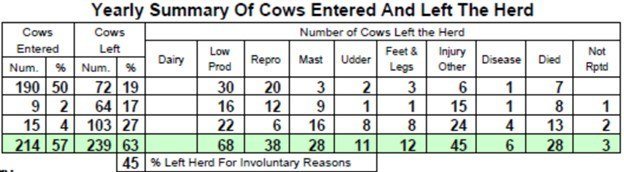
Dairy managers can use DHIA records to evaluate and assess weaknesses in their herds with respect to involuntary culling. The herd cull rate can be found on the DHIA 202 Herd Summary at the Yearly Summary of Cows Entered and Left the Herd. It is the measure of herd turnover and herd replacement. In the table below, the herd cull rate is 63 percent. Forty-five percent of cows left the herd for involuntary reasons. The table also lists reasons for culling and the number of cows that left for each reason.
Benefits of reducing involuntary culling
There can be an economic benefit to low involuntary cull rates. The economic benefits come from increased production efficiency, lower expenses, and increased income. Most often, a low involuntary cull rate on dairy farms can be achieved by using management practices that control the animal environment.
Here are some benefits and management practices for reducing involuntary culling.
- Reduced number of heifers needed to maintain herd size – the fewer cows that are involuntary culls the fewer replacements that need to be raised for the milking herd. As a result, there may be more heifers available to sell or to select from for the herd. A high rate of involuntary culling increases replacement costs, limits voluntary culling, and keeps less profitable cows in a herd (Rushen J., 2013).
- Less money spent on health treatments – disease prevention is always less expensive than treatments. Keeping stalls clean and dry, following proper milking procedures are less expensive than the cost of udder infections. It has been estimated that one clinical case of mastitis costs $325 and $426 for primiparous and multiparous cows, respectively (Liang D., 2017). Providing a clean environment and good housing practices are the keys.
- Cows stay in the herd longer – it takes over three lactations for a producer to recoup heifer raising costs (around $2,000), but the average productive life in 2.7 lactations (Zijlstra J., 2016). However, half of the total cows culled in herds were culled during first two lactations (USDA/NAHMS 2018).
- Healthy cows produce more income – many of the common diseases cows are treated for have a negative impact on production. It has been estimated that one clinical case of retained placenta or displaced abomasum would cost a producer as much as $130 and as much as $280 in milk loss production, respectively. Cows affected by diseases produce less in the future as well. (Liang D., 2017; de Vries A., 2013)
- Timing of culling – data show that a large number of cows culled during the first 60 days in lactation signals metabolic problems, or injuries. It would be worthwhile to review the fresh cow program (Nennich T.D., 2006; de Vries A., 2006; Dechow C. D.; Goodling R.C.. 2008).
Involuntary or biological culls can be costly for the herd, may reduce income, and increase heifer raising costs. Evaluating the reasons that cows are leaving the herd can help to target the management areas that need improvement. Simple changes in management can often decrease the number of cows that are involuntary culls and can increase profitability.
Resources
DRMS/Dairy Metrics Report, Pennsylvania Dairy Herds. October 2020.
Dechow C.D., Goodling R.C., 2008. Mortality, culling by sixty days in milk, and production profiles in high- and low-survival Pennsylvania herds. JDS 91: 4630-4639.
De Vries, A. 2006. Ranking dairy cows for future profitability and culling decisions. Proceedings 3rd Florida & Georgia Dairy Road Show (2006)
De Vries, A. 2013. Cow longevity economics: the costs benefit of keeping the cow in the herd. Cow Longevity Conference, Hamra farm, Tumba, Sweden
Liang D. et al. 2017. Estimating US dairy clinical disease costs with stochastic simulation model. JDS. 100:1472-1486.
Nennich, T.D. 2006. What do cull rates say about your dairy? Texas Dairy Matters, Texas A&M AgriLife Extension.
Rushen J. 2013. The importance of improving cow longevity. Cow Longevity Conference, Hamra Farm, Tumba, Sweden
USDA/HAHMS Health and Management Practices on U.S. Dairy Operations 2014. USDA, February 2018, Report 3.
Zijlstra J. et al. 2016. Longevity and culling rate: how to improve? Wageningen Livestock Research, Wageningen University & research, the Netherlands


Be the first to comment