
A new study in JDS Communications® explores young calves’ motivation to seek companionship
Individual housing of dairy calves is intended in part to manage milk intake and prevent cross-sucking of pen mates. Prior research has suggested that individual housing also benefits calf health, although this claim has been disputed.
“Past behavioral studies have indicated that lack of social interaction can negatively affect calves’ feed intake, social skills, coping abilities, and cognitive performance,” stated lead investigator Marina von Keyserlingk, PhD. “However, previous studies on social motivation among young cattle have not addressed the first six to eight weeks of life, when individual housing is the most common.” To fill that gap, the research team examined behaviors of young dairy bulls, averaging approximately five days of age at the start of the study.
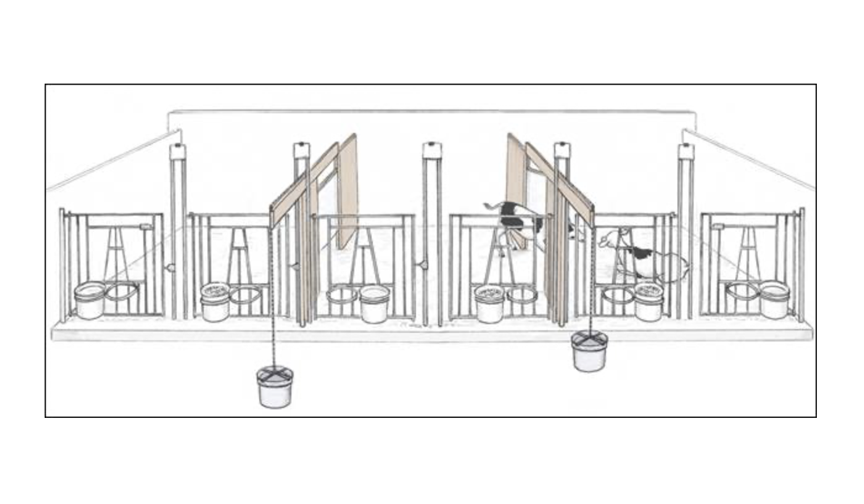
“Each time the test calf pushed open the gate to access a side pen, he would remain in it until the next milk feeding (approximately 0800 and 1600 h), at which time he was returned to the central home pen,” von Keyserlingk explained. “After each successful pushing event, additional weight was added to the gate – initially a small amount, then incrementally higher.” With this design, the task of pushing through the gate was nearly effortless at the beginning of the trial, to facilitate learning, but more substantial differences could be detected by the end of the 15-day trial. Additionally, the pen that would hold the companion calf was randomly assigned daily, so that calves would not simply learn which side housed their companion.
The researchers found that the dairy calves pushed more weight to access pens with a social partner compared with empty pens. All calves but one pushed through a gate for the first time on the first day of the study, on average within ten minutes of the experiment’s start. Of the ten calves tested, eight pushed more for the social side, one pushed more for the empty side, and one pushed the same weight for both sides. Over the 15-day trial, calves pushed on average 1.0 kg more (with an average of 2.2 more pushing events) to access the social versus the empty pen.
The results indicate that young calves are motivated for full social contact, even when they have partial contact, adding to the body of research demonstrating the importance of social contact for calves. The findings highlight the ability of calves to spontaneously display their social motivation. Further, the authors note, the testing method used in this study did not require training, but calves quickly learned to use the gates on their own, suggesting that this task could be readily used to assess spontaneous motivation in other situations.
The American Dairy Science Association (ADSA) is an international organization of educators, scientists, and industry representatives who are committed to advancing the dairy industry and keenly aware of the vital role the dairy sciences play in fulfilling the economic, nutritive, and health requirements of the world’s population. It provides leadership in scientific and technical support to sustain and grow the global dairy industry through generation, dissemination, and exchange of information and services. Together, ADSA members have discovered new methods and technologies that have revolutionized the dairy industry. www.adsa.org
Elsevier employs 8,100 people worldwide. We have supported the work of our research and health partners for more than 140 years. Growing from our roots in publishing, we offer knowledge and valuable analytics that help our users make breakthroughs and drive societal progress. Digital solutions such as ScienceDirect, Scopus, SciVal, ClinicalKey and Sherpath support strategic research management, R&D performance, clinical decision support, and health education. Researchers and healthcare professionals rely on our 2,500+ digitized journals, including The Lancet and Cell; our 40,000 eBook titles; and our iconic reference works, such as Gray’s Anatomy. With the Elsevier Foundation and our external Inclusion & Diversity Advisory Board, we work in partnership with diverse stakeholders to advance inclusion and diversity in science, research and healthcare in developing countries and around the world.
Editor’s Note: Full text of the article is also available to credentialed journalists upon request. Contact Eileen Leahy at +1 732 238 3628 or jdsmedia@elsevier.com to obtain copies. Journalists wishing to interview the authors should contact the corresponding author, Marina A.G. von Keyserlingk, Animal Welfare Program, Faculty of Land and Food Systems, The University of British Columbia, Vancouver, BC, Canada, atnina@mail.ubc.ca.



Be the first to comment