

Last time we visited with Robbie Watson about his farm in Peru. This month, we conclude the interview by talking about Ecuador, and hearing Watson’s thoughts on the future of dairying in Ecuador, Peru and the USA in general.
Ecuador is a completely different dairying system than Peru and the USA. The two main factors for the styles of dairying differences are climate/dairying style and government policies, in Watson’s view.
“In Ecuador,” Watson says, “the government subsidizes the support price. By law, they can’t pay less than 45 cents for the liter of milk.” For comparison purposes, Watson has done the conversion of the various prices in for the USA, Ecuador and Peru–noting, of course, that the price doesn’t include volume, quality or solids bonuses.
The price of inputs also benefits from the government price controls. “If I want to buy a ton of corn in Ecuador, it’s $300 minimum, a support price,” Watson says. “In Peru, I can import it for a cost $150-$180 per ton, on the international market, plus the cost of shipping, so maybe a total of $220. It might be from Uruguay, Argentina, Brazil or the USA. But Ecuador doesn’t allow this importation—and also doesn’t allow any GMO’s (genetically modified organisms). Any corn that comes into Ecuador can’t have GMO’s, which also makes a difference.”
Labor is another input that is different in the two countries. “Labor is expensive in Ecuador, not as expensive in Peru.”
Politics enters into the equation in all countries, Watson believes. “The milk price is political; they would rather have commerce unhappy than the people unhappy. It’s difficult to let the price go up in Peru. The government will import butter from Holland, for example, or powdered milk from New Zealand. There is huge competition.”
The most important difference is caused by climate. Ecuador is very temperate, with most cows located in the regions with altitude, meaning cool nights and days that don’t ever feel too hot.
“If you go to Ecuador,” Watson says, “it’s mainly grazing. Very few farms—and I’m counting with the fingers of one hand and still having fingers left to count on—very few farms will have cows enclosed. The cows in Ecuador are all on pasture. They harvest food for themselves, walk to the barn to be milked.”
Production per cow is lower in a grazing system, with an average of 35-40 pounds/cow/day. “An excellent production in Ecuador would be 44-49 pounds/cow/day,” he says.
He compares the grazing system to driving a car. “Grazing is like 30 miles per hour. It’s difficult to have an accident, and you enjoy the drive,” he says with a chuckle. “When you start enclosing the cows, pushing for production, then it’s like driving at 100 miles per hour. If you miss the curves, you are going to get hurt.
“It’s the same thing for the cows. “I think grazing cattle is a beautiful job,” he says. “Cows work for you, instead of you working for them. If you are grazing, you really enjoy it. The cows are at ease, and you don’t put the pressure on them.”
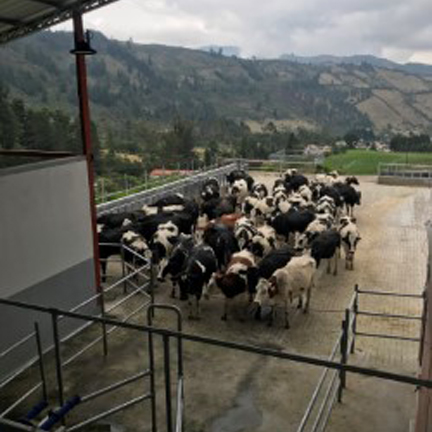
He acknowledges that even with grazing, you can still push the cows harder—and he says that they have tried the “in-between” system, with grazing and enclosed combined. “You can get more milk per cow, but the input is more expensive. In the end of the day, you are much better off with grazing well, with good management, staying about 45 pounds/cow/day, instead of pushing for 60 pounds/cow/day.”
With two such diverse systems, Watson knows that he has a very unique situation. When he compares the two countries, he finds positives in both systems. The business professional in him feels the attraction of the more free-market system in Peru. “Peru is more competitive, you need more controls, more professionals, and you have to measure everything. I enjoy that.”
Then again, there is much that he loves about Ecuador. “I enjoy Ecuador. It’s what I call a ‘soft ride’. You can have a farm and a life with 60 cows; many people live on that here,” he says.
With his background and MBA, Watson sees views dairying as a business, which has led to decisions to expand his farms into other areas.
“Dairying–really worldwide–is not all that profitable,” Watson states matter-of-factly. “If you only do milk, you can’t make ends meet. You either have to work off the farm, or reinvent the farm to get extra cash. One way is genetics. Another way is farm tours and do ag tourism. That brings in extra income, which allows us to reinvest to get new technologies.”
The farm in Peru faces a probable move in the next five years. Like what has happened in the USA– particularly in California, Watson notes–the city of Lima continues to grow. “City people complain about flies, smell. Everything has developed around us. I see us moving outside of Lima, with better access to feedstuffs and forage for the cows. There are also ag exports, and there is a surplus of mangos, asparagus, broccoli, grapes that are leftovers that are being used in dairy feeds. A farm can grow and thrive in those areas; ours could grow from 370 cows to 1,000,” he says. “But we would have to stop doing the tours for children; we’d be too far out.”
“Just this past weekend, we had organized horse back rides for eleven people for four hours. It helps people understand that farm life is intense, but it is beautiful. We can go around the farm for five hours by horse, and people love it.”
He has also taken an old guest house from 1835 which was “almost in ruins,” turning it into a “hacienda house,” which they rent out on AirBnB. “People are having lots of fun.” Another side venture is a small convention center on the farm, a place that serves as a great corporate meeting space or wedding venue.
“We’ve had people from Honduras, Guatemala, Panama, Holland, Africa, the USA… they come to learn and to share ideas. It’s wonderful to watch. They teach me, too,” he says. “A girl from Germany has copied La Querencia—she has a petting zoo now in Germany,” Watson says with a grin. “We love it.”
A passion for the dairy industry: this is a trait which dairy producers around the world share.
Editor’s note: The author based in Brattleboro, Vt., operates Global Cow, Connecting the World, a training program for dairy producers who want to work in the U.S. or in offshore countries. For more information go to www.globalcow.com. She’s the Author of Silver Linings: GOOD things that happened… BECAUSE of a pandemic www.jillstahltyler.com
Be the first to comment