
Improve starch digestibility and avoid feeding turkeys with a few key strategies.
The goal of feed efficiency constantly drives nutritionists to closely monitor and formulate rations with starch digestibility in mind. While this feed factor is regularly researched to learn more, many still struggle with results.
“Typically, by this time of year we forget about looking at or monitoring fecal starch as most starch sources have had plenty of time to ferment and become more available to the animal,” says Cliff Ocker, Rock River Laboratory director of sales and client relations. “Interestingly, this year as we looked at fecal starch levels in the spring of 2021, when the results are often below 2.5 to three percent, we saw that fecal starch was still running above these levels.” This can be seen in Figure 1.
Figure 1: Fecal Starch Over Time
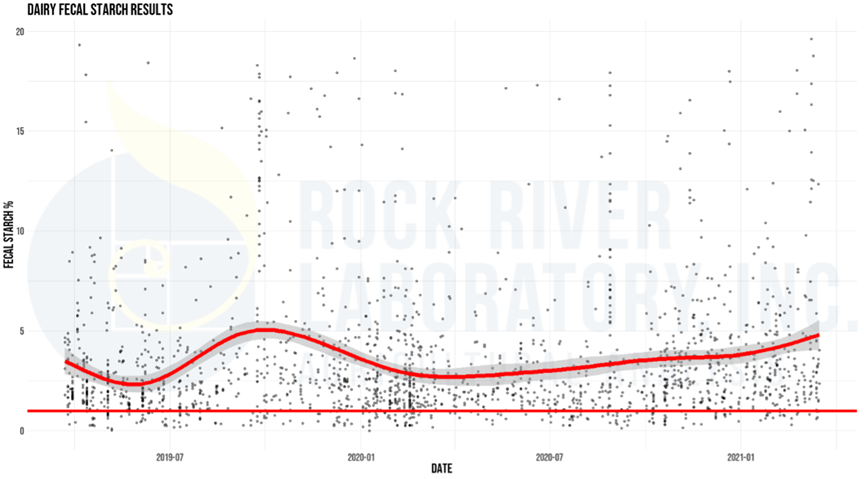
When fecal starch is running over three percent, producers are ‘feeding turkeys’ rather than the rumen, with expensive starch – this negates any return on investment. As the corn is growing in the fields, Ocker suggests that now is a good time to review ways to improve starch digestibility and ensure better utilization this fall and winter.
Follow Harvest Recommendations
Delay Feed Out
Reviewing lab data, Rock River Laboratory has seen as much as a five to 10 point improvement in starch digestibility in corn silage from fresh forage to three weeks fermented.
“Over the next three to five months, we can gain an additional five to 10 points of starch digestibility when corn or other small grains are harvested at the right moisture,” explains Ocker. “Adding these together, when harvested correctly and left to sit for three to five months before feeding, producers can gain 10 to 20 points in starch digestibility.”
KPS: A Valuable Tool
“Kernel Processing Score (KPS) should be reviewed prior to harvest as well as monitored throughout harvest to ensure optimal processing,” recommends Ocker. “Lab data proves that harvesting at the correct moisture will also allow for greater change of kernel particle size over time in storage, helping improve starch digestibility.”
As corn silage is harvested drier than recommended, these effects lessen- resulting in less starch digestibility improvement as well.
“I’m aware of several large farms that now hire an intern to spot check loads of corn silage as it comes in from the field, to ensure that KPS is where it needs to be,” says Ocker. “Much can change during harvest so constant monitoring is recommended.” He shares that, with today’s equipment, shooting for a KPS score greater than 70 should be the goal. Then, with proper time and moisture, the crop should be over 80 KPS at feed out.
For high moisture grains, Ocker also recommends harvesting at the correct moisture and allowing for fermentation to take place before feeding to ensure the best starch digestibility. “With today’s cost of diet nutrients, we certainly want to take advantage of better utilization of all home-grown nutrients to reduce purchased costs.”
Following these few tips will help ensure the best starch utilization for optimal rumen digestion and return on investment. Ocker also reminds producers, “fecal starch can be checked anytime throughout the year, providing the level of starch passing through the animal, to keep an eye on what cows are actually utilizing.” Monitoring starch can help provide benchmarks to improve the digestibility of harvested feedstuffs every year.
Founded in 1976, Rock River Laboratory is a family-owned laboratory network that provides production assistance to the agricultural industry through the use of advanced diagnostic systems, progressive techniques, and research-supported analyses. Employing a team of top specialists in their respective fields, Rock River Laboratory provides accurate, cost-effective, and timely analytical results to customers worldwide, while featuring unsurpassed customer service.


Be the first to comment