

At school, food choices are critical – fueling students’ energy, resiliency and ability to concentrate and be successful in the classroom. Dairy offers so many key nutritional benefits that families and schools rely on to support healthy learning and development. Because of this, Midwest Dairy is working strategically alongside education partners to ensure that schools are providing a variety of options that will
Why have smoothies been so successful in driving dairy consumption in schools? There are several powerful ingredients that contribute to its success.
For starters, smoothies are an incredibly healthy option. Smoothies help kids get their daily servings of dairy, packing a 1-2 punch with milk and yogurt and can be customized with other nutritious options such as fruit and greens. And, thanks to their health profile, smoothies are now considered a reimbursable school meal when paired with another food such as a whole grain, making them an even smarter options for school districts.
Additionally, smoothies are easy to prepare, which is important for mass production in a school setting. Whether it be through the use of blenders at breakfast carts, or using a five gallon bucket and immersion blender to make larger quantities quickly, smoothies are a simple and delicious option for schools that are very efficient to prepare.
Thinking about the unique needs of the school day, smoothies provide an added benefit of flexibility.
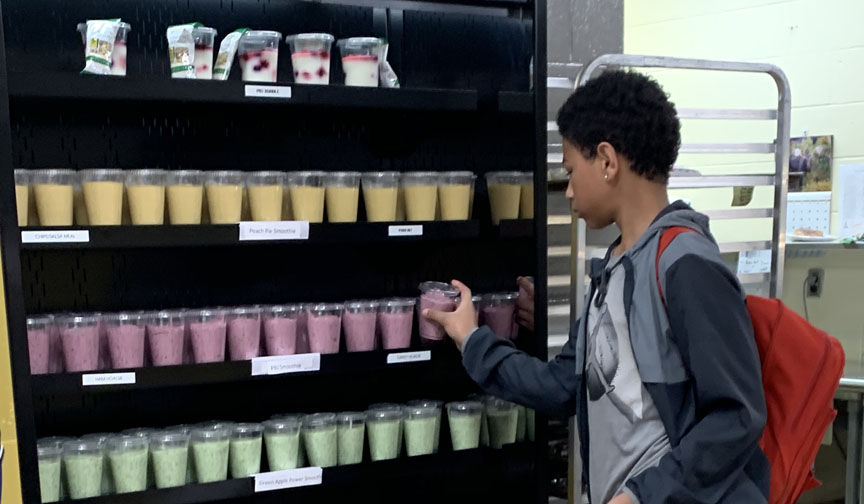 A blended drink is a great option virtually any time of day—at breakfast, lunch or a la carte as a grab and go option in the afternoon. They are a fantastic way for students to quickly fuel up and get the energy they need to perform their best – in the classroom, on the field and as a developing member of our society. Convenience plays an important role, too. Because of their portability, smoothies are the perfect option for students (and teachers) to grab as they head to class or rush to chat with friends. The last thing we want food to be is a distraction or a challenge for students or teachers in the classroom, but smoothies are beloved for their ease and simplicity – not to mention their great taste and healthy nutrition profile.
All of our efforts, however, hinge on what students will enjoy and reach for. Smoothies check that box, too. No matter what age or grade, there is no denying that smoothies have become an extremely popular option for students and adults. Today, we see smoothies on menus at trendy coffee shops and boutique restaurants, and even grocery stores and convivence stores have dedicated smoothie bars, with their popularity is still rising. In fact, according to recent Nielsen data, smoothies accounted for 22.6 million in dollar sales in grocery stores last year, up 84 percent from the previous year, highlighting their popularity and demand. When kids enjoy them at school, it emulates experiences they want to be having in the “real” world, as young consumers.
These smoothie programs are important to us at Midwest Dairy for multiple reasons – not only providing kids with the essential nutrients they need, but also delivering a real impact on current dairy sales, while building future dairy demand. This past year, Wichita Public schools implemented second chance breakfast and smoothies into 13 middle and high schools, which resulted in more than 216,5000 incremental pounds of milk sold. And this was during the pandemic when many schools were in and out of distance learning, showcasing the enormous potential for this program this school year and in years to come. Additionally, there are several new smoothie programs being planned for the 2021-22 school year in places like Omaha, Nebraska and Springfield, Missouri, along with districts in Illinois and Minnesota—all of which will not only reach thousands of new students, but will also make a significant impact on incremental pounds of milk sold through this work. A win-win-win for the students, the schools and dairy farmers.
Moving the needle on immediate dairy demand is always a priority for us as a checkoff program, and these smoothie programs are doing that. Simultaneously, these programs are setting us up for more demand in the future, taking a thoughtful approach to how we reach young consumers who are being shaped and developed by their environment and influences. Students have a lot of questions and perspectives when it comes to the products and food that they consume, and their values are showing through in their choices. As we continue to build trust and preference for dairy among this audience, we believe strongly in the growing number of opportunities to enjoy dairy within schools to fuel them today while laying the groundwork for more demand tomorrow.
Editor’s note: The author is a registered dietitian and has more than a decade of experience working in dairy checkoff, starting as a school nutrition program manager before being promoted to leadership positions on Midwest Dairy’s health and wellness team. In her current role, she develops and leads wellness strategy and activations. This encompasses adult wellness along with partnerships with the National Football League (NFL) and the Fuel Up to Play 60 youth education program.
Be the first to comment