
In a recent webinar with Alta Seeds, the author provided updated research on the renewed interest in forage sorghum.
Typically, dairy farmers turn to corn and alfalfa to achieve their forage needs, but when part of a properly balanced ration, forage sorghum can provide high-quality silage comparable to corn at a lower per-acre cost ratio. While some might think it is just a warm-season crop for the southern U.S., forage sorghum grows well across the country. In Advanced Ag Systems trials replicated in Chazy, New York, the yields proved that forage sorghum can benefit growers up to the Canadian border. The yield trial compared sorghum silage to corn silage grown next to each other.
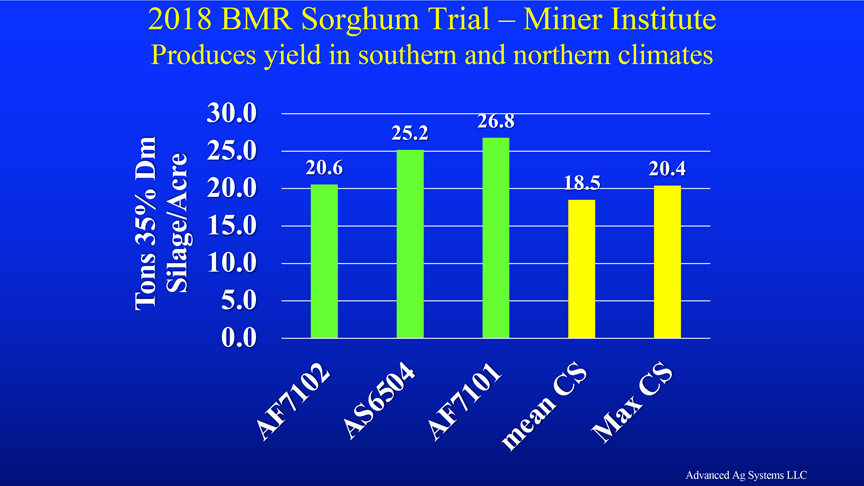
In the 2018 study, sorghum produced 35 percent more dry matter silage per acre than corn (see figure 1). The three short-season BMR forage sorghum varieties, AF7102, AS6504 and AF7101, provided 20.6 to 26.8 tons per acre, consistently producing more tons of silage per acre than the maximum achieved by corn.
Figure 1
Forage sorghum compared to corn
When growing any type of forage, farmers need to consider their water usage, weed pressures and input costs. Here are a few examples of why livestock producers are taking renewed interest in forage sorghum over corn.
Choosing to grow sorghum works well with a typical forage rotation. Sorghum is planted in June, allowing farmers to cut haylage before needing to plant. Sorghum also takes less time to harvest with just one direct cutting, producing twice the dry matter as the traditional two-cut system. Achieving twice the yield with half the trips over the field means that harvest costs 50 percent less than multicut. Direct cutting has the added benefit of not contaminating the silage with soil as in the multicut systems.
Another benefit of sorghum is the ability to drill the crop instead of planting corn’s standard 30-inch rows. In field studies, we found that drilled sorghum gets maximum sunlight interception that increased yields by 18 percent. A narrow-drilled canopy was
Sorghum advantages during drought
Water use in forage sorghum is much less than corn, making forage sorghum an excellent choice during or when recovering from drought. Brown midrib (BMR) sorghum silage varieties were found to yield 50 to 125 percent more than corn on an inch of water. When drought is a concern, sorghum can still produce a quality forage source with a lower risk for drought-stressed silage come harvest time.
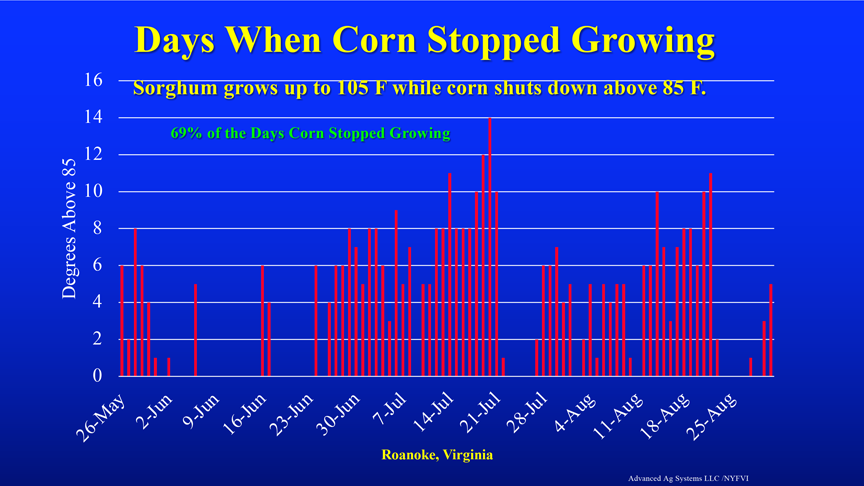
Sorghum continues growing in heat stress events until 105 degrees Fahrenheit, while corn slows and stops growing at 85 degrees Fahrenheit (see figure 2). During a growing season in Roanoke, Virginia, the middle of the northern and southern regions of the United States, temperatures go above the corn threshold of 85 degrees 69 percent of the time. Sorghum’s natural tolerances to warmer temperatures and water use are the ideal fit for growers facing heat, drought and water restriction issues.
Figure 2
Sorghum in dairy cattle diets
Non-BMR forage sorghum is most economically used in replacement heifer and fresh and dry cow rations. Corn silage with its high starch level is notorious for producing overconditioned replacement dairy heifers that subsequently milk poorly. BMR sorghum has high fiber digestibility that still can produce overconditioned animals. Non-BMR sorghum harvested at very early dough stage will grow excellently-framed replacements without overconditioning and at lower cost than corn silage.
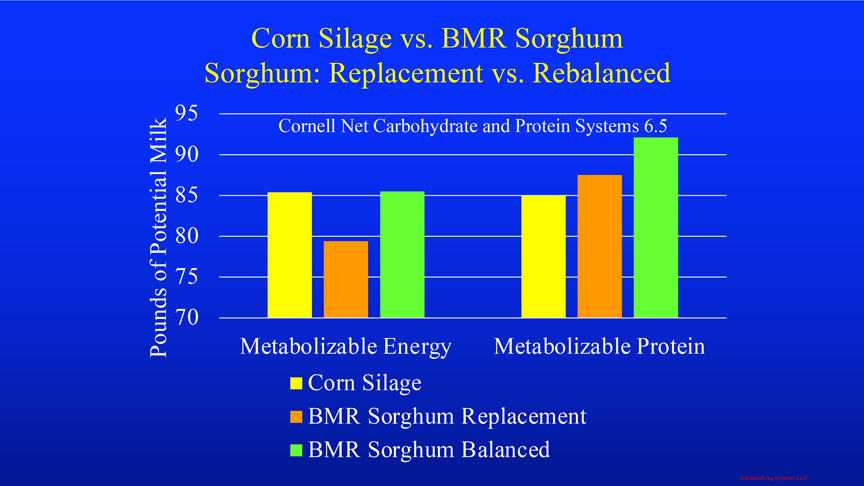
Forage sorghum is not a one-to-one replacement for corn silage: the ration must be rebalanced. Advanced Ag Systems found that the metabolizable energy of forage sorghum was equal to that of corn silage. When comparing the metabolizable protein between the balanced corn and the rebalanced sorghum diet, there is a potential for seven additional pounds of milk (see figure 3). The most important factor is for producers to work closely with their nutritionist to rebalance the ration when adding sorghum.
Figure 3
Sorghum as a forage is a viable option, no matter the location of your operation; it’s not just a crop for the south. The benefits of replacing corn silage for sorghum silage offer not only similar nutritional benefits for your cattle but also lower water usage, lower input and labor costs, and increased yields. Realizing the potential of forage sorghum may help your operation as the new addition to your crop rotation and cattle’s rations. Click here to watch Tom’s full presentation.
Editor’s note: Tom Kilcer is the owner of Advanced Ag Systems, LLC a private consulting firm specializing in forage production in Kinderhook, New York. A leading expert in forage research and education, he is often a speaker at industry events. Prior, he spent 33 years as a Cornell Cooperative Extension multi-county field crop and soils educator in Rensselaer County, N.Y. Through his work with Cornell, Kilcer has developed best-management practices for planting, managing and harvesting BMR sorghum-sudangrass crops and evaluating BMR sorghums for dairy forages.



Be the first to comment