

Dairy cattle play a significant role in providing food security for consumers by converting human inedible food such as forage and by-products to human-edible high-quality protein, micronutrients, and essential fatty acids. However, the value of dairy cattle and other ruminant animals is being challenged because of concerns about the environment and climate change. These concerns typically focus on lactating cows; however, heifers are a necessary part of the dairy cattle lifecycle, and strategies to reduce environmental impacts when raising heifers also need to be considered.
The unique digestive system of the dairy cow allows them to eat human inedible foods, but during the digestive process they produce methane, a greenhouse gas. Cattle are less efficient than other species at converting feed protein into meat and milk protein. The heifer raising period is the least efficient period for cattle as they are just growing and gestating during this phase. The timeframe for raising heifers currently averages about two years and during this developmental period they do not directly produce any human food products. An additional challenge of ruminant animals is that a higher level of protein and nitrogen is excreted in the manure than other species. Depending on the handling of manure, some of the excreted nitrogen may be converted to nitrous oxide, another greenhouse gas.
Much of the current research in the area of greenhouse gases is focused on lactating cows. However, many of the same principles and products that work in lactating cows also apply to heifers. For an example, the use of a holistic approach implementing precision formulation and specific management recommendations apply regardless of the age and production level of the animal. Utilizing a ration-balancing platform that optimizes the balance of nutrient supply with the nutrient needs of cattle maximizes dairy farm profitability and reduces environmental impact in three key ways. First, by optimizing conversion of feed ingredients for growth; second, by balancing all sources of energy ingredients used; and third, by selecting the best protein and amino acid sources in the diet, which decreases methane emissions and nitrogen excretion.
Nutrition strategies that improve the conversion efficiency of feed to milk or meat have been shown to decrease methane production. When nutrients are supplied without overfeeding, animals become more efficient, resulting in less
Limited research has focused on dairy heifers, but information and feeding strategies explored in beef heifers and dairy cows are likely to respond similarly in dairy heifers. Feeding ionophores is an example of a feeding strategy that has resulted in improved feed efficiency in growing animals. A recent meta-analysis by Moore et al. (2021) evaluating the impact of feeding an ionophore to replacement beef heifers reported an average increased gain:feed of 0.013 and an average reduction in age to puberty of 8.9 days. Ionophores are often utilized in dairy heifer diets, and as with beef heifers, would be expected to improve feed efficiency and decrease time to maturity and to enter the lactating herd.
Ingredient selection and the amount of each ingredient included in dairy cattle rations impacts the production of enteric methane and nitrogen excreted. In general, grass-based diets result in greater methane emissions; therefore, feeding diets with additional concentrates may reduce the enteric methane emissions from heifers. Incorporating feeds from other industries, such as ethanol coproducts, have also been shown as an opportunity for reduction in the overall GHG emissions from cattle raising systems, but the value of feeding some of these coproducts are dependent on the amount fed (Dudley et al., 2014). Through time, a better understanding how various ingredients impact emissions and how selecting specific ingredient sources and the amounts of those sources directly affect the methane that comes from the animal and manure are needed. Although much of this research is likely to be done in lactating cows, heifer research needs to be conducted to determine if the same strategies apply to growing animals.
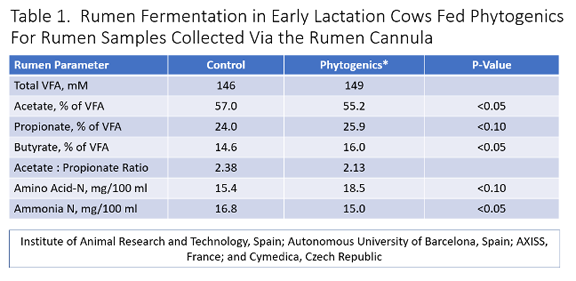
Another feeding approach demonstrated in dairy cattle to reduce environmental impacts is the use of specially selected phytogenics. Specific phytogenics, which are standardized and protected in a microencapsulated matrix, have shown to provide a natural solution of proven technologies to alter rumen fermentation for favorable production responses. Lactating cow data have shown a 2.6% improvement in milk production and decrease in MUN by cows fed a proprietary phytogenic formulation. These targeted phytogenics impact the rumen volatile fatty acid (VFA) profile by lowering acetate production and increasing propionate and butyrate production (Table 1). This results in more available energy with less methane released as greenhouse gas. Use of phytogenics needs to be evaluated in heifers to determine if these feed additives result in significant reductions of greenhouse gases for growing animals as well. Additional evaluation of the economics of phytogenics will also be a valuable component to determine the overall sustainability of using these feed additives in heifer diets.
Improved efficiency, health, and profitability can be achieved with a more precise ration formulation approach that also has the benefits of decreasing methane emissions and nitrogen excretion. The value of improvements in feed efficiency are often overlooked and are not considered as a criterion when evaluating profitability in heifer raising systems. Utilizing a targeted approach focused on ration balancing to evaluate the energy and protein sources being fed, along with use of specially selected phytogenics, strategically improves conversion of feed to growth while reducing production of methane and other volatile compounds that contribute to greenhouse gas emissions.
Finding strategies to reduce greenhouse gases from all aspects of dairy farming, including raising dairy heifers, is gaining importance. Focusing on feeding strategies that improve efficiency and reduce emissions in a cost-effective manner will help heifer raisers stay sustainable from both an environmental and profitability standpoint.
*ADM’s proprietary product RumeNext.
Author bio:
Tamilee Nennich Adolph and Brian Lammers are Dairy Nutritionists with ADM Animal Nutrition.
References:
Dudley, Q.M., A. J. Kiska, A.K. Watson, and G.E. Erickson. 2014. Uncertainties in life cycle greenhouse gas emissions from U.S. beef cattle. J. of Cleaner Production. (75)15:31-39.
Institute of Animal Research and Technology, Spain; Autonomous University of Barcelona, Spain; AXISS, France; and Cymedica, Czech Republic
Moore, M.F., S. Gadberry, D. Lalman, F. White, S. Linneen, R. A. Beck. 2021. Meta-analysis of the performance responses of replacement heifers and beef cows to Monensin. J. of Animal Sci. (99)3:191-192.
Zanton, G.I., and A.J. Heinrichs. 2009. Review: Limit-feeding with altered forage-to-concentrate levels in dairy heifer diets. Prof. Animal Sci. (25)4:393-403.


Be the first to comment