
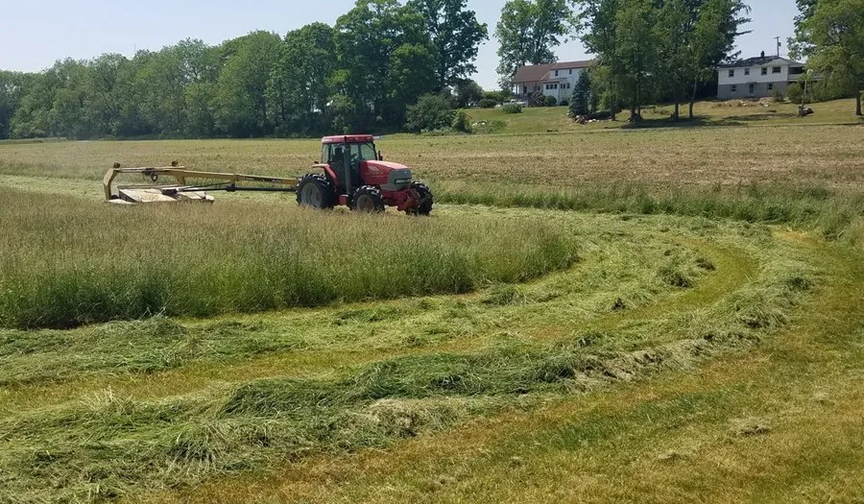
These tips will help you manage nitrogen and potassium in hay crops, as well as avoid potential nitrate toxicity when feeding livestock, during this abnormally dry spring.
Continue with Previously Planned Nitrogen and Potassium Applications
Although many hay crops did not reach their typical first cutting yields due to the dry weather, this does not necessarily mean the crops left behind significant quantities of nitrogen (N) that will remain available for future cuttings. Forages take up the majority of N for each cutting early in the growth cycle, and that early uptake becomes diluted by biomass growth later in the cutting cycle. With sufficient soil moisture early in the growth cycle, N uptake levels were probably close to normal in the first cutting. However, an issue that arises in droughty conditions is that the nitrate taken up the plant is not assimilated into protein, which can lead to high accumulations of nitrate in the harvested forage, potentially leading to nitrate toxicity when feeding the hay to livestock. More information about managing nitrate toxicity is discussed at the end of this article.
To meet the N needs of future grass hay cuttings this year, N applications should continue to be made between each cutting based on the anticipated yield of the following cutting, using 50 lbs N/ac per ton of expected dry hay yield. It is important to carefully consider N source and method of application to reduce the risk of ammonia volatilization losses. These losses are especially high for urea containing fertilizers that are applied on the soil surface without incorporation during warm temperatures, which is what most hay producers are likely faced with now. Volatilization losses are reduced when a rainfall greater than 0.5-inches occurs within a day or two of applying urea fertilizers. However, the current forecast over much of Pennsylvania does not call for that amount of rain, and even in typical years, it is normal to have somewhat long periods between rain storms in late spring and summer. In this situation, urease inhibitors will help to prevent volatilization losses for up to 14 days and allow for a rainfall event to incorporate the urea.
In situations where rain is not expected to occur even within 14 days, an alternative to using urea treated with urease inhibitors would be to switch the N source ahead of the next cutting to ammonium sulfate, which is not susceptible to volatilization losses. Ammonium sulfate also provides the additional advantage of helping to meet the S needs of hay crops. Ammonium sulfate should not be the only N source used over the entire production year, because it will lead to unnecessarily high S applications, and ammonium sulfate is also more acidifying than other N sources like urea. Rather, use the ammonium sulfate strategically on a cutting where the potential for volatilization losses are expected to be high and where the window of protection provided by a urease inhibitor is likely to expire before a rainfall event occurs.
Continuing to meet the potassium (K) needs of crops is also important during droughty periods because K helps plants cope with water stress. Potassium application rates should always be determined based on a recent soil test, which accounts for the pre-existing stores of K in the soil. Furthermore, because of the potential for luxury consumption (excessive uptake of a nutrient when it is applied beyond the crop need), K applications on hay crops should always be split-up between cuttings. The overall annual K2O recommendation based on the soil test can be divided into doses applied between cuttings in proportion to the expected yield for the following cutting. Although most of the K that is transported to plant roots occurs through diffusion in the soil, and diffusion rates can be reduced in dry soil, K will still make its way to roots and provide a benefit to the crop, even in droughty conditions. Therefore, it is important to keep up on recommended K applications, even in dry weather.
Managing Nitrate Toxicity in Forages
Nitrate concentration in oat, barley, sudangrass, sorghum, sorghum-sudan hybrids, brassicas, and some common weeds such as kochia, lambsquarter, and pigweeds can be high enough to cause livestock nitrate poisoning. Nitrate is easily converted to nitrite in blood, and the nitrite will react with hemoglobin disabling the oxygen-carrying capacity of blood cells. In low nitrate forages, the nitrite can routinely be converted to ammonium and then amino acids and proteins. With high nitrate levels, the nitrite will accumulate and cause toxicity. Under unfavorable growing conditions, such as drought, cold soil and air temperatures, pest infestation, cloudy days, and so on, those listed plants tend to accumulate lots of nitrate in their lower stems. When we apply nitrogen fertilizer in one application, plants also tend to accumulate lots of nitrates. If the nitrate level in the forages is over 1000 ppm, it is sensitive to livestock in pregnancy, milking, and other reproductive stages. If the nitrate level is over 4400 ppm, it is toxic for all livestock metabolic stages.
Specifically for oat this year under drought, nitrate testing is a must for an accurate and safe management plan. It will cost a little bit more when you send forage samples, adding a nitrate test besides the standard forage quality test. If the test results are unsuitable for any livestock species and stages, mixing oat forage with other low-nitrate forages is the only option if you need to feed the oat forage. Mix forages thoroughly and feed them in small quantities often so the animal preference for oat forage is limited. Making greenchop for direct feeding is worse than making dry hay. Drought-stressed oat right after rain will promote tillering and new growth; it will also worsen the nitrate accumulation for the first several days right after significant rainfall after drought. Cutting oat hay with higher-than-normal stubble will help alleviate the problem. Making silage will also lower the forage nitrate levels because the ensiling microorganisms will transfer some nitrates into proteins. When feeding oat hay with high nitrate levels, presenting energy supplements such as corn will help. In the end, if the animal shows nitrate toxicity symptoms (rapid breathing, muscle tremors, incoordination, diarrhea, and frequent urination), with the consultation of your veterinarian, intravenous injection of a methylene blue solution can be the last solution. We hope we never get to this point.


Be the first to comment