
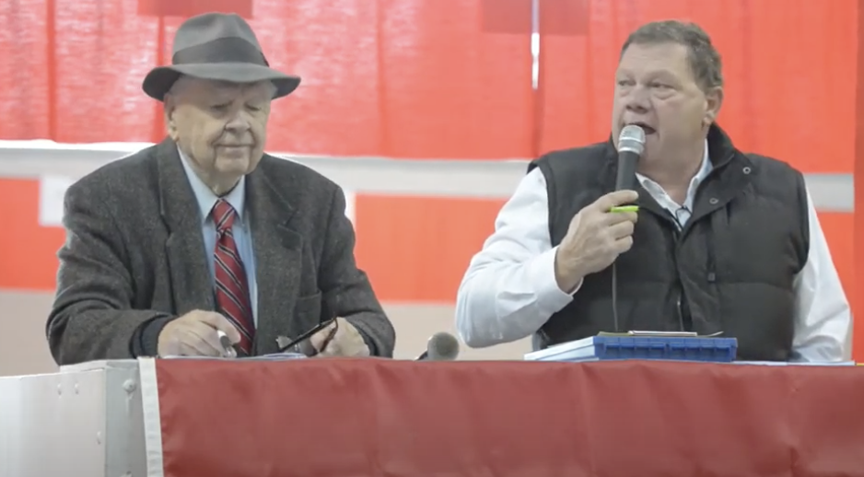
Horace A. Backus, 96, of Mexico, N.Y., often called the “Dean of Holstein Pedigrees”, passed peacefully in his sleep early on October 22 after several years of declining health. He spent his long career working with Registered Holsteins as a breeder, auction sale manager, author and organizational leader. Widely recognized, he was considered a friend and adviser by literally thousands of dairy breeders and industry leaders nationally and internationally. In many ways, his death signals the end of an era as well as a personal loss for many, including this writer.
His commitment and enthusiasm for registered Holsteins began at an early age working with his grandfather, father and uncle on the family’s Butterfly Farms, a leading herd of that era. It was home to the first cow in the U.S. that made over 1300 lbs. of fat in a single lactation on 3X milking. He also worked in his youth compiling pedigrees for the sale management business, operated by his father, R. Austin Backus, who was managing up to 100 sales a year.
Even with his work on the farm and in the pedigree office, Horace was a successful high school athlete with a special talent for baseball where he excelled at third base. He was a lifelong baseball fan, always keeping up to date on the standings and enjoying a trip to Syracuse to watch the Triple A ball team there, regardless of the parent club at the time.
It was in 1953 when Horace at age 25 and his older brother Charles, were put into the auction box on their own for the first time at a major sale. Their father had suffered a debilitating stroke only a week before on the eve of the dispersal of a world renowned herd in New York, General Cochran Farm. The herd had been owned by Dr. and Mrs. John Jackson and managed by noted cowman Baird Hammond. With the elder Mr. Backus not able even to attend, hiring a more experienced auction team was discussed. But Hammond, and especially Mrs. Jackson, told the young Backus brothers that they could do the job just fine. And they did, with 109 head averaging $1207, the highest averaging Holstein dispersal in the U.S. for the past six years. The high seller was the bull Sovereign Cochran at $14,000, the highest price for a Registered Holstein since 1947.
With that sale under their belts, Horace and Charles along with their brothers Olin and Everet formed the R. Austin Backus, Inc., firm which managed herd dispersals, local, state and national sales for the next 30 years, with equal diligence whether selling a farmer-breeder herd dispersal or a high end consignment from a leading merchandiser.
After the sale of the business in 1983, Horace continued as a pedigree reader working usually with David Rama of the Cattle Exchange. Rama takes great pride in the fact that he worked in the auction box with Horace for more sales than even brother Charles. He writes, “It was an honor to work with Horace for over 35 years, traveling thousands of miles, countless meals, hundreds of sales… he was one of the finest human beings on the planet.” Horace was also a fixture in the box at the World Classic sale series managed by Tom Morris at World Dairy Expo.
Horace estimated that he had worked over 3000 sales and assisted with the preparation of over 5000 catalogs. Those who know him appreciate the fact that when asked about a favorite sale, he always said he appreciated them all, with one as good as the next. Horace’s last appearance in a Holstein auction box was in 2016, fittingly working with Dave Rama at the Cornell Dairy Club fall classic sale in Ithaca, N.Y.
His commitment to Registered Holsteins included service to Holstein organizations, managing sales that funded New York, Pennsylvania and other state and county associations and serving as a delegate to Holstein Association annual meetings. He served two terms on the Holstein Association’s board of directors from 1987 until 1995 using his business experience with an eye on Association finances and leadership along with a seat on the audit committee.
With Registered Holsteins at the center of his career, it’s no surprise that he was also an enthusiastic and successful breeder. He began in 1948 purchasing Noblevar Farm in his home town, but then sold with the demands of the sale business. Later he bred cattle under the Shady Lake prefix working with the Freleigh family in Central New York. A favorite was the development of a six-generation Excellent cow with 200,000 lbs. lifetime. He also had close ties to the famous Audrey Posch, an EX-93 cow who once called Butterfly Farms home, and is the founding dam of many generations in direct line of continuously Excellent cows.
A case can be made that Horace Backus, as much as any other individual, contributed to the growth in value of registered Holsteins throughout his career as a sales manager, pedigree expert, association leader and adviser to hundreds in the industry. He is the epitome of all that is positive in the Holstein business… knowledge, respect and enthusiasm, with unwavering integrity in every instance.
Beginning in 1988 and through 2012, Horace wrote and published a series of books on Holstein history, including the influence of leading herds and bloodlines as well as personal reminisces from his wide experience with top cattle and leading breeders. These books have received wide circulation among Holstein folks everywhere.
The contributions Horace has made to the purebred industry have been widely recognized. It was in 2003 that the Klussendorf Association made him an honorary member. Then in 2010 World Dairy Expo named him Industry Person of the Year, followed in 2013 by the Holstein Association USA recognizing him with its Distinguished Leadership Award. National Dairy Shrine honored him one of its Pioneers in 2016.
Horace was also a leader in his local community. The Backus business published local newspapers for many years, using the same printing press as for the sale catalogs. He served on the board of the Mexico Academy and Central School for ten years. He was a life member of the First Presbyterian Church where he was Sunday school superintendent for a time.
It’s no surprise that Horace married a dairyman’s daughter, Doris Anne Nicholson, also from Mexico who died in 2022. In their 70-year marriage, she became not only well regarded in the industry and a local community leader, but also the mother of their three children. A son, Harry, predeceased them, while son John and his wife Debra have three sons. Their daughter Kim Grindle and her husband Marc have a son. Horace also leaves a brother-in-law Bill Nicholson and a nephew, Mark Backus, and their family members. Funeral services were held October 29 and interment is in the Mexico Village cemetery. The family welcomes memorial contributions to the Horace Backus Memorial Scholarship Fund at the Holstein Foundation (www.holsteinfoundation.org) or the local Presbyterian Church.
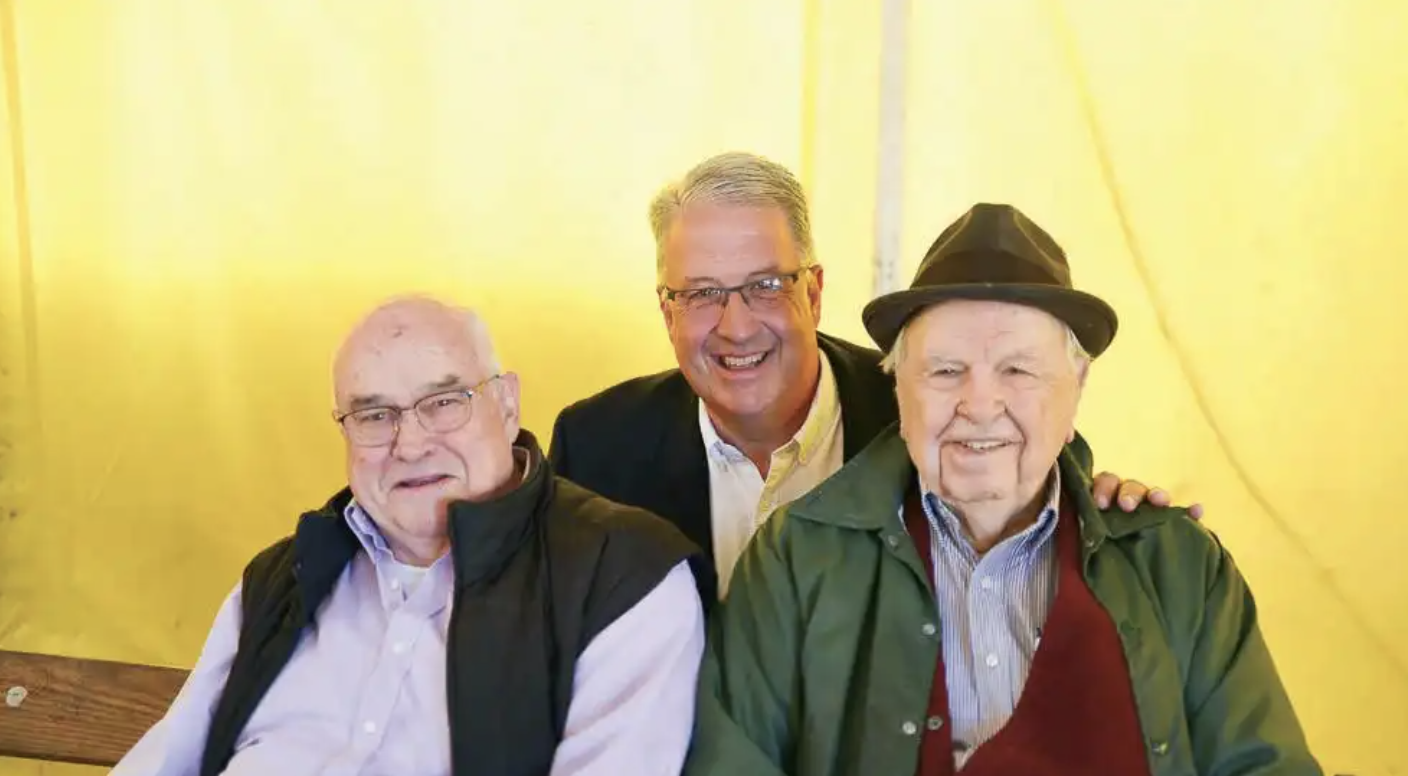
Sidebar – On a Personal Note
It has been my privilege and pleasure to have had Horace Backus as a respected mentor and friend for my career dating back to the late 1960s. And our families were friends and Holstein enthusiasts long before that.
As publisher and editor of Holstein-Friesian World, my grandfather, Maurice Prescott, knew and appreciated R. Austin Backus not only as a friend but also as a successful sale manager whose sales provided headlines and lots of stories. MSP also knew RAB as a customer for many pages of advertising in the magazine. Happily for us, and for me, Horace and Charles continued that tradition, using not only Holstein World but also the New York Holstein News and the Pennsylvania Holstein News state papers.
Early in my work, when I was the newest, and youngest, staff member, both companies had small printing plants to produce our respective publications – the World and related pubs and the Backus pedigree sale catalogs. Often, the same photos of cattle were needed for advertising and catalog pages. With tight deadlines, mailing was not useful in the days before UPS and FedEx (or digital files!), so I was often delegated to deliver or pickup pictures, driving the 20 miles between our offices in Sandy Creek and Mexico.
Even now, I recall what a pleasant assignment that was, greeting the friendly Backus staff… Had Hinman at his typewriter with his ever present cigar, for example. And even better, being received as a colleague by Horace and Charles… Horace with a comment about the upcoming sale and Charles with a quip about life in Oswego County and beyond. My interest in baseball matched Horace’s too so we could always compare notes on the standings.
The enjoyment of a visit to the Backus office I know was shared by my colleagues at the time and by the younger members of our team over the years. Carol Moyer on our World staff spent a good bit of her long career working on advertising, sale reports and photos with Horace and later Dave Rama. She might have been Horace’s biggest fan of all on our side and I know those feelings were reciprocated.
Even as the technology and the staffing changed, over the years it was always a privilege to visit Horace in his office surrounded with catalogs, bound volumes of the World and his pictures of favorite cows. He also had a remarkable collection of Holstein memorabilia which he displayed more fully when the catalogs were no longer being produced. He had such items as the hand written minutes of the very first Holstein Association meeting, held then in Buffalo, N.Y.
Watching Horace and Charles at work at a sale, whether they were meeting with a herd owner, selecting cattle, overseeing preparations or working in the box, was always routine in a way but impressive, nonetheless. Each brother had his areas of emphasis. Horace updated the catalog with the latest info and his own notes in consultation with the herd owner or consignor. Charles made sure the caretaking of cattle, tent, ring and chairs were properly set up. Each had his own circle of breeders who wanted opinions on particular animals, but they compared notes on the sale order, working with the herd owner as might be preferred. They were always polite and considerate of others’ opinions but never indecisive or unclear about what they thought was needed for success.
As the industry changed and our media evolved, it continued to be my privilege to share my concerns and questions with Horace, who was always interested and unfailingly thoughtful in his conversations. He was generous with his compliments but never reluctant to, in effect, criticize or challenge. He often did it gently with questions, but he made his points.
At the top of this piece, we said “end of an era.” Horace began his career with smaller herd dispersals – often fewer than 100 head of all ages – and consignment sales ranging from local clubs to national sale quality. Printed catalogs and advertising, only calls on the phone in the house, (yes folks, landline only); production records and classification scores and of course, pedigrees. Sires were proven with live daughters, often used on the heifer herd first. Then there was the introduction of PDs (predicted differences). For promotion, it was mostly black and white photos with no airbrushing or digital manipulation.
From that, we’ve moved to genomic testing of all, crossbred Holsteins and Jerseys, registered Holsteins bred to beef semen, vastly larger and many fewer herds, and not only large commercial sales but almost every sale of note on the internet, promoted on line with lush digital images in all poses.
But Horace evolved as the industry did, reading pedigrees for sales with his trademark skill and enthusiasm until the mid – 20teens. In fact, working with Dave Rama, he “read the pedigree” of an extremely highly ranked genomic bull calf from a New York breeder. Only several AI firms were in on the bidding (maybe on Zoom) and the price was well into six figures. He was completely aware that his role was given to him out of friendship and respect, but he really enjoyed the opportunity, and he hit all the right strong points for the bull. He relished the chance to see a fine larger herd that day, as well.
Horace knew to his core that the role of the breeder is produce something better in the next generation and he never begrudged technologies if indeed they helped the dairyman achieve that goal. But whatever the level of technology, it was always the people and the cattle that Horace relished.
Editor’s note: Joel Hastings is editor emeritus of DairyBusiness News and former longtime editor and publisher of Holstein World breed magazine.

Be the first to comment