

With all the research invested in determining the nutrient content and availability for dairy cows, the question that I get asked the most by both nutritionists and dairy producers is “How much canola meal can I use in my rations?”
This is an important question and worthy of thought. While cows require nutrients vital to production, ingredients supplying the required nutrients to the diet need to support high dry matter intakes and optimum milk production. The Canola Meal Feeding Guide, available at canolamazing.com, provides results for milk production when compared to alternative proteins, but that does not fully address the question, as each study used different amounts of canola meal in the diets that were tested.
Because soybean meal is well accepted as a source of protein for lactating dairy cows, I assembled results from studies published since 2015 in which canola meal was used to replace soybean meal. The percentage of canola meal added to the diets was used to calculate the actual pounds of canola meal that the cows received (Table 1).
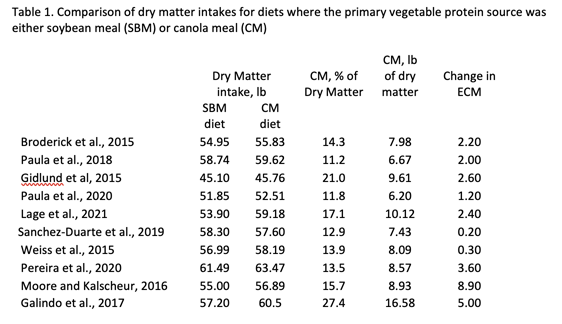
As Table 1 shows, there was a range in intake for canola meal from 6.2 to 16.58 pounds/cow/day. Canola meal did not impair intakes in any of the studies. From this, I concluded that, much like soybean meal, canola meal can be added to diets based on the amounts needed to optimally balance the protein and amino acid needs of cows.
Recently a group of scientists (Martineau et al, 2019) published a research paper entitled “Does blending canola meal with other protein sources improve production responses in lactating dairy cows?” After analyzing results from 22 studies, the researchers concluded that canola meal had a positive effect on dry matter intake, and that canola meal could be used as the sole source of supplemental protein. This further confirms that canola meal does not need to be limited, nor does it need to be blended with other proteins.
There are reports however, that canola meal works well in diets where it is blended with other protein sources. The important factor to consider when selecting a vegetable protein ingredient is: how well does this ingredient support the amino acid needs of cows? This will certainly depend on the amino acids being supplied by the forages and grain sources in the diet.
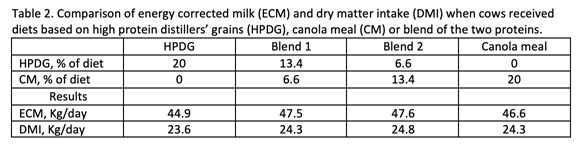
In a study conducted in California, Swanepoel et al (2014) found that a blend of canola meal and high protein distillers’ grains resulted in better performance than either protein source alone. As Table 2 shows, cows were able to produce 44.9 kg of energy corrected milk/cow/day with the high protein distillers grain, and 46.6 kg of energy corrected milk with canola meal. However, when the two proteins were blended, even greater milk production resulted. Blend 2 which included two-thirds canola meal resulted in the best overall performance (Table 2).
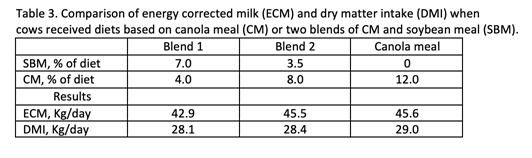
In another recent feeding trial (Gauthier et al., 2019) blends of soybean meal and canola meal were evaluated. As Table 3 shows, the control diet contained 12% canola meal. The test diets were formulated to contain 4% or 8% canola meal. Soybean meal was blended with the canola meal to balance the diets. The cows could easily tolerate diets with 3.5% soybean meal and 8.0% canola meal, producing just as much milk as the control treatment with 12% canola meal. However, there was a loss in milk production when soybean meal was blended at the higher level.
Protein ingredient blends may be better or as good as canola meal alone. This will depend on the ingredients available, and how well they can be used to meet the nutritional needs of the herd and to optimize cost returns. Getting back to the original question: “How much canola meal can I use in my rations?”, the answer would be as much as is needed to balance the ration. There is no need to limit canola meal in diets for lactating cows.
References cited-Available upon request.
Broderick, G.A., Faciola, A.P. and Armentano, L.E., 2015. Replacing dietary soybean meal with canola meal improves production and efficiency of lactating dairy cows. Journal of dairy science, 98(8), pp.5672-5687.
Galindo, C.E., Ouellet, D.R., Maxin, G., Martineau, R., Pellerin, D. and Lapierre, H., 2017. Effects of protein and forage sources on milk production, rumen parameters and intestinal digestibility in lactating dairy cows. Journal of dairy science, 100, p.111.
Gidlund, H., Hetta, M., Krizsan, S.J., Lemosquet, S. and Huhtanen, P., 2015. Effects of soybean meal or canola meal on milk production and methane emissions in lactating dairy cows fed grass silage-based diets. Journal of dairy science, 98(11), pp.8093-8106.
Lage, C.F.A., Räisänen, S.E., Stefenoni, H., Melgar, A., Chen, X., Oh, J.O.O.N.P.Y.O., Fetter, M.E., Kniffen, D.M., Fabin, R.A. and Hristov, A.N., 2021. Lactational performance, enteric gas emissions, and plasma amino acid profile of dairy cows fed diets with soybean or canola meals included on an equal protein basis. Journal of dairy science, 104(3), pp.3052-3066.
Martineau, R., Ouellet, D.R. and Lapierre, H., 2019. Does blending canola meal with other protein sources improve production responses in lactating dairy cows? A multilevel mixed-effects meta-analysis. Journal of dairy science, 102(6), pp.5066-5078.
Moore, S.A.E. and Kalscheur, K.F., 2016. Canola meal in dairy cow diets during early lactation increases production compared with soybean meal. Journal of Animal Science, 94, pp.731-731.
Paula, E.M., Broderick, G.A., Danes, M.A.C., Lobos, N.E., Zanton, G.I. and Faciola, A.P., 2018. Effects of replacing soybean meal with canola meal or treated canola meal on ruminal digestion, omasal nutrient flow, and performance in lactating dairy cows. Journal of dairy science, 101(1), pp.328-339.
Pereira, A.B.D., Moura, D.C., Whitehouse, N.L. and Brito, A.F., 2020. Production and nitrogen metabolism in lactating dairy cows fed finely ground field pea plus soybean meal or canola meal with or without rumen-protected methionine supplementation. Journal of dairy science, 103(4), pp.3161-3176.
Sánchez-Duarte, J.I., Kalscheur, K.F., Casper, D.P. and García, A.D., 2019. Performance of dairy cows fed diets formulated at 2 starch concentrations with either canola meal or soybean meal as the protein supplement. Journal of dairy science, 102(9), pp.7970-7979.
Swanepoel, N., Robinson, P.H. and Erasmus, L.J., 2014. Determining the optimal ratio of canola meal and high protein dried distillers grain protein in diets of high producing Holstein dairy cows. Animal Feed science and technology, 189, pp.41-53.
Weiss, W.P., Wyatt, D.J., Kleinschmit, D.H. and Socha, M.T., 2015. Effect of including canola meal and supplemental iodine in diets of dairy cows on short-term changes in iodine concentrations in milk. Journal of dairy science, 98(7), pp.4841-4849

Be the first to comment