

In today’s current environment with feed prices steadily increasing, dairy producers are seeking effective solutions to optimize production efficiency of their herds. Feed conversion provides the greatest opportunity for producers to capture additional margins. Supplementing ruminant diets with a non-protein nitrogen (NPN) source is one way to optimize feed costs and provides the opportunity for the rumen microbiota to utilize supplements more fully.
A major source of NPN commonly used in cattle diets is urea. The disadvantage of urea, however, is the rapid rate of ammonia release in the rumen. This fast release can be problematic if the diet contains high amounts of urea or feeding rates are not properly managed. When fed incorrectly, the results can be detrimental such as elevated milk urea nitrogen (MUN), loss of nitrogen that was expected to be utilized, and decreased milk production. A safer, better alternative in dairy rations is biuret. Biuret has a slower, more controlled release of ammonia that is safer and better aligns with rumen microbial needs for cattle on moderate to higher forage diets.
While there are other slow-release nitrogen products on the market, biuret has advantages over these other typical NPN sources. Nearly all of these NPN sources are fat-coated ureas. The fat used to encapsulate the urea will degrade under certain environmental conditions, when used in mineral mixes or when pelleted. If the fat coating is compromised prior to consumption by the animal, it will break down in the rumen faster than expected and not deliver the urea at a controlled release rate. Conversely, biuret will maintain its integrity in all of these applications and conditions. Biuret does not require special coatings to achieve controlled release of ammonia into the rumen. By its complex nature, biuret releases ammonia more slowly as unique rumen enzymes work to breakdown its structure into useable nutrients. The predictability of this process means that ration ingredients and other dietary conditions do not affect the ammonia-release characteristics, and biuret is still contributing to rumen ammonia even more than a day after its consumption. Biuret also attracts very little if any moisture, even in extremely humid conditions. This provides the product with extended shelf-life and will not bridge or brick under storage conditions compared with pellets containing high amounts of urea.
Biuret can be included in rations as the sole NPN source or as a blend of the total NPN. For lactating cows, it is recommended to include biuret at a rate of 0.1 to 0.2 lb. per head daily. Producers feeding a diet with forages at a low to moderate inclusion will benefit from a 50/50 blend of biuret and urea. The ammonia release of urea is better timed to meet the microbial needs of a high grain diet as the starch is fermented more rapidly. In a high forage diet, the slower fermentation rate will coincide with the ammonia release of biuret, providing the ideal release pattern to optimize performance and return on investment.
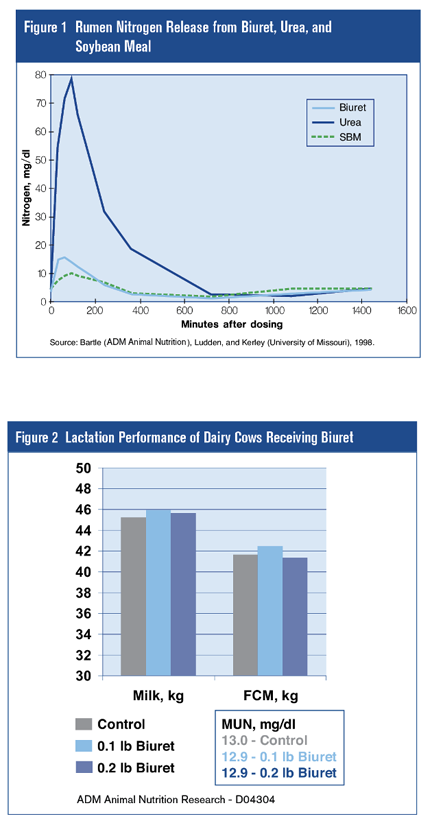 Research at the University of Missouri evaluated the rate of nitrogen (ammonia) release from biuret, urea and soybean meal. Holstein steers were fed a maintenance high fiber diet of soybean hulls, hay and cottonseed hulls were given biuret, urea or soybean meal. Rumen ammonia levels, along with serum ammonia and urea levels were monitored. This study confirmed biuret’s unique rumen nitrogen release rate (Figure 1). Its nitrogen release curve is similar to soybean meal. This research study demonstrates that the release rate of nitrogen from biuret does not exceed the rumen microorganisms’ ability to utilize nitrogen.
ADM Animal Nutrition research has evaluated the use of biuret in lactating diets (see Figure 2). Approximately 0.5 and 1 lb./head/day of soybean meal was replaced by about 0.1 and 0.2 lb./head/day of biuret. Diets were equal in crude protein and predicted rumen undegraded protein (RUP). Feeding biuret did not affect milk production or milk composition of the higher production animals. Milk urea nitrogen (MUN) was similar for each treatment. In the lower producing cows, milk production was unaffected by biuret use, but when receiving 0.2 lb./head/day biuret, MUN was elevated and fat content was reduced. The connection between the high MUN and depressed fat is unclear but is sporadically reported in the literature in studies focused on rumen degradable protein (RDP) feeding. With appropriate balancing of RDP and RUP, biuret was an effective substitute for degradable true protein in these lactation diets.
Editor’s note: The author is an experienced Ruminant Business Manager with ADM with a demonstrated history of working in the livestock production industry, in various capacities of livestock management, business planning and management, agribusiness, and plant management. Chris received his Bachelor of Science degree focused in Animal Sciences – Nutrition and Management from University of Nebraska-Lincoln.


Be the first to comment