
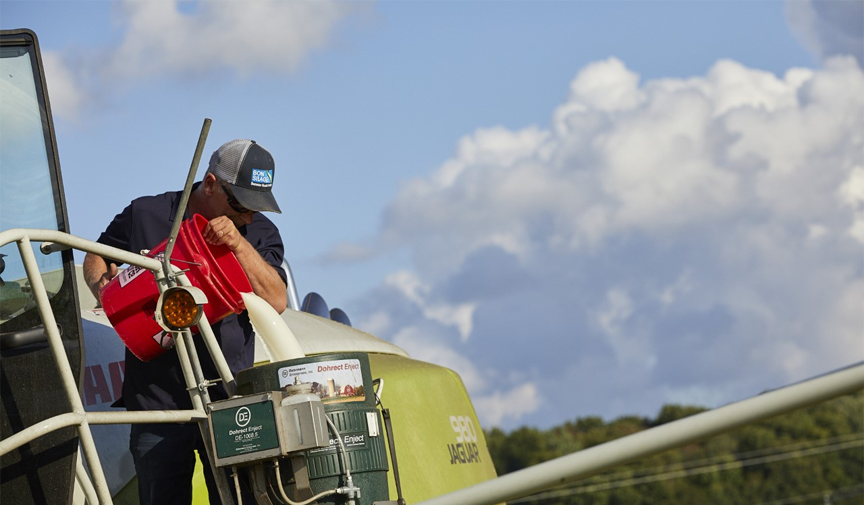

On today’s modern dairy, producers need to take advantage of every opportunity to improve efficiency. While most conversations around farm efficiency focus on topics such as finding ways to increase milk production and yield per acre, there are other topics worth considering. Silage efficiency is an important conversation that may not receive the spotlight it deserves. For example, when the quality of silage is lessened, producers may have to make up for that quality loss by buying ingredients to improve it down the line. This can account for extra use of resources that producers may want to invest in other aspects of the farm.
Here are some helpful best practices producers can implement on their farms to improve efficiency for their forage.
Establish and Follow Management Best Practices
Before a producer makes any product decisions, it is important to establish good management practices and adhere to them throughout the process, from harvest through feed-out. To establish good management practices, it is helpful to create a checklist to reference throughout the year.
Topics to consider including on the checklist:
- Safety practices
- Cutting height
- Haylage wilting period
- Theoretical Length of Cut (TLC)
- Inoculant applicator
- Kernel processing
- Packing density
- Cover
- Pile size and face management
(Click here for an example checklist to help make sure a farm is set up for success: BONSILAGE Silage Checklist.) https://bonsilageusa.com/wp-content/uploads/2021/04/BONSILAGE-Silage-Checklist_USA2021.pdf
Microbial Inoculant 101
One type of inoculant that has proven to be beneficial to forage is microbial inoculants. Microbial inoculants are select species of microorganisms that are applied to forages prior to ensiling to control the fermentation.
The goal is to have a final product that is a high-quality forage with minimal DM and nutrient losses. Even the most well-managed piles can have fermentations that go wrong and for a variety of reasons. When this happens, the losses include both DM and quality. In severe situations, the forage can become completely unpalatable and therefore become a total loss. The use of an inoculant is for protection, as an insurance policy, against any inefficient or mis-fermentations.
Know the Difference: Homofermentative vs. Heterofermentative vs. Combination
Microbial inoculants can be categorized as using homofermentative lactic acid bacteria (LAB), heterofermentative LAB, or a combination of the two. This is determined based on what strains of microorganisms are in the formulation.
Homofermentative inoculants contain LAB that can quickly and efficiently drop the pH by creating large amounts of lactic acid. During feeding trials, forage treated with a homofermentative inoculant has been shown to improve milk production. Heterofermentative inoculants contain LAB, most commonly Lactobacillus buchneri species, that convert lactic acid to acetic acid and 1,2-propanediol. Research has shown that using a heterofermentative inoculant causes significant improvements in aerobic stability. However, the current species of L. buchneri on the market are slow at this conversion, and improvements in aerobic stability may not be seen until after ensiling for 30 days or more (Muck et al 2018). Research is ongoing to find other species of heterofermentative LAB that can improve aerobic stability earlier in ensiling.
Combination inoculants are used to combine the benefits of both the homofermentative and heterofermentative LAB. Within the combo, the homofermentative LAB will improve the front end of fermentation by rapidly decreasing the pH. This suppresses harmful microorganisms like clostridia and enterobacteria, reduces enzymatic protein degradation, and reduces other nutrient and DM losses. After the drop in pH has happened, the slow conversion of lactic acid to acetic acid will take place by the heterofermentative LAB and lead to improvements in aerobic stability.
Due to the complexity of ensiling and characteristics of different forages, there is no one inoculant that will work in every situation. The BONSILAGE inoculant line offers a variety of products that are formulated with research-proven LAB strains to obtain an improvement in overall feed quality and cow performance.
The Silage Inoculant Difference
Though there are clear benefits that come with implementing inoculants on the farm, not everyone is aware of how those benefits can make an impact on their specific operation. For producers who regularly use inoculants, the key drivers for them include reduced nutrient and DM losses, reduction of undesirable end-products, and improving feed intake.
- Reduced nutrient and DM losses
Nutrient and DM losses can be a big problem for producers. These costly losses are oftentimes caused by undesirable fermentations (anaerobic losses), secondary heating, and molds (aerobic losses). Utilizing products that combine homofermentative and heterofermentative lactic acid bacteria (LAB) can help producers prevent these losses.
- Reduction of undesirable end-products
- Feed intake
Undesirable fermentations lead to end products that decrease palatability resulting in reduced feed intake. When ingested these end products can have adverse effects on the cow. Some end products can accumulate to levels that cause the silage to become unpalatable. Using a BONSILAGE inoculant leads to more palatable, hygienic quality silage.
Choosing the right silage inoculant for an operation is an important next step for producers to ensure their resources are used optimally, producing high-quality forages. Visit BONSILAGEUSA.com today to discuss silage management and the benefits inoculants can have on forages.
References:
Muck, R. E., Nadeau E. M. G., McAllister T. A., Contreras-Govea F. E., Santos M. C., and L. Kung Jr. 2018. Silage Review: Recent advances and future uses of silage additives. J. Dairy Sci. 101:3980-4000



Be the first to comment