
A variety of pests are active as the growing season progresses; we will address black cutworm moths, alfalfa weevil, and cereal leaf beetle.
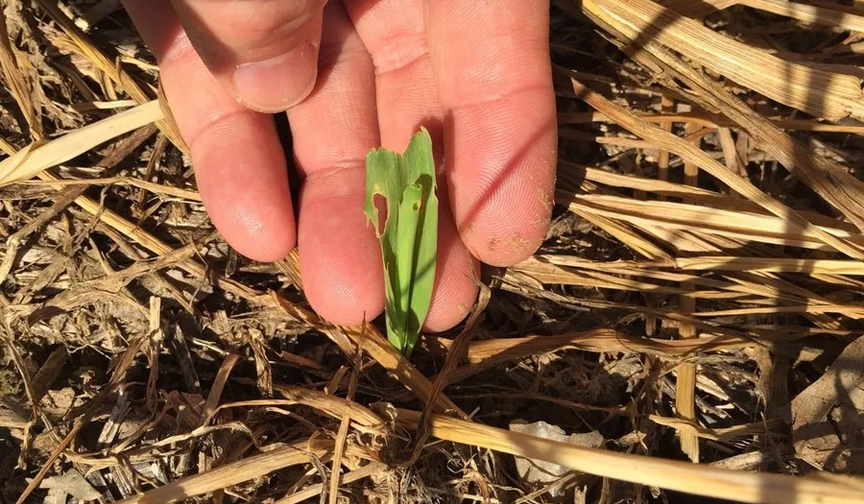
First, black cutworm moths have been arriving in Pennsylvania for a few weeks, but our Black Cutworm Moth Trapping Network has detected only three “significant flights,” which would indicate an increased risk of cutting damage from caterpillars (Figure 1). These flights occurred in Blair County (near Williamsburg) on 15 April, and two in Lebanon County on 19 April (near Bellegrove) and 26 April (near North Cornwall). We are accumulating growing degree days for these sites to keep people apprised of the risk—as of 9 May the expected degree-day accumulations will around 200, whereas the threat for cutting emerges around 300 degree days, which is likely to occur at those locations around 20 May. In the coming weeks, we will continue to update readers on the risk. In other parts of Pennsylvania, based on our trapping results, the risk of cutting does not seem elevated, but black cutworms can still cause damage; therefore, I encourage you to scout your fields from emergence to V4. Damage from young caterpillars looks like a line of holes across the leaves (Figure 1). Older caterpillars cut plants off at the base and take the plant to an underground burrow to consume the plant. If you find 2, 3, 5, and 7 caterpillar-cut plants per 100 seedling-, V2-, V3-, and V4-stage plants, respectively, your field will likely benefit from an insecticide application. Keep in mind, however, that if cutting damage is only evident in a portion of the field, you can restrict your insecticide application to that area. Also, remember that preventative spraying is often useless against black cutworm caterpillars because the window of activity of the insecticide often misses the active period of caterpillars. Continue to scout until plants reach V5, when they are rarely troubled by black cutworm. See our fact sheet for more details.
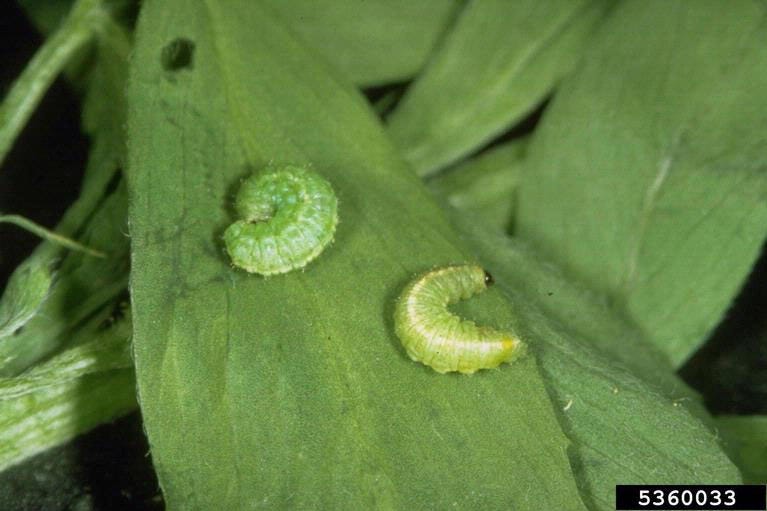
Figure 2. Alfalfa weevil larvae with the distinct white line down their backs. Photo by Frank Peairs, Colorado State University, Bugwood.org
Lastly, this is the time of year that cereal leaf beetle larvae are active in small grain fields (wheat, oats, barley, and rye can be infested), particularly in eastern Pennsylvania. Cereal leaf beetle larvae are easily identified because the larvae look slimy and shiny due to their practice of piling their frass, the word for insect feces, on their backs (Figure 3). Infestations are difficult to predict and can be very patchy, with some fields heavily infested, while others nearby have almost none. Scouting is the key to identifying local populations and populations that are large enough to be managed. If you scout fields and find populations that exceed the economic threshold (one larvae per flag leaf), then using an insecticide is likely to be profitable. If you do not have populations, then an insecticide application is unlikely to be helpful, may do more harm than good by suppressing beneficial insect populations, and you are likely wasting money on a product that you do not need. Similarly, I would strongly recommend avoiding the practice of adding an insecticide to a tank mix simply because a sprayer is making a pass across the field; unless economically damaging populations of insects are present, there is no point. A Penn State fact sheet provides more details on their lifecycle and some images of adults, larvae, and their damage.
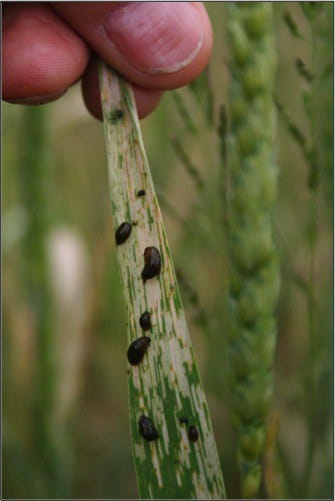
Figure 3. Several cereal leaf beetle larvae feeding on the flag leaf of wheat. These are not slugs, (which are nocturnal), but beetle larvae covered with mucus and their own feces as a defense against other insects that might want to eat them! (Photo by Mike Fournier, Penn State Extenson).

Be the first to comment