
Below ground pests can be challenging in corn production (grain or silage), particularly when it is grown in the same fields year after year.

Below ground insect pests can be challenging to control. In common field crops of Pennsylvania, they can occur in soybeans, small grains, or hay, but tend not to be too problematic in these crops. By contrast, below ground pests can be challenging in corn production (grain or silage), particularly when it is grown in the same fields year after year. Other than continuous corn production, underground pests tend to be sporadic in corn fields that have been rotated annually—some fields have the same pest year after year and others do not have any issues. Many of these pests cause similar symptoms including missing, wilted, or stunted seedlings. The best way to determine if soil-dwelling pests are causing problems in your fields is to scout for them by digging up damaged seedlings or poorly established sections of rows to inspect roots and look for damage.
Seedcorn maggot

Figure 1. Adult Delia fly (top left) Image Credit: Image Number: 5312054, Pest and Diseases Image Library, Bugwood.org. Creative Commons Attribution-Noncommercial 3.0 License; Larvae feeding damage to corn seeds (top right and bottom) Image Credit: Image Number: 5434908 and 5434908, Mariusz Sobieski, Bugwood.org. Creative Commons Attribution-Noncommerical 3.0 License

Figure 2. Seed corn maggot life cycle, including number of growing degree days (GDD, base 39F) that are needed to complete each stage. Credit: Nick Sloff, Penn State University.
| Delia Growth Stage | Cumulative Growing Degree Days (GDD) | Activity |
|---|---|---|
| Peak adult emergence of first generation | 360 | Egg laying |
| Larvae emerge from eggs | 414 | |
| Three larval instars | 414 – 781 | Feeding damage |
| Pupation | 781 – 1051 | “Fly-free” period. No feeding. |
| Adults emerge and reproduce | 1116 | Egg laying occurs |
| Larvae of second generation emerge from eggs | 1170 | |
| Three larval instars | 1170 – 1537 | Feeding damage |
| Pupation | 1537 – 1807 | “Fly-free” period. No feeding. |
| Adults emerge & reproduce | 1872 | Egg laying |
| Larvae of third generation emerge from eggs | 1926 | |
| Three larval instars | 1926 – 2293 | Feeding damage |
| Pupation | 2293 – 2563 (or next season) | “Fly-free” period. No feeding. |
Figure 3. Cumulative growing degree days for seed corn maggot to reach “fly-free” periods.
Wireworms

Figure 4. Wire worms are the larvae of click beetles. Image Credit: (left) Anna Busch, Penn State Extension; (right) Image Number UGA1435036 Clemson University – USDA Cooperative Extension Slide Series, Bugwood.org, Creative Commons Attribution-Noncommerical 3.0 License.
Wireworms are larvae of click beetles (Figure 4). Females lay eggs in grassy areas or cultivated fields, making corn at a higher risk when it follows hay, pasture, or alfalfa. The larvae take 2-3 years to develop and have overlapping generations. Due to their long development time, wireworm issues can persist for multiple years, but most fields in Pennsylvania are never colonized by significant populations of wireworms. Wireworm larvae feed on below ground plant tissue, boring into stems and roots. Spring tillage can help decrease wireworm damage and they are easily controlled with seed or soil-applied insecticides at planting.
White grubs
White grubs represent multiple species of scarab beetle larvae. This includes Japanese beetles, European chaffers, and June beetles (Figure 5). Not all white grubs are pests. Some species are manure feeders. Unless they are in the root zone, they are unlikely to be pests. Larger species are more concerning due to the amount of feeding damage they can cause. The different species can be identified based on patterns of hairs on the tip of their abdomens, and this information can be easily found through various online resources.
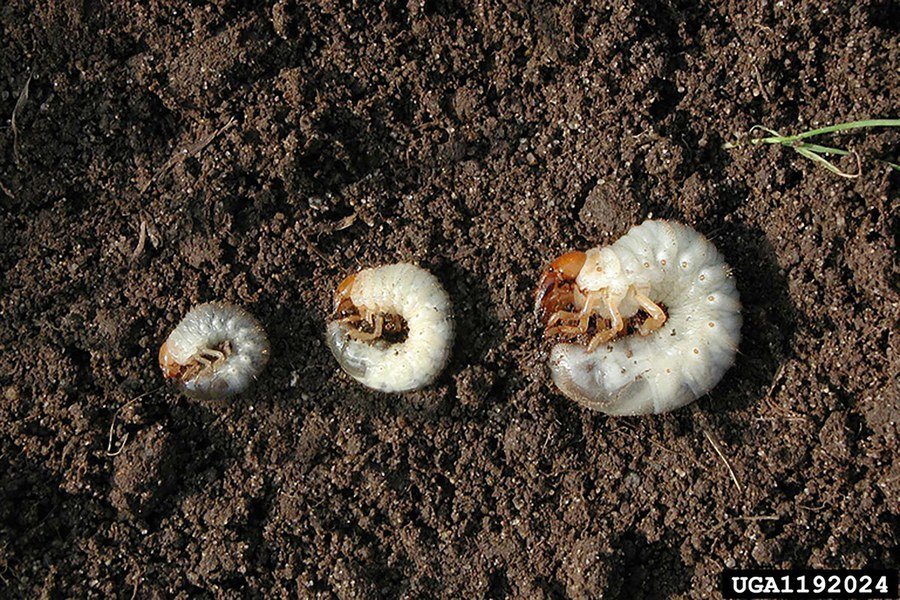
Figure 5. White grubs represent multiple species that vary in size (Left to right, Japanese beetle, European chaffer, June beetles). Image Credit: Image Number: UGA1192024, David Cappaert, Bugwood.org, licensed under a Creative Commons Attribution-Noncommercial 3.0 License.
White grubs feed on roots and are more likely to damage corn that follows alfalfa, hay, or pasture. Symptoms include missing, wilted, or stunted seedlings. Most fields never see infestations, but some fields are regularly infested. White grubs can be controlled with seed- or soil-applied insecticides at planting.
Slugs

Figure 6. Gray garden slug (left) and typical slug feeding damage to corn seedlings (right). Image Credit (left) Nick Sloff, Penn State University; (right) John Tooker, Penn State University.
Western corn rootworm

Figure 7. Adult corn rootworm (left) and larvae (right). Image Credit (left) Anthony Zukoff, Kansas State University; (right) Pat Porter, Texas A&M University.
Western corn root worm is the most problematic pest of corn in the United States and costs growers about a billion dollars annually in damage and pest control expenses (Figure 7). In Pennsylvania, they are only problematic in continuous corn fields, and are not problematic if farmers rotate their corn with soybeans, alfalfa, sorghum among other crops. Western corn root worms overwinter as eggs. The larvae begin feeding on corn roots in late May and are present through early August. Severe larval feeding can greatly reduce root volume, leaving plants vulnerable to lodging when conditions become wet or windy.
| Brand name | Bt protein | Field-evolved resistance in U.S. rootworm populations? |
|---|---|---|
| YieldGardRW | Cry3Bbl | Yes |
| Herculex RW | Cry34/35Abl | Yes |
| Agrisure RW | mCry3A | Yes |
| Agrisure Duracade | eCry3.lAB | No** |
Table 1. Bt toxins targeting root worms **not being deployed alone
Root worms are tough to control, and populations in the U.S. have evolved resistance against all the management options that have been developed (e.g., soil insecticides, crop rotation, single-toxin Bt corn varieties, and two-toxin Bt corn varieties (Table 1), though not every root worm population is resistant to all the control tactics. In Pennsylvania, we have fewer problems with resistance than growers in the heart of the Corn belt, but we can still have issues. In Pennsylvania, for example, some fields that have been in corn continuously for just three years have developed populations of root worm beetles that are effectively resistant to corn hybrids expressing single toxins of Bt. As a result, we recommend rotating continuous corn fields to non-host plants (e.g., soybeans, alfalfa, or sorghum; longer rotations are better), and farmers should strive to avoid growing corn in any one field more than two years in a row. If growers need to grow corn continuously, the best management practice is to use Bt hybrids that have at least two toxins for controlling root worms. Alternatively, growers can consider using untraited corn with a soil insecticide at planting—this option is better than putting insecticides over the top of Bt seed targeting root worms because the cost of untraited seed can be significantly lower than Bt seed.

Be the first to comment