
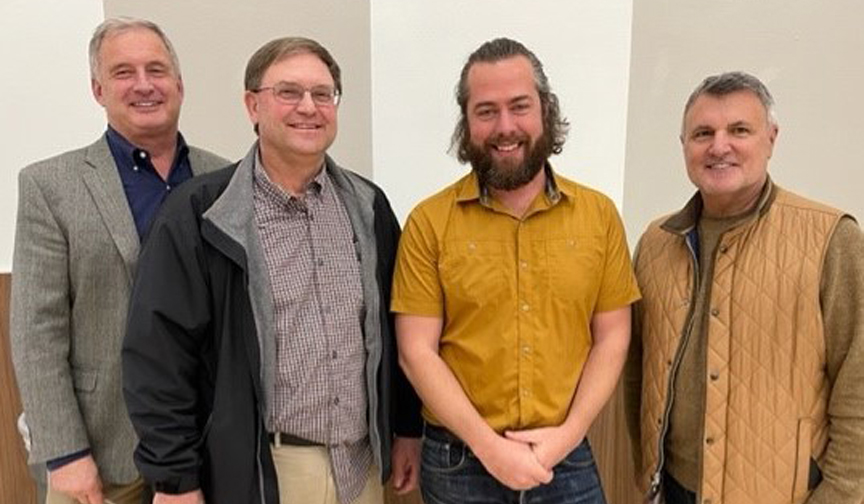
The impact of SGMA (State Groundwater Management Act) on California’s dairy and cattle industries was the focus of a meeting held February 2 in Tulare at the Veteran’s Memorial Building. Presented for the first time was a study on the economic impacts of SGMA on the dairy and beef industries in the San Joaquin Valley. Speakers also provided background on how SGMA is being implemented in dairy communities across the Central Valley and how common-sense solutions to water scarcity might be implemented. Over 200 attended the session hosted by Dairy Cares and the California Cattle Council, the two groups that commissioned the study, along with the California Creamery Operators Association. The meeting was called to order right a 1:30 p.m. by Michael Boccadoro, executive director of Dairy Cares and the Creamery Association, who introduced the speakers and moderated the question and answer session at the end of the program.
Economic Impacts of SGMA
He said in contrast to some reporting, dairy feed is a high value input to milk production with a value similar to nut crops. The study estimates that if all the reduced water allocations are put into place, there will be a total reduction of 1.5 million acre/feet of water by 2040. [An acre/foot as it sounds is the amount of water needed to cover an acre of land with one foot of water. This is 325,851 gallons, enough to fill about 20 backyard swimming pools.] This reduced water will result in a 100,000-acre reduction in alfalfa, exceeded only by nut crops, with fewer acres across the spectrum of vegetables, silage crops, pasture and grain. All crop production losses will total $1.742 billion with a reduction of 8,837 jobs, this in addition to the reductions described above in dairy and beef.
He concluded noting several additional considerations which the study acknowledges but does not try to quantify, including Colorado River cuts impacting western feed production, more stringent waste discharge requirements coming for Valley dairies, and impacts on related industries like transportation, cold storage, and real estate. There will also be impacts on state and local taxes.
SGMA: Game Changer?
Leading off was Geoffrey Vanden Heuvel, director of economic and regulatory affairs of the Milk Producers Council. He’s a former dairy producer originally from the Chino area. He does as good a job as anyone we have heard providing an overview of California water issues. He opened with a quote from a writer from North Carolina who in 1855 traveled end to end in California to assess the new state.
“Balancing resource against defect and comparing territory with territory, California is the poorest state in the Union… the average or general surface of the country is incapable of sustaining a dense population.” -Hinton R. Helper, The Land of Gold
Vanden Heuvel continued, explaining how the linchpin of California’s growth in population and output, including today’s rank as the number one agricultural state in the U.S., has been due to the
With less surface water available to Central Valley, farmers increased groundwater pumping to the point where the series of underground aquifers began to be depleted, causing in some cases land subsidence or sinking and both domestic and agricultural wells going dry, even when dug deeper. In 2014, the state legislature passed and Governor Jerry Brown signed the State Groundwater Management Act (SGMA), the first ever control on groundwater pumping. It requires that by 2040, water removed from under the Central Valley must be equal to the water going in… the aquifer must be sustainably balanced.
To accomplish this, across the state, local agencies were formed to implement local solutions. Called Groundwater Sustainability Agencies, some 263 in all, 18 were in the Central Valley which were labeled “critically over drafted.” Each of these was required to prepare a Groundwater Sustainability Plan (GSP) either on its own or with their neighbors to be submitted to the state for approval. By January 31, 2022, 200 GSAs had submitted 65 GSPs in 63 basins, with unprecedented legal and groundwater management requirements. Vanden Heuvel provided an overlay of the locations of California dairies on these over drafted regions.
He went to say that that dairy facilities themselves… barns, milking parlors, corrals and manure storage areas, use on average less than six inches per acre of water annually. All the allocations programs even in 2040 are above that. That said, it is of course crop production for feed and manure disposal that require larger amounts of water.
He concluded offering several points for consideration. Specifically, he said: “Dairy will be stressed because of reduced and more expensive water supply – the era of cheap water is over. Planning ahead is critical – stockpiling forage is worth considering. Producers need to stay informed and involved in their local GSAs. Producers need to be willing to invest in efforts to bring in more surface water both locally and on a regional basis. And finally, finding an alternative manure solution is probably going to require change and investment.”
Water Blueprint for the San Joaquin Valley
The day’s final speaker was Dr. Scott Hamilton of Bakersfield, head of a non-profit entity called the Water Blueprint for the San Joaquin Valley. An ag economist with a PhD from Oregon State, he received his undergraduate degrees in his native Australia. He has experience with farming operations and public and private water agencies. His firm, Hamilton Resource Economics, has expertise in water supply planning and resource management analyses.
The Blueprint board of directors includes members from agriculture, water districts, white land areas, and government. Hamilton also heads the technical committee. He introduced himself and said he was sympathetic to dairy producers. He said, “We have 10 million acre/feet per year that flows out through the Delta… and with all considerations, we’re short of water in the [Central] Valley by about two million acre/feet.”
He said, “You’d think we could manage that but in California we’ve done an awful job.”
He said Blueprint meetings provide a place for everyone to talk about water. He continued, saying, “Water meetings tend to be depressing because they’re aren’t any easy solutions. Whatever water rights you have, someone else is out to get them.”
He went on to say that building more dams is not a good idea. Farmers can’t afford it and the state won’t pay for it. Surface water storage just doesn’t work with California water cycles. Reservoirs are empty every second or third year. But he said, there is the possibility of 50 million acre/feet of water storage capability underground.
He said the key is to get water out of the Delta river flows in an “environmentally friendly” water diversion. He described a system using perforated pipes under riverbeds that allows the water to slowly perc out, without disturbing fish. He said this works and an example was put in place by the Turlock Irrigation District to extract water but protect salmon. He said this needs to be done in the Delta. After water is extracted, it needs to move south through existing canals with a few new ones added to take water to “white areas.”
He said urban areas need long term reliability while agricultural areas need sufficient supplies. He advocates creating urban – rural partnerships, since the urban areas have money but need a place to store water. While the aquifer with its huge capacity sits under rural areas which will also require some pumping. He identified what he termed “water resiliency projects” currently underway. He said potentially close to a million acre/feet could be generated for the Valley.
He said going forward, people have to work together. He said support for these environmentally friendly diversion projects is critical but also doable.
He finished his presentation about 2:30 p.m. and moderator Boccadoro then posed questions to the panel that had been submitted in writing from the audience.
Question: What are the barriers to solutions and how do we overcome them?
Vanden Heuvel – We are running upstream in a political environment that doesn’t value ag. He said if the Water Blueprint was only for the Valley, he wouldn’t be hugely optimistic. He said Los Angeles has three sources of water… the Owens Valley, the Colorado River and the State Water Project (bringing water down from the north). We need more water from the Delta is the same challenge they have. They need more water but a place to store it.
“We have the opportunity for a real breakthrough,” he said. He said the large amount of national press coverage of the water going out the Delta which can’t be pumped raises awareness.
Hamilton: He agreed but said dairy has been very progressive and involved with policy for a long time. He said four million dollars is needed for the study while in January alone, $50 million worth of water was lost.
McCollough: He said regulatory barriers are significant but he is really touting dairy as a model for doing things right.
Question: What will happen to state and local tax revenues as property values for ag land are reduced?
McCullough: The study did not look at that but there are communities that will disappear because agriculture will go away. People will go to the cities to find jobs so everyone should be interested in solutions.
Question: Why is the Delta smelt so important?
Hamilton: It’s only important because it’s endangered. He said there are many non-native species that have replaced it in the food chain.
Question: I’ve heard about groundwater recharge. What are the opportunities and what is the importance of recharge.
Vanden Heuvel: What is the importance of oxygen?
Scott: We need to think of the basin as a bank… you can only take out what you put in. He said the Kern Water Bank is a U-shaped levee that provides habitat for wildlife. He said people loved the idea of “multiple benefit recharge.” It helps recharge, builds habitat and helps disadvantaged communities.
Question: There will still be a lot of cows in the Tulare area. Are we going to see feed moving from areas its grown to areas where there a lot of cows.
McCullough: Yes, definitely. Having a more mobile feed supply will be part of it.
Question: Is Sacramento waking up to the need for more water projects?
Vanden Heuvel: He said he sees no upside to being critical of the Governor. He said he’s put forward two major initiatives on water, a resiliency strategy and this summer, a water supply strategy. He said the Valley only has five percent of the population of the state… two million compared with 40 million. He continued saying that with high salts in the Colorado River water, the Governor’s plan needs more Delta water. He said if the Governor is going to run at the national level, he needs to run on solving problems. He said we need to position these things smartly in order to solve these problems.
Boccadoro: He said he’s had years of experience in state government. Water policy is always a topic, but it always flows when there is a drought and ebbs when we’re out. But we are reaching a tipping point on water issues, and also energy costs. The Blueprint is that preparation for when the government looks for solutions.
Question: What’s the timeframe for the Water Blueprint going forward? It this drainage program really the solution?
Hamilton: He said he met with the Governor’s point man on infrastructure, Antonio Villaraigosa, the former mayor of Los Angeles. Hamilton said he seems to get it but needs to prove that the technology works. We have met with a lot of people and farmers understand because they have put in tile drain systems. He said it may be two years for approval, then lawsuits and studies but unlike the tunnels, this is a solution for all of California and not nearly as expensive. [Proposed by Governor Jerry Brown, the tunnels would be massive structures to move water from north to south costing billions of dollars. They are opposed by farmers and environmentalists in the Delta region.]
Vanden Heuvel: The Blueprint is a coalition of the willing. It’s been a volunteer group but it’s time for a professional manager and the board is meeting next week to finalize that.
Question: Environmental groups in Sacramento, like Food & Water Watch, have bad policies that don’t need dairy or almonds. And they don’t want to desalinate or recycle water. What about that?
Boccadoro: Why wouldn’t we want to recycle? You use water four or five times on your dairies before you put it on your crops. This study today helps us communicate our story. This is the beginning, certainly not the end of water quality issues. “We’re trying to arm ourselves the best we can,” he concluded.
Question: How do we capture peak flood flows?
Hamilton: Most people don’t realize the depth of the topsoil here in the Valley. At his home in Australia the soil is only inches deep. The challenge for us is to show how important our farms are. This last drought hit California hard. Our concept of drains is very simple.
Vanden Heuvel: He said he hosted a farmer from Florida who was shocked at the opposition between fisherman and farmers in California. They work together in Florida, he said. They both are mostly individual entrepreneurs working with natural resources to produce food. Vanden Heuvel said it’s a mystery to him why they are in league with the most extreme environmental groups. He said at the Blueprint, they won’t get involved with the tunnel discussion. He said we ought to be on the same page and we can mend the fence between Valley farmers and Delta farmers.
Taking no further questions, Boccadoro recognized congressional and state legislative staff in the audience. Vivian Cao, district director for State Senator Shannon Grove from Bakersfield, spoke assuring the group that state legislators from both parties are vitally interested in working to solve water problems. She said, “Equip yourselves with actual information… share your insights with us.” Perry Finzel, field representative for Congress Member and now Speaker, Kevin McCarthy, was also present.
Boccadoro said the Water Blueprint information has been sent to other legislators. He is cautiously optimistic this year between the weather, national publicity and the Governor’s ambitions. He said we should take this opportunity to unite and collaborate.
Winding up, Boccadoro thanked the sponsors for the refreshments, Producers Dairy and Hilmar Cheese, adjourning the session at 3:30 p.m.
The executive summary of the economic study as well as the slides from the three presentations can be accessed online at www.dairycares.com/SGMA. A video recording of the meeting is expected to be posted soon at the same site.
Editor’s note: California is the number one state in the U.S for ag output totaling some $3.5 billion in the sector. California has been the number one milk producing state for more than 20 years. However, the California economy represents over $4.5 trillion, the fourth largest in the world. While ag is crucial for farmers, processors and rural communities and for the nation’s food supply, it represents less than two percent of the economy and the population of California, while using an estimated 80 percent of California’s water.
Be the first to comment