

New World Screwworm is a parasitic insect originating from South America, the Dominican Republic, Haiti, and Cuba. Recently, it has been impacting cattle markets in the U.S. Know the facts and who to contact with concerns.
What is it?
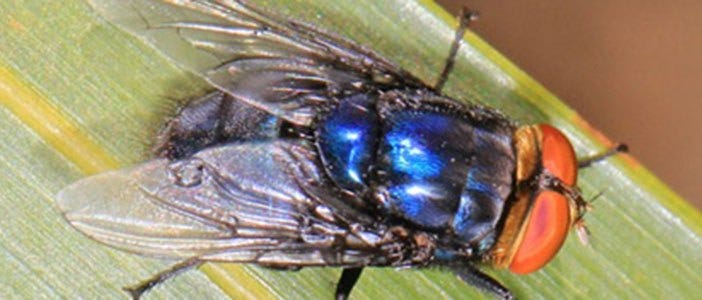
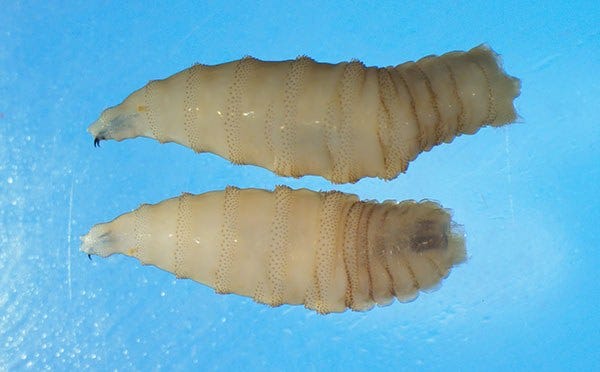
Lifecycle
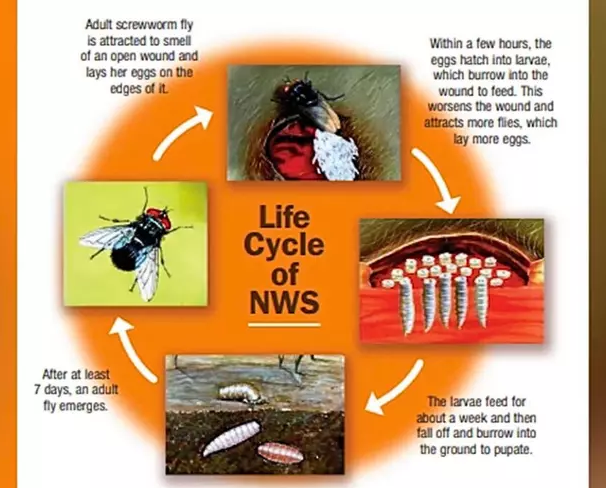
The life of a NWS begins when a female lays her eggs, up to 400 at a time, onto the body of a live animal. The female will often lay her eggs onto an open wound or the mucus membranes on the animal. These areas include nostrils, ears, vulva, anus, and the navel in newborn animals. After hatching, the larvae (maggots) begin burrowing into the host’s living flesh. At the beginning of infection, it may be hard to see the maggots at the wound’s surface as only the breathing tube is exposed to the outside environment. As the maggots continue to feed and grow, the wounds will become deeper and wider.
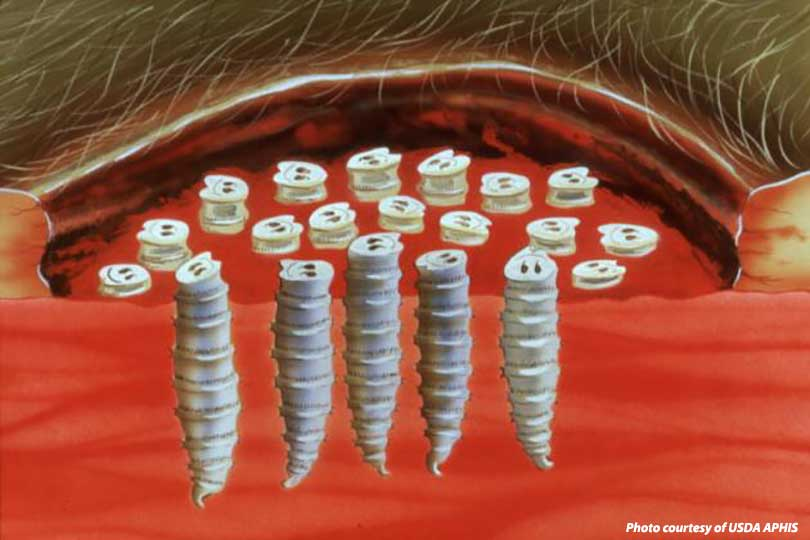
After about five to seven days of feeding, the maggots will drop off the host and burrow into the ground, where they begin pupating. The process of pupation can last anywhere between 7 to 54 days. After this time, the adult NWS will emerge from the ground and begin mating. The males can begin mating within twenty-four hours of emerging, while the females can take around 3 days to reach sexual maturity. Once mated, the female NWS can fly up to 125 miles before laying eggs1. Within their 10 to 30-day lifespan, the female NWS can lay up to 2,800 eggs.
Infestation
Signs of a NWS infestation include:
- Maggots in any wound or body openings that are draining or enlarged
- Foul-smelling wounds
- Depression or separation from other animals
- Weight loss due to decreased appetite
Treatment
New World Screwworm has the potential to cause catastrophic effects on United States agriculture and public health. Any and all suspicious wounds, maggots, or infestations should be reported immediately. Reports can be made to an accredited veterinarian, USDA veterinarian, and/or your state animal health official. Contacts can be found at State Animal Health Officials or USDA-APHIS Veterinarian Services. Accredited veterinarians are legally required to report any disease for which USDA has a control or eradication program in place and for any animal diseases not known to exist in the United States3. Once the report is made, the veterinarian will examine the affected animal/animals, collect samples, and send the samples to a lab for identification.
If NWS is diagnosed, the animal/animals need to be immediately quarantined. They will then be treated with both larvicides and insecticides daily until the larvae have been completely eliminated. The USDA will investigate to determine if additional control measures are needed.
Recent Updates
On November 22, 2024, the USDA’s Animal and Plant Health Inspection Service (APHIS) Veterinary Services temporarily halted all live animal imports from or transiting Mexico due to the confirmation of NWS in cattle.
Effective January 31, 2025, and until further notice, the APHIS has reduced restrictions on live cattle and bison imports from Mexico. All cattle and bison must complete a pre-clearance inspection and treatment for screwworm and enter the United States through APHIS-approved facilities associated with specific ports of entry. All cattle and bison must also meet all previously established import requirements4. As part of this protocol, Mexico has created pre-export inspection pens, which APHIS has visited, identified, and approved. Before entering pre-export inspection pens, all cattle and bison will be inspected and treated for NWS by authorized and trained veterinarians. Once in the pens, the animals will be inspected again before going to a final APHIS inspection before crossing into the United States. All cattle and bison approved for importation will be dipped in a solution to ensure they are insect-free and tick-free5. For more information and updates, please visit the APHIS website on Importing Live Cattle and Bison from Mexico to the United States.
Works Cited
1: CDFA. 2022. Screwworm. California Department of Food and Agriculture: Animal Health and Food Safety Services, Animal Health Branch. Accessed on February 28, 2025.
2: Novy, J.E. 1991. Screwworm control and eradication in the Southern United States of America. Special Issue of World Animal Review FAO, pp. 18–27. Accessed on February 28, 2025.
3: USDA-APHIS. 2025. New World Screwworm: What You Need to Know. Accessed on February 28, 2025.
4: USDA-APHIS. 2025. Import Alert: New World Screwworm Restrictions for Live Animals Originating from or Transiting Mexico. Accessed on February 28, 2025.
5: USDA-APHIS. 2025. Cattle and Bison Imports from Mexico Resume under New Protocol. Beef Magazine. Accessed on February 28, 2025.
Images Courtesy of:
2024. About New World Screwworm Myiasis. Accessed on February 28, 2025.
IAEA. 2021. New World Screw Worm. Accessed on February 28, 2025.

Be the first to comment