

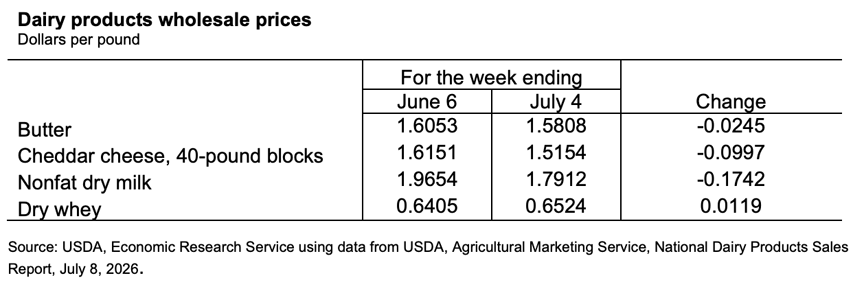
Most wholesale dairy product prices reported in the USDA National Dairy Products Sales Report (NDPSR) declined from the week ending June 6 to July 4. The prices per pound of Cheddar cheese (40‑pound blocks), nonfat dry milk (NDM), and butter declined by 9.97, 17.42, and 2.45 cents, respectively. However, the dry whey price increased by 1.19 cents per pound over the same period.
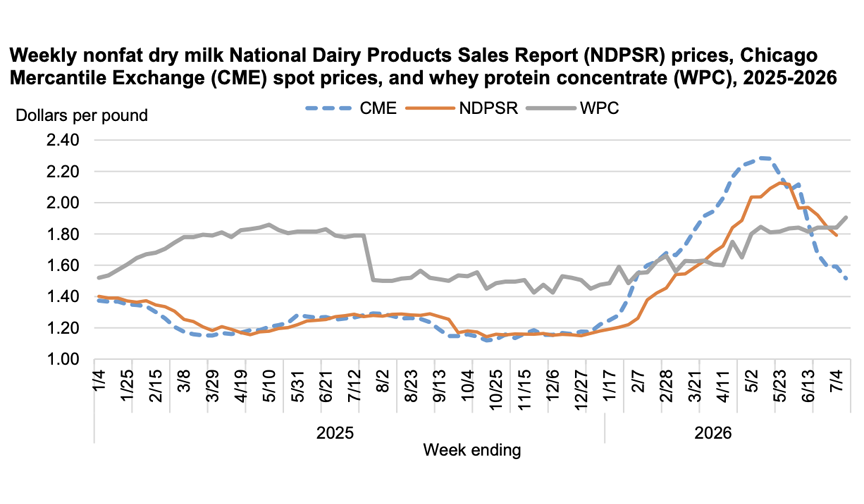
Spot prices for NDM at the Chicago Mercantile Exchange (CME) decreased during June and through the week ending July 10, with the NDPSR weekly average prices following a similar pattern in June and first week in July 2026. According to the USDA, National Agricultural Statistics Service (NASS)
The whey protein concentrate (WPC) and isolate (WPI) products are dairy products with high whey protein content. Supply and use data shows that total WPC (for human and animal use) production was 1 percent lower year over year in the first 5 months of 2026 while domestic use was about 8 percent higher. WPC ending stocks for May 2026 were about 20 percent lower than for May 2025. According to DMN, weekly average prices for WPC 34 percent climbed throughout April and were steady around mid-$1.80s per pound in June and early July. January through May 2026 production data for WPI was 7.7 percent higher year over year.
Recent Dairy Supply and Use Data
The all-milk price in May 2026 averaged $21.30 per hundredweight (cwt), 10 cents lower year over year. Meanwhile, May 2026 feed costs, as reported for the USDA, Dairy Margin Coverage Program (DMC) were 22 cents per cwt lower than the same period in 2025, with lower premium alfalfa and corn offsetting higher soybean meal prices. In May 2026, the DMC farm margin above feed cost was estimated at $10.62 per cwt, 22 cents higher than May 2025 and 8 cents higher than April 2026.
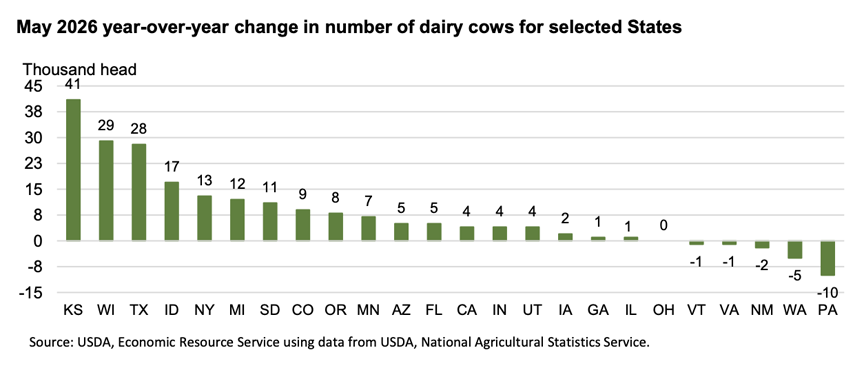
With favorable farm margins and low dairy cow slaughter rates, the National dairy herd continued to expand in May. According to the most recent USDA, NASS Milk Production report, the number of cows averaged 9.665 million head in May 2026, 184,000 more than in May 2025. The USDA, NASS milk per cow estimate for May 2026 was 2,128 pounds, about 0.4 percent higher than in May 2025. Consequently, May milk production was estimated at 20.565 billion pounds, about 2.3 percent higher year over year.
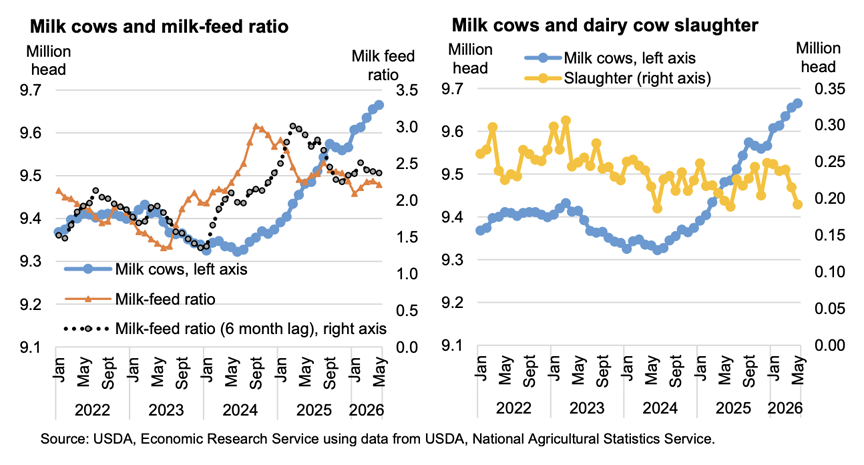
Supported by robust demand for beef-on-dairy calves, the dairy herd continues to expand despite relatively steady milk to feed ratios in 2025 and 2026. The following charts show the U.S. milk cow herd usually responds to changes in prices and feed costs with a lag of several months. The length of the lag is also affected by factors other than feed costs, such as the availability of dairy replacement heifers, particularly with the sustained trend of beef-on-dairy practices. Additionally, federally inspected dairy cow slaughter during the first 5 months of 2026 totaled 1.13 million head, about 43,400 head above last year’s slaughter levels, but still below 2024 levels. Culling rates will likely remain relatively low in the near term given the high returns from beef-on-dairy calves and tight replacement inventories.
Milk components continue to test at higher levels. The May 2026 milk-fat test reported by USDA, NASS averaged 4.31 percent, while the skim-solids test reported by USDA, AMS averaged 9.14 percent, both higher year over year. Consequently, May total milk fat and skim solids production were about 4.0 and 2.9 percent higher year over year, respectively. The yearover-year growth of milk fat and skim solids in May was higher than the growth rate of 2.33 percent for milk production. Higher concentration of components in milk means that more dairy products can be manufactured using the same quantity of milk.
On a milk-fat milk-equivalent basis, dairy product imports totaled 856 million pounds in May 2026, about 20.7 percent higher than last year. Following year-over-year lower imports in the first quarter, milk-fat milk-equivalent imports were higher year over year in both April and May 2026. On a skim-solids milk-equivalent basis, imports totaled 639 million pounds, about 11.3 percent higher than May 2025.
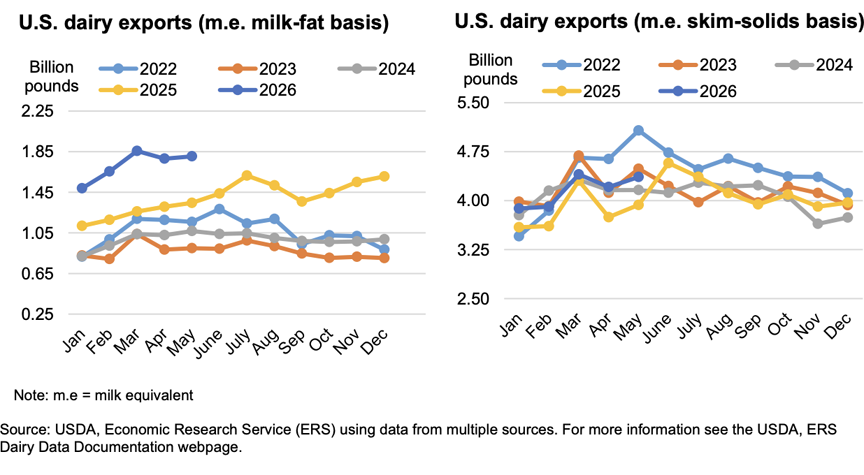
On a milk-fat basis, May 2026 exports totaled 1.804 billion pounds, about 34.1 percent higher than last year. On a skim-solids basis, exports totaled 4.363 billion pounds for the same period, about 10.9 percent higher than the same period in 2025. Exports for most dairy products increased year over year. Of note, May dry whey product exports more than doubled over last year’s level, with most of the increase due to shipments sent to China and Canada. However, exports of dry skim milk products were 20.0 percent lower than last year. On a milk-fat basis, May dairy exports represented 9 percent of total milk production, up from 7 percent last year. On a skim-solids basis, May exports were 21 percent of milk production, up from 20 percent last year.
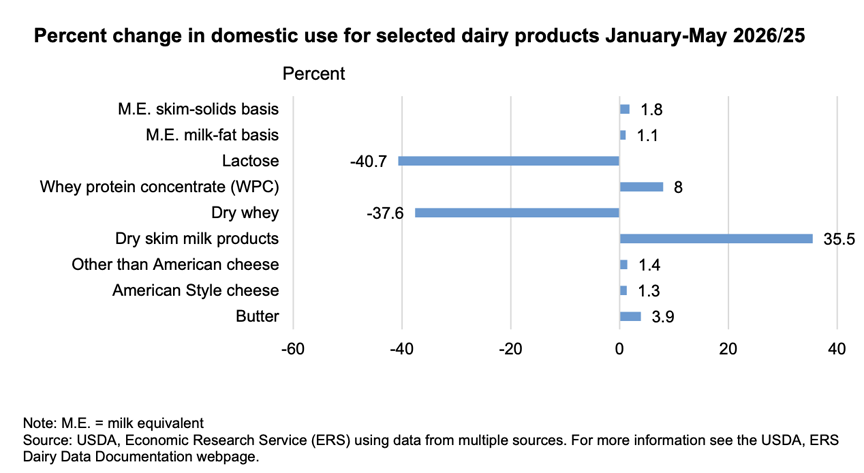
Domestic milk use in all products was higher year over year in the first 5 months of 2026 on both milk-equivalent bases. On a milkfat basis, domestic use was 89.908 billion pounds, 1.1 percent above the same period last year. On a skim-solids basis, domestic use was 79.742 billion pounds, 1.8 percent above the same period last year. Among major dairy products, yearto-date domestic uses for dry skim milk products and whey protein concentrates had the largest year-over-year percentage increases: 36 and 8 percent, respectively—a reflection of strong dairy protein demand. January through May, domestic uses of butter and cheese also increased year over year, albeit at lower rates. Conversely, domestic uses for dry whey and lactose declined in the first 5 months of the year.
With higher year-over-year exports and domestic use, May 2026 ending stocks were lower year over year by 5.5 percent on a milkfat basis and 3.1 percent on skim-solid basis. May 2026 ending stocks were year-over-year lower for butter, American style cheese, dry skim milk products, and whey protein concentrate products
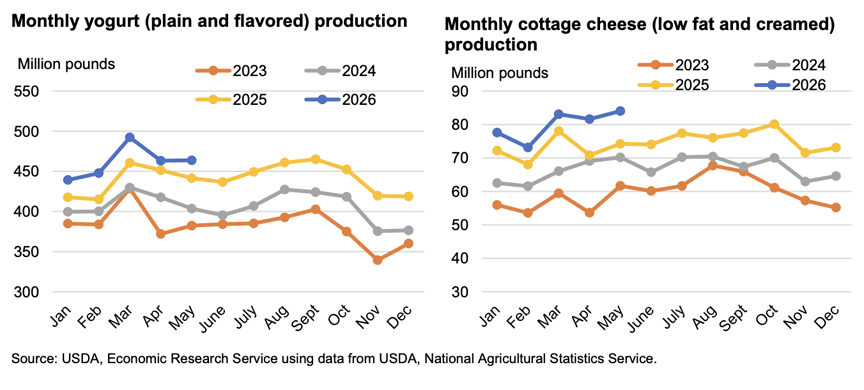
Cottage cheese and yogurt are ready-to-eat dairy products with high dairy protein content. Their total production steadily increased over the past few years in response to an increase in the demand for dairy products with high protein content. From January through May 2026, total production for cottage cheese was about 10 percent higher year over year, while total production of yogurt (plain and flavored) increased by 5.5 percent.
Dairy Forecasts for 2026
Based on recent data showing higher-than-expected number of cows, low slaughter rates, adequate milk margins above feed costs, longer expected cow retention due to beef on dairy, and tight replacements stocks, the new forecast for the national number of dairy cows for 2026 was adjusted to 9.660 million head, 15,000 higher than the previous forecast. The milk per cow forecast was adjusted to 24,495 pounds, 15 pounds lower than the previous forecast. Consequently, the new forecast for 2026 milk production is 236.6 billion pounds, an increase of 0.2 billion pounds from the last forecast. USDA, NASS will release its Cattle report on July 24, including milk cow and dairy replacement heifer data. The report will offer updated information to help future forecasts for the rest of 2026 and 2027.
The dairy import forecast for 2026 increased by 0.4 billion to 8.2 billion pounds on a milk‑fat basis and by 0.1 billion to 6.8 billion pounds on a skim‑solids basis. Despite forecasted domestic prices, higher imports are expected for cheese, butter, and a variety of fluid and cream products.
Export forecast adjustments were mixed from last month’s forecast. On a milk-fat basis, 2026 dairy exports were unchanged at 20.6 billion pounds, while on a skim-solids basis the 2026 dairy export forecast was revised upward to 49.9 (+0.5) billion pounds due to higher expected cheese and dry whey exports. International market conditions are expected to continue to be favorable for U.S. dairy exporters.
The forecast for ending stocks for 2026 on a milk fat basis is increased from last month’s projection. Despite lower expected prices, cheese and butter inventories are expected to build due to higher milk supplies. Ending skim-solids stocks are expected to decrease from the last forecast, mainly due to strong demand for dry skim milk and dry whey ingredients.
On a milk‑fat basis, the 2026 domestic disappearance forecast is 223.5 billion pounds (+0.5 billion), reflecting an expected increase in domestic use of high‑fat products from the last projection. On a skim‑solids basis, the forecast remains unchanged at 192.8 billion pounds.
With increases in milk production expected to direct more milk into manufacturing and based on recent price movements, the 2026 wholesale price forecasts for cheddar cheese, butter, and NDM have been lowered to $1.570 (‑4.0 cents), $1.690 (‑5.0 cents), and $1.615 (‑8.5 cents) per pound, respectively. The dry whey price remains unchanged at $0.660 per pound.
These commodity price revisions result in corresponding reductions in milk class prices. The Class III price has been lowered to $16.15 (‑$0.45) per cwt, reflecting reduced cheese prices and unchanged dry whey price. The Class IV price has been lowered to $18.40 (‑$0.95) per cwt due to decreases in both butter and NDM prices. The all‑milk price for 2026 is now projected at $20.00 per cwt, 70 cents below the previous forecast.
Dairy Forecasts for 2027
Dairy herd expansion is projected to continue from 2026 into 2027. The forecast for the average size of the dairy herd in 2027 has been revised upward by 45,000 head, bringing the average to 9.695 million. Yield per cow remains unchanged at 24,560 pounds. As a result, milk production for 2027 is projected at 238.1 billion pounds, 1.1 billion pounds higher than last month’s forecast.
Dairy imports for 2027 have been revised upward from the previous forecast. On a milk‑fat basis, import volumes are projected at 8.4 billion pounds (+0.3 billion), while on a skim‑solids basis, imports are forecast at 6.9 billion pounds (+0.1 billion). These upward revisions reflect higher expected imports of butter and some miscellaneous dairy products.
Dairy exports for 2027 have also been revised upward. On a milk‑fat basis, export volumes are forecast at 21.0 billion pounds (+0.3 billion), while on a skim‑solids basis, exports are projected at 49.9 billion pounds (+0.6 billion). These revisions are supported by higher expected exports of cheese, butter, dry skim milk products, and dry whey on favorable market conditions.
Driven by higher milk supplies, lower milk prices, and strong domestic demand for dairy products, the domestic use forecasts for 2027 have been raised. On a milk‑fat basis, domestic use is projected at 224.7 billion pounds, an increase of 0.9 billion pounds from the previous forecast. On a skim‑solids basis, domestic use is forecast at 194.3 billion pounds, 0.3 billion pounds higher than last month’s projection.
With higher milk supplies available for manufacturing, prices for key commodities were adjusted downward from last month’s forecast. The 2027 wholesale price forecasts for cheddar cheese, butter, and NDM have been revised to $1.665 (‑4.5 cents), $1.750 (‑7.0 cents), and $1.470 (‑10.5 cents) per pound, respectively, while the dry whey price remains unchanged at $0.650 per pound.
These commodity price revisions support reductions in milk class prices. The 2027 Class III price is now forecast at $17.05 (‑$0.50) per cwt, reflecting lower cheese prices and an unchanged dry whey price. The Class IV price has been lowered to $17.40 (‑$1.20) per cwt due to decreased prices for both butter and NDM. The all‑milk price for 2027 is now forecast at $19.85 per cwt, $1.05 below the previous projection.

Be the first to comment