

In Ireland, climate change is creating more variable farming conditions, with warmer temperatures, wetter winters and drier summers influencing grass growth, shifting grazing windows and threatening animal health and productivity. This article outlines strategies to build resilience in grass-based dairy systems — from fodder security and drainage to water infrastructure and buffer feeding — and explains how data-led feeding decisions can support performance in Irish agriculture and protect Irish dairy exports as conditions evolve.
A series of national climate studies, based on long‑term historical data, provide a clear picture of how Ireland’s climate, weather patterns and growing conditions are changing — and how they’re expected to change in the coming decades, affecting Ireland’s grass-based dairy agri-food industry.
While year‑to‑year weather variability is familiar to farmers, these shifts are unprecedented and will require the Irish dairy community to implement innovative farm resilience strategies.
How climate is shaping dairy farming in Ireland
Four key climate trends are expected to have the greatest impact on Irish agriculture:
Warmer conditions becoming the norm
Ireland has already warmed by approximately 1°C since the early 20th century, with a further increase in average temperatures of 0.5–0.7°C projected by 2050 under best‑case scenarios. This will result in fewer frost days and longer growing seasons — particularly in spring and autumn — leading to earlier growth for grass in Ireland. However, warmer summers will also increase the risk of heat stress in livestock.
Wetter winters and more intense rainfall
Drier summers and increased drought risk
Summer rainfall is expected to decline by approximately 8% nationally, with the greatest reductions likely in the east and southeast. More frequent dry spells will increase the risk of mid‑season growth deficits, often followed by heavy rainfall. While some years will have optimal climate conditions, overall variability and risk will increase.
More extreme and unpredictable weather
Nutrition for dairy herds will be challenged as an increase in heat waves, heavy rainfall events and storms results in less predictable grazing and silage conditions, with greater year‑to‑year variability in grass and fodder production.
What this means for grass-based systems
Many of these changes are already being experienced, meaning farms are adapting to increased variability rather than gradual change. This creates higher risk and more complex management decisions.
In Ireland, climate change will not eliminate grass‑based dairying, but it will make it less predictable. Earlier spring growth may coincide with poorer ground conditions, summer growth dips will become more common, and silage harvesting windows will narrow. Heat stress, parasite pressure, disease risk and fodder shortages are also likely to increase.
Practical steps to build resilience
Though these challenges are significant, there are practical steps that can strengthen farm resilience. Many, including the following, are already best practice:
-
Building stronger fodder security with larger silage reserves
-
Focusing on silage quality as well as quantity, to narrow the gap with grazed grass
-
Maintaining and improving land drainage while minimizing soil compaction
-
Investing in water supply and storage as well as simple ventilation and cooling infrastructure
-
Accepting buffer feeding as standard practice during spring and summer deficits and in poor weather
How farms cope with difficult weeks and months will have a big influence on long-term results. Resilient systems are those that protect soil, secure high‑quality fodder, remain flexible and meet animal nutritional requirements, and these farms will consistently outperform more fragile farms over time.
What resilient systems look like in practice
Performance data from commercial farms shows how resilient systems are already delivering results.
While some farms may be reluctant to adopt systems that include supplementation alongside grazed grass, experience shows that well-designed systems can remain simple, efficient and cost-effective. Poorly structured systems with excessive concentrate use, additional forages and low grass utilization offer limited benefit and undermine system performance.
Data from KEENAN and InTouch customers, compared with figures published in the Teagasc Roadmap for 2030, demonstrate what can be achieved within resilient grass-based systems. These farms produce high levels of milk solids (+105 kg per cow compared with the national average) while maximizing grass utilization (8.8 t DM/ha vs. 7.8 t DM/ha on average Irish farms). Concentrate use is limited to just over 1 metric ton per cow, almost 250 kg less than the national average for spring-calving systems. Performance also compares favorably with Teagasc 2030 targets and current research benchmarks.
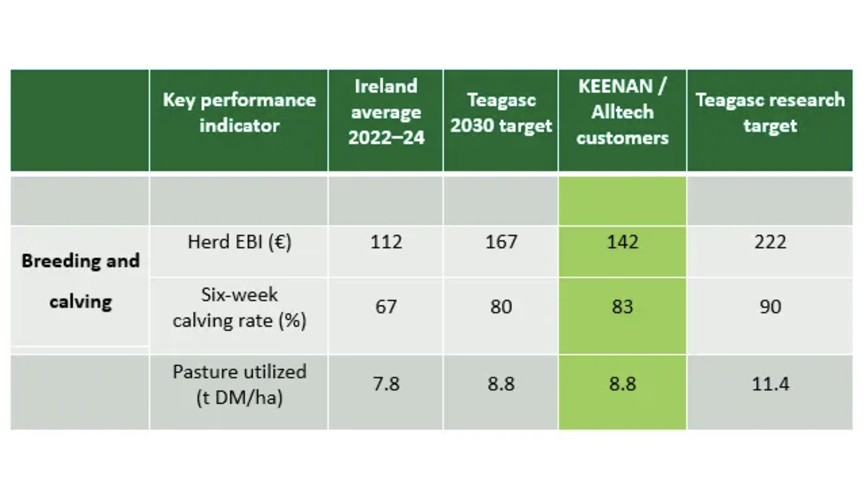
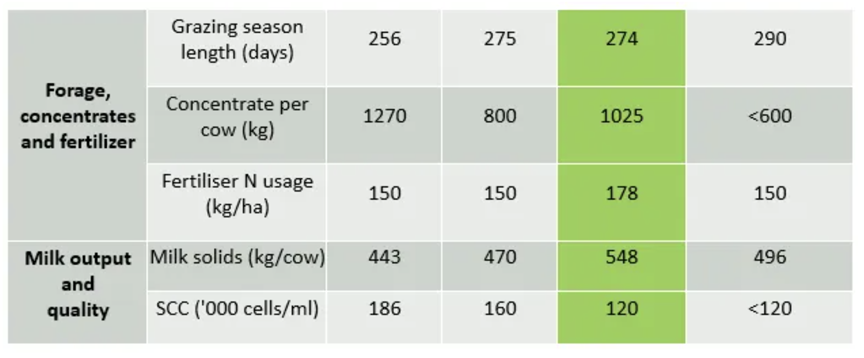
Most of these farms rely heavily on grazed grass, minimize concentrate inputs where possible and use conserved forage, predominantly grass silage, to address intake shortfalls. Typically, systems utilize a single concentrate across all stock classes, supported by straw and silage. This system focuses on youngstock, dry cows and milking cows, maintaining simplicity while delivering strong technical and financial performance.
The role of KEENAN and InTouch
KEENAN and InTouch help farmers get the most from grass‑based systems by supporting better feeding decisions and stronger farm performance. Their role is not to change how grass‑based farming works, but to help make it more reliable, efficient and resilient as conditions become more variable.
KEENAN focuses on how feed is delivered on-farm. Its feeding systems help farmers use grazed grass and silage more effectively while keeping feeding simple and consistent. When extra feed is needed, KEENAN helps ensure it is used in a controlled and targeted way, matching animal demand and grass supply.
InTouch supports decision‑making with timely, accurate farm data. It brings together information on feed, forage and animal performance so farmers and advisors can see how the system is performing. This helps identify issues early, manage risk and make informed changes when grass growth, weather or costs become challenging.
Together, KEENAN and InTouch help farmers build strong, grass‑focused systems that are easier to manage and better able to cope with change.
Conclusion
Grass-based farming remains Ireland’s competitive advantage, but it must adapt to increasing climate and cost pressures. By combining precision feeding and data-led decision-making, KEENAN and InTouch can help strengthen resilience, improve feed efficiency and manage risk, ensuring pasture-based systems remain productive, profitable and sustainable into the future for Irish farmers.


Be the first to comment