
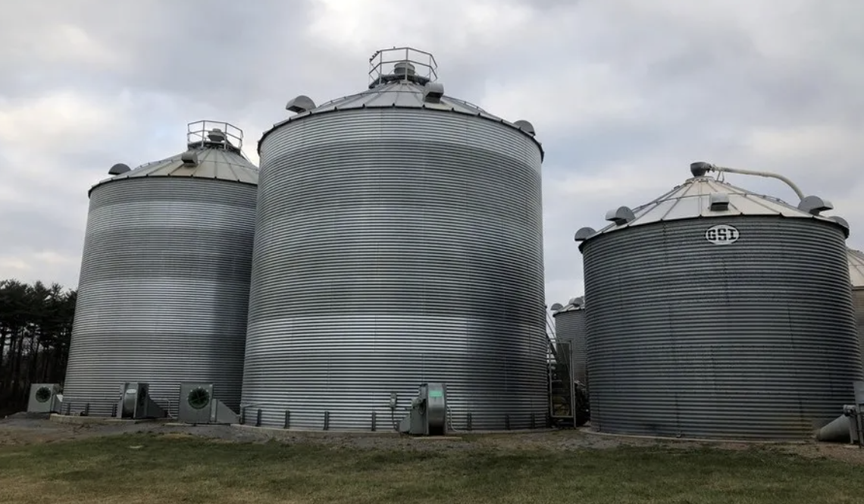
The grain bin safe entry retrofit research project examined whether existing on-farm grain bins could safely accommodate an anchor point and lifeline system with the goal of reducing grain-related injuries and fatalities.
Grain bins are one of several types of confined spaces found in production agriculture.
Hazards Associated with Grain Bins
Standards and Regulations
The Occupational Safety and Health Administration’s (OSHA) Grain Handling Facilities Standard provides safety guidelines regarding grain bin entry and the use of harnesses and lifeline systems. According to this standard (1910.272), employers should provide properly fitting body harnesses with a lifeline whenever someone enters a grain storage structure or whenever they need to walk in or stand on stored grain. These lifeline systems must be engineered to support the forces imparted on them during an entrapment incident. The standard also emphasizes permit procedures and should be followed for entering bins, silos, or tanks. However, the limitation of this standard is the OSHA’s Small Farm Exemption rule, which excludes small farms from the enforcement of rules, regulations, and standards.
The American Society for Agricultural and Biological Engineers (ASABE) developed the ANSI/ASABE S624 Grain Bin Access Design Safety standard. This standard is a voluntary standard, and it recommends that grain bins manufactured after 2018 be equipped with a lifeline and anchor point to support the person from sinking in grain with anchor attachment points that support a minimum of 2,000-pound load.
Research Project Overview
Gorucu, S., Pate, M., Fetzer, L., and Brown, S. (2022) Farmers Perceptions of Grain Bin Entry Hazards. Journal of Agricultural Safety and Health 28(1): 19-30 (doi: 10.13031/jash.14662).
In the second part of the project, we aimed to assess the feasibility of a safe entry anchor point retrofit by using finite element analysis (FEA). We used a grain bin owned by Penn State for 3D FEA modeling in Solidworks to predict if the structure can withstand when subject to loads to support the person entering the grain bin. The current project was a continuation of a graduate project and incorporated some of the improvements. When the 3D model was created, it was conducted using surface modeling techniques in Solidworks to accurately model the forces in a grain bin during an entrapment incident, while ensuring the bin is simple enough to be parametrically driven. The deflection testing process was used to validate the 3D model and FEA simulations using a precision phase-comparison laser while applying incremental static loads to the retrofitted rescue anchor points. Then we compared the predicted deflections from the FEA model and the actual experimental measured deflections. The
Detailed information on the research methodology and results is available in the following ASABE conference paper:
Gorucu, S., Dyer, M., Bock, R., Thomas, R., Fetzer, L., & Brown, S. (2022). Modeling a Grain Bin for Safe Entry Anchor Point Retrofit. In 2022 ASABE Annual International Meeting, July 17-20, 2022, Houston, TX. American Society of Agricultural and Biological Engineers.
Conclusion and Resources
Due to the numerous variables and the varying conditions of grain bins, each grain bin needs to be evaluated to determine whether it can safely accommodate an anchor point and lifeline systems. If a grain bin has been constructed after 2018, when ASABE S624 was implemented, the bin manufacturer/company should be contacted to verify that your grain bin was equipped with the appropriate anchor points. If a person wants to retrofit their on-farm, non-stiffened grain bin built prior to 2018 with anchor points, it should be evaluated by a structural engineer to determine the safety and feasibility of the retrofit. Due to variations in foundations, sidewalls, roofs, and rust of grain bins, a grain bin inspection guidance document was developed to assist structural engineers when making this determination. The inspection criteria are a guideline, and the judgment of a structural engineer is highly recommended to ensure the safety of grain bin modification. The layout of the criteria provides both text and visuals to assist the person inspecting the bin. To download a free PDF copy of the criterion or to purchase a hard copy, visit the publication webpage.
Whether or not a grain bin can be retrofitted with an anchor point and lifeline systems is just one step in the prevention of grain-related injuries and fatalities. There are several best practices that should be implemented to reduce grain bin entry and falls. These best practices are outlined in the following Penn State Extension article: Best practices and products to reduce grain bin entry


Be the first to comment