
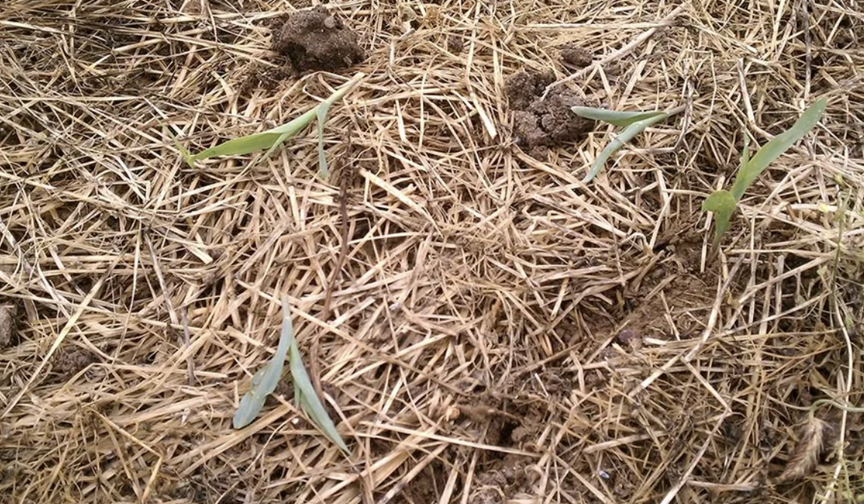
In southeastern PA, there is a heightened risk of damage from black cutworm, so now is the time to begin scouting for their cutting damage in corn fields. Across PA, folks should scout for cereal leaf beetle, mostly in wheat and oats.
Black cutworm
A few weeks ago, Penn State’s Black Cutworm Monitoring Network detected significant flights of black cutworm moths at four locations in three counties: two sites in Lebanon County (near Bellegrove and Fredericksburg), and one site each in Lancaster (near Manheim) and Bedford (near New Paris) Counties. These flights are notable because once a significant flight occurs, cutting damage by black cutworm caterpillars tends to occur 300 degree-days later.
While the flights we detected indicate that areas of Lebanon, Lancaster, and Bedford counties appear to be at a higher risk for black cutworm damage, I also recommend that corn growers in the rest of Pennsylvania begin scouting for cutworm damage in the coming weeks. Our trapping network does not cover the whole state, and it is safe to assume that pulses of cutworm moths that came north in the past weeks reached other parts of Pennsylvania. Therefore, be sure to scout your corn for cutting damage as your corn emerges and until it reaches V5.
While you are scouting, it is good to remember that the risk of black cutworm damage depends on the growth stages of corn. Economic thresholds for black cutworm are 2, 3, 5, and 7 cut plants per 100 plants for seedling, V2, V3, and V4 stage plants, respectively. Finding this cutting damage (Figure 1) and applying rescue treatments if necessary is the most effective and economical way to control black cutworm populations.
Only two Bt traits (the Cry1F protein, known as the Herculex 1 trait, and the Vip3a protein, known as Viptera) provide some control of black cutworm, and seed-applied insecticides provide little control, with at least one research study showing that seed-applied insecticides only provided 30% control. Tank mixes of pesticides that include insecticides are often unreliable because they are rarely applied at the right time for black cutworm control and can significantly set back natural enemy populations, which can help control black cutworms. The best approach is scouting periodically and applying insecticides if cutting damage exceeds economic thresholds. See our fact sheet on black cutworm for more details.
| County | Nearest town | Date of sig. flight | Accumulated degree days* |
|---|---|---|---|
| Lebanon | Bellegrove | 11 April | >300 |
| Lebanon | Fredericksburg | 11 April | >300 |
| Lancaster | Manheim | 25 April | >300 |
| Bedford | New Paris | 7 May | 160 |
*As of 20 May 2025
Cereal leaf beetle
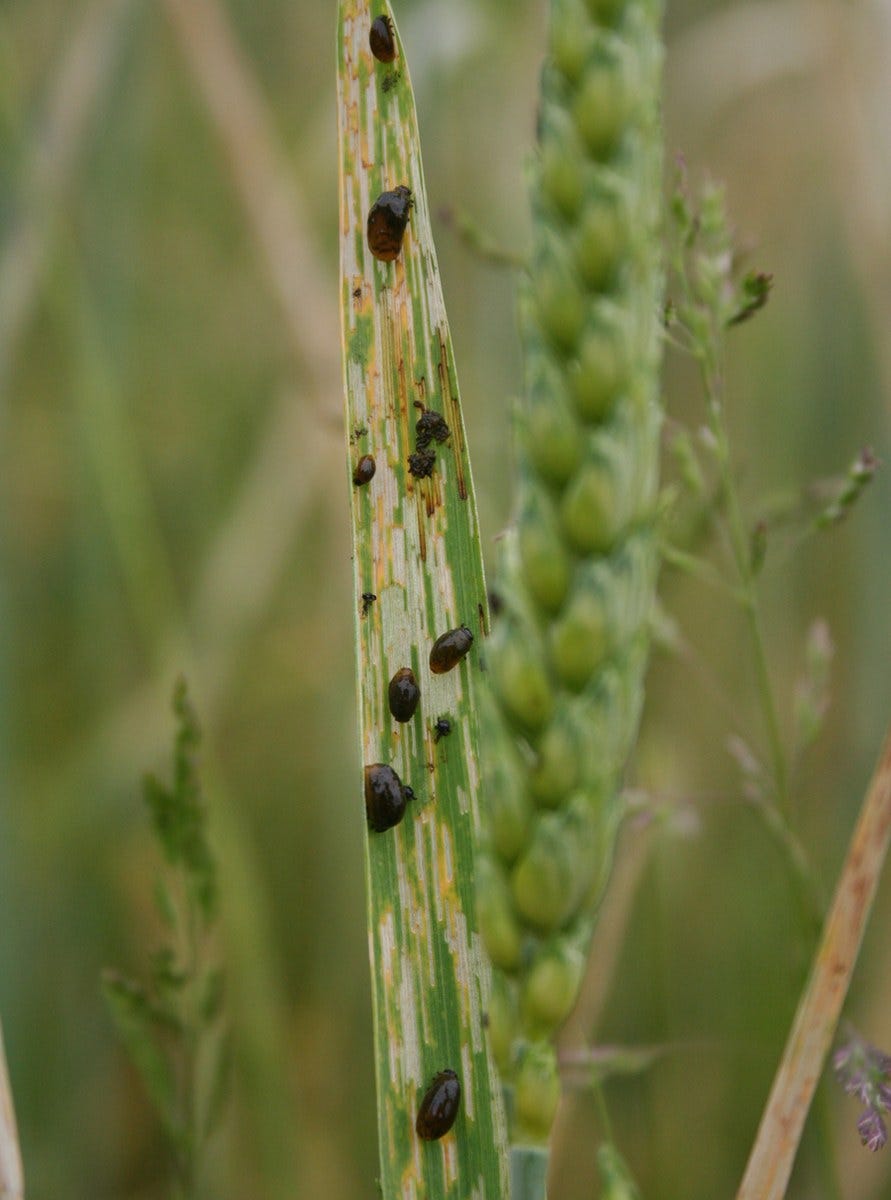
This is the time of year that cereal leaf beetle larvae are typically active in small grain fields, particularly in wheat and oats. Infestations are difficult to predict and can be very patchy, so scouting is the key to identifying local populations and populations that are large enough to be managed. Cereal leaf beetle eggs and young larvae are orange and relatively easy to see. As they get older, however, they can be mistaken for slugs as they look dark and shiny (Figure 2) because they cover themselves with their own frass, which is the word for insect feces. If you look closely at these shiny animals and see six small legs, you will know you are dealing with cereal leaf beetle larvae and not slugs. Moreover, slugs are nocturnal, so slimy creatures out during the day in small grains have a good chance of being cereal leaf beetle larvae. If young larvae are detected at populations exceeding the economic threshold, cereal leaf beetle is easily controlled with insecticides, but larger larvae are more difficult to control and cause more damage, particularly if they are feeding on the flag leaf. Insecticide treatments are warranted if populations exceed the economic threshold of one larva greater than one-eighth-inch long per stem over a field or a portion of a field. Our fact sheet provides more details on their lifecycle and some images of adults, larvae, and their damage. For insecticide options, please consult Penn State’s Agronomy Guide.

Be the first to comment