

Grazers should consider more than green grass and available forage when turning livestock out on spring pasture.
As the weather warms and the spring rains give us plentiful pasture and hay growth, the temptation to get livestock out and onto grass will be high. Wait. If you have the hay and the ability to continue feeding, this will reward you more than turning livestock into muddy, underdeveloped pastures.
Soil Fertility
The best place to start when thinking, “When will I start grazing?” will be fertility. Applying fertilizer according to a fall soil test will allow you to make the most economical and environmental decisions for your operation. If you have soil tests and need help interpreting results, read Interpreting Your Soil Test Reports. Contact your local Penn State Extension Agronomy Educator if you need further assistance.
As you start making amendments to your pastures, begin with lime and pH management, as it is one of the most critical steps when managing pasture. Pasture pH management must be maintained to ensure optimum growth for grasses and legumes (clovers, birdsfoot trefoil, alfalfa). Lime is usually applied in the fall in perennial forages; however, weather conditions can dictate when applications are made. Read Soil Acidity and Ag Lime for more information on pH and liming.
Lastly, we want to look at nutrient management. Many factors play into pasture nutrient management and optimizing growth, but the one most often overlooked is our winter feeding practices. Anytime that feeding happens in pastures, we provide nutrients to those areas through nutrient cycling. In general, 80% of livestock consumed nutrients are redeposited on fields. Some rough math- for every ton of grass hay livestock consume in a pasture field, they return 40 pounds of potassium, 12 pounds of phosphorus, and 40 pounds of nitrogen. Nutrient additions through hay consumption should be considered when purchasing and applying fertilizer.
Pastures and hay can also benefit from an application of supplemental nitrogen at green-up to increase plant production. Applying 30-40 pounds of nitrogen per acre can substantially boost yield and carrying capacity, root growth, and plant density. Watch our short video on Maximizing Spring Green Up on Pasture for more information on nitrogen applications for more details.
Managing Damaged Areas from Winter
At this point, you may notice a few areas of pasture that incurred some damage over the winter. Most likely, those heavy traffic areas near water, feeders, minerals, and their favorite pasture corner to hang out. It can be beneficial to have a sacrifice lot during winter or use it during wet weather to save your valuable pastures. But there are usually still some areas post-winter that could use some improvements.
First, move water, feed, and mineral sources to new locations so that you can re-seed the damaged areas or allow them to rest and regrow. Rotating those items more frequently or having a permanent location with a concrete pad can help alleviate the stress from heavy traffic.
Sometimes it is necessary to restore or renovate our main pastures due to excessive damage, but it’s important to consider carefully before fully renovating. Your assessment should be based on the current productivity of the pasture, and a full-blown renovation should be a last resort. This article, Seeding Perennial Forages: Restoration/Renovation of Pastures and Hay Fields, can help you determine your best approach.
Finally, consider what you will plant in your winter-feeding areas or the damaged spots in your fields. If you are treating areas of your fields or rotating your winter-feeding area, returning them to a suitable perennial forage that fits your operational needs is best. If you will reuse the same feeding area again next winter, consider using an annual grass that takes less time to become established. You can read Selecting the Correct Forage Species or call your local agronomy educator to learn about the proper species selection.
Grazing Management
Grazing management is an essential aspect of pasture health and productivity. Maintaining good forage heights will ensure our desirable forages maintain good quality, suppress weeds, and survive through the summer. Management systems also allow for more even distribution of manure across our pastures. Rotational grazing is when only a field section is grazed at a time while the remainder of the pasture is left to rest and regrow. A continuous grazing system allows animals access to a pasture throughout the entire grazing season.
While requiring fewer physical inputs from the producer, continuous grazing systems allow animals to be more selective and graze certain areas and plant species more heavily than others. The forages left behind will mature and decline nutritionally as animals continuously return to the new lush growth that was more recently grazed. Rotational grazing favors our desirable forages by limiting the space for livestock to graze and rotating them to fresh paddocks, ideally when forages reach a certain height. Then, the paddocks can “rest,” allowing forage to regrow and replenish carbohydrates. This grazing height can be valuable in botanical compositions because different forages, grasses, and legumes will tolerate different grazing heights. Table 1 shows the start and stops grazing heights for different types of grasses and legumes.
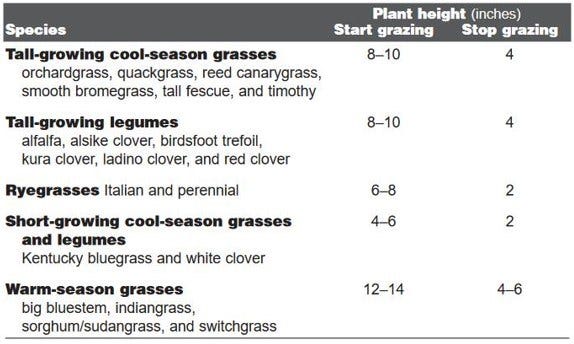
Table 1. Start and stop grazing heights for different grass and legume forages. From USDA Pastures for Profit: A Guide to Rotational Grazing
Grazing systems also allow us to manage our carrying capacity, which can help when pastures are wet in the spring. Rotational systems allow us to move animals on and off our pastures to avoid damage. Wet soils allow hooves to tear through roots, causing damage to forages and potential soil compaction.
Grazing too early in the spring, before forages reach an ideal height, can stunt their growth for the remainder of the grazing season. It’s important to remember that what you see above ground in terms of forage biomass is reflected in the soil as root biomass. Spring is when forages actively grow, accumulate carbohydrates, and develop complex root structures. So, if forages are grazed too early, they will not have a good root structure belowground to scavenge for nutrients and water during the summer months. For more information on residue heights, check out Grazing Residue Height Matters.


Be the first to comment