

The decision to use supplement fats in modern dairy rations has become more complex. Today, dairy producers and their nutritionists should consider the type of fat, the fatty acid profile, the quantity they feed, all in context with the economic benefits that they expect to see on the farm.
Rumen inert/bypass fats are sometimes fed as a delivery vehicle for specific fatty acids, much like you feed protein sources to provide amino acids. Specific fatty acids have been shown to enhance reproductive performance and can serve as immune system modulators, thus improving animal health. These benefits are well beyond what we attribute to improved energy status when supplemental fats are fed. The fatty acid composition of commercial fat sources has added to the complexity of feeding decisions surrounding supplemental fat addition to dairy rations.
Fats are energy dense, with 2 ¼ times the energy content as most grain sources. As one would expect, they have always carried a premium price as compared to carbohydrate sources. Over the past 12 months, feed and ingredient prices in general have risen
Another important question is “Can my ration be balanced or formulated without the use of expensive fat sources?”. There are many variables that go into answering this question. Consider these factors before adding or removing supplemental fat:
- What are your herd goals? The higher your herd’s milk production and component goals, the more energy you will need in the ration, and the more likely you will need supplemental fat.
- What is the dry matter intake (DMI) of the group or herd of cows in question? Calorie consumption is directly related to pounds of feed consumed. There are many management factors that can influence DMI, including pen stocking rate, feeding frequency and the number of times you push up feed. Environmental temperature and humidity have a big effect on DMI, too. Lower DMI may dictate using added fats to meet energy needs.
- What is the quality of your forages? Highly digestible neutral detergent fiber (NDF) is key to optimizing the energy content of the ration. For ensiled forages, did you get a good fermentation? What does the fermentation profile (VFAs) look like? Is lactic acid the predominant volatile fatty acid? Rations containing low to moderate energy forages will usually require some added fat.
- What is the current starch and sugar content of the ration? Can you increase fermentable carbohydrates without compromising rumen health as a means of increasing ration energy content?
Stepwise Process of Adding Fats
Fats are typically divided into three distinct categories, as shown in Figure I. Many high producing dairy herds run their total dietary fat between 5 and 6%.
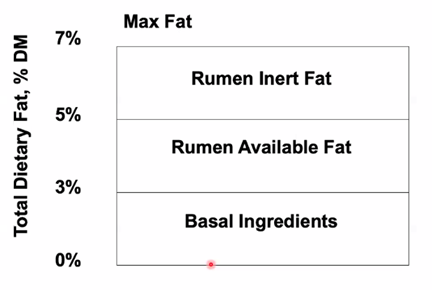
Chances are you will need more fat than what is provided by your forages and grains to meet the energy requirement of your cows. Your next option should be rumen available (active) fat sources, which are more economical than rumen inert/bypass fat sources. This includes fat from roasted soybean, whole cottonseed and tallow. Soybeans and whole cottonseed are high in unsaturated fat, which limits the quantity of oilseed sources that you can feed. Popular commodities such as distillers’ grains, hominy and bakery byproducts provide significant amounts of RUFAL (rumen unsaturated fatty acid load), as well. Be cognizant of the total RUFAL. If you exceed the limit, rumen function will likely be negatively impacted, which may depress NDF digestibility, depress dry matter intake, decrease de novo fatty acid synthesis, resulting in depressed milk fat. The RUFAL limit is not a hard and fast number; it is very much dependent on rumen pH, VFA profile and the pool of rapidly fermentable carbohydrates. Typically, the RUFAL limit falls between 1-2% of ration dry matter.
Once you have reached the limit on rumen available fat, commercial bypass/rumen inert fats need to be your go-to-source for additional energy. The benefits of including rumen inert fats in your diet go well beyond just adding calories to the ration. Depending on the fatty acid profile of the rumen inert fat, improvements in reproductive performance and body condition, enhanced immunity and increased milk fat may also be observed. The fatty acid profile of a rumen inert fat determines its overall digestibility. Of course, the more digestible, the better. There are two important rules of thumb to keep in mind: 1) The digestibility of a fatty acid decreases as the carbon chain length increases (C16:0 is more digestible than C18:0), and 2) Unsaturated fatty acids are more digestible than saturated fatty acids.
Fats that are almost exclusively comprised of palmitic acid (C16:0) have become very popular the last several years. Palmitic acid , a saturated fatty acid, can be preferentially incorporated into milk fat. Research and on-farm results consistently show increased milk fat content and yield when high-palm fat sources are fed. Palmitic acid modifies energy partitioning, channeling energy towards milk production and away from body fat reserves.
Balancing Your Ration
The energy demands of your fresh cows and high producing cows are the most difficult to satisfy. Follow the steps below to optimize balance of your feed rations.
- Always feed your highest quality forages (lowest NDF and highest NDF digestibility) to your fresh cows and highest production groups.
- Provide sufficient eNDF to provide for good rumen health.
- Feed sufficient rumen buffers to help stabilize rumen pH.
- Optimize starch and sugar levels of the ration to provide for good rumen health and good components. Be careful not to feed too much ‘fast’ starch.
- Take full advantage of ionophores, botanicals, plant extracts, yeast cultures and other cost-effective feed additives that can help capture more energy from the forages and grains that you grow on your farm, or source locally.
- Most high producing cows will benefit from adding 1.0-2.0% rumen available fat. How much you need and can add will depend on how well you have incorporated steps 1-5.
- When supplementing rumen available fats:
- Consider oilseeds (whole cottonseed, roasted soybeans) and tallow first. Soybeans should not be finely ground.
- Fat coming from distillers’ grains, hominy, bakery byproducts, etc. are all included in this category, and all contribute to the RUFAL pool.
- Rumen inert/bypass fats will be the final fats that you add, if you still need additional energy. Adding 0.25 – 0.75 lb. of rumen inert fat will add $0.25-$0.75/cow/day to your ration cost. There are many rumen inert fats available on the market, differing in fatty acid profiles. Select the rumen inert fat that best fits your situation.
Determining the ROI of a specific fat supplement that you have added to your ration goes well beyond the benefits gained from the additional milk, fat and protein in the bulk tank. You must also take into account effects that the fat had on body condition, reproductive performance and overall health of the cow. It is much more difficult to put a dollar value on the reproductive and cow health benefits that are attributed to some of the specific fatty acids provided by specialty rumen inert fats, especially when the benefits are not immediate. The decision to add or remove a specific fat source from a ration is quite complex, especially given the unprecedented prices that we are facing today.
Author Bio: Dr. Don Jaquette leads the dairy technical team for ADM Animal Nutrition and serves as a dairy field support for the mid-Atlantic region. His role at ADM also includes overseeing dairy technical training, ration formulation program support as well as product and program development for the domestic feed business. He has master’s and doctoral degrees in dairy nutrition from North Carolina State University.

Be the first to comment