
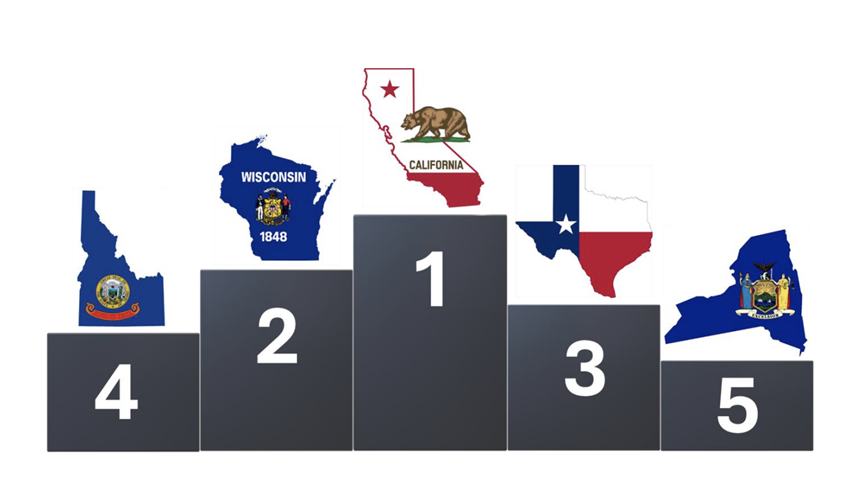
Competition drives innovation in better products, services and efficiencies. In dairy, Texas has grown 6% annually over eight years, outpacing Idaho’s 2% growth, making Texas the third-largest dairy producing state. While this growth supports a $50 billion industry and over 250,000 jobs, we must keep innovating to build drought-resilient systems. This article covers why water scarcity is the U.S. dairy industry’s biggest challenge and how producers are adapting.
Focus on Water
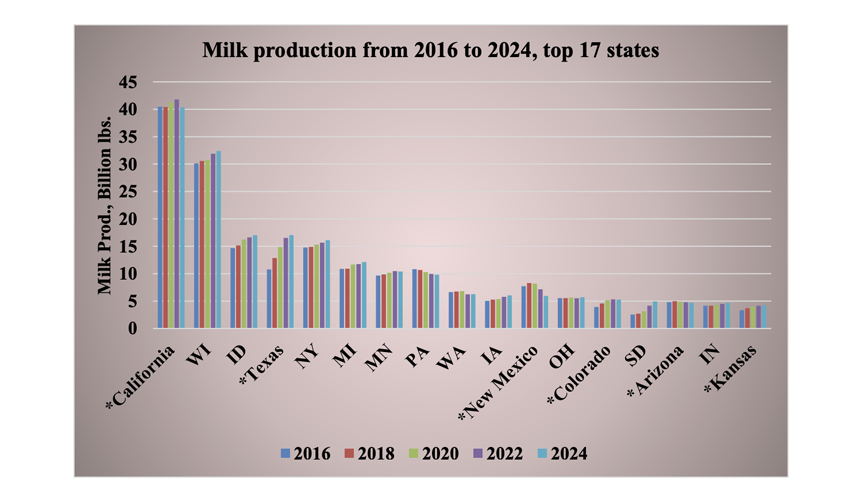 Over a third of U.S. milk is produced in water-scarce states including California, Arizona, New Mexico, Kansas, Texas and Colorado. USDA, NASS, 2025. ]
Dairy in Dry Times:
The Next Frontier Texas dairy farmers have been adopting drought-tolerant crops, precision irrigation and non-forage fiber sources (NFFS) to reduce water use. Here are four key strategies used by Texas dairy farmers to combat the challenges of water scarcity:
Drought- and Climate-Adapted Forage Systems Crops like sorghum, triticale and winter wheat thrive in dry conditions and are increasingly replacing corn silage. Brown midrib (BMR) sorghum hybrids have good fiber digestibility, making them excellent feed for lactating dairy cows.3 Seed-producing sorghum hybrids benefit from advanced grain processing technologies that improve berry processing and starch digestibility in silage.4 Triticale and winter wheat grown in cooler temperatures help reduce evapotranspiration losses. When harvested at the boot or heading stage, they provide high protein and fiber digestibility. In addition, silage is displacing cash crops. More corn, wheat and sorghum is being grown for silage instead of grain, which can increase forage availability on dairy farms. To support this, data on cut height and maturity trade-offs between yield and quality will help set fair premiums for crop farmers.
Precision Irrigation and Digital Monitoring Smart tools like new irrigation technologies, soil moisture sensors, and drone or satellite monitoring help apply water efficiently, when and where crops need it. In addition, computer programs predict water needs and detect crop stress early, helping farmers respond quickly
Soil Health and Water Retention Healthy soil holds water better, reducing irrigation needs. Keeping soil covered with double cropping or cover crops reduces erosion and moisture loss. Double cropping doesn’t always mean more irrigation — drought-tolerant, early maturing sorghum and triticale/wheat can keep water use low. No-till or strip-till preserves soil structure, while compost and manure improve water-holding capacity and soil biology, which help to build resilient soils.
Non-Forage Fiber Sources (NFFS) in Diets Feeding byproducts such as whole cottonseed, corn gluten feed and distillers grains helps reduce reliance on irrigated forages. Improving the availability and consistency of these byproducts’ nutrient content would encourage greater adoption on dairy farms in water-scarce regions of the southwestern and western U.S.
References
- U.S. Department of Agriculture, National Agricultural Statistics Service. 2025. Milk production, disposition, and income 2024 summary.
- Scanlon, B.R., C.C. Faunt, L. Longuevergne, R.C. Reedy, W.M. Alley, V.L. McGuire, and P.B. McMahon. 2012. Groundwater depletion and sustainability of irrigation in the US High Plains and Central Valley. Proceedings of the national academy of sciences, 109:9320-9325.
- Duhatschek D. and J.M. Piñeiro, 2024. Partially replacing corn silage with BMR male-sterile sorghum silage. Texas Dairy Matters website. Texas A&M AgriLife Extension.
- Piñeiro, J.M., D. Duhatschek, A.G. Pilati. Strategies to include sorghum silage in lactating cow rations. Part 3. Texas Dairy Matters website. Texas A&M AgriLife Extension.


Be the first to comment