
Do you know how much it’s costing you to raise your calves daily? Or are you thinking about having someone else raise them and don’t know how much to pay them? The cost to raise a heifer from birth to freshening continues to climb and now ranges from around $2,100 up to about $2,800 per head, using estimated 2024 costs for feed and labor. Although birth to weaning costs are not the highest cost area in the heifer raising program (15% of total cost, Karszes, Cornell 2020), getting calves off to a good start should not be compromised. Of that 15%, nearly 75% of the cost is associated with labor, management, and feed.
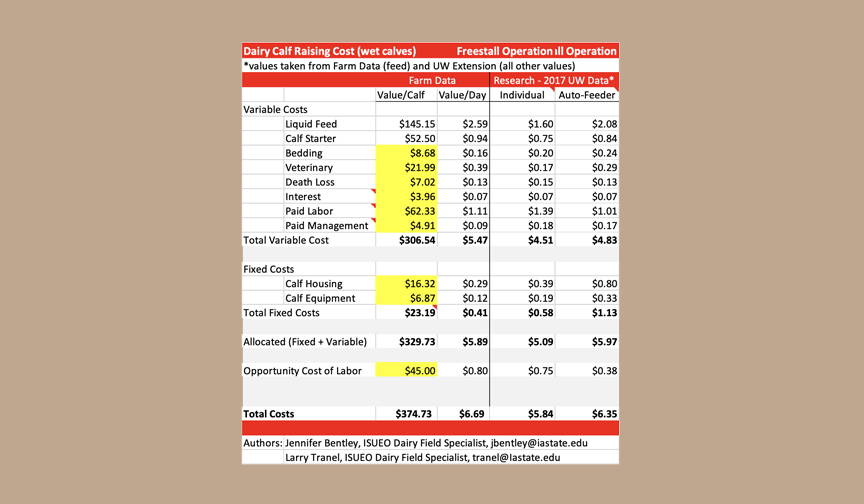
Bedding, Veterinary, Death Loss, Interest, Paid Labor, and Paid Management are variables that need to be calculated by user. In this example, an interest rate of 4.5% annually; a paid labor rate of $14.50 per hour; and paid management rate of $22 per hour was used. A typical range for feeding/cleaning labor is 5-10 minutes per calf per day in individual housing and about a minute per calf per day in an automatic calf feeding system. Paid Management includes labor and records management and can be factored in at approximately ½ hour/day, depending on herd size and feeding system used.
Table 1 Above. Calf Raising Costs
Fixed costs include calf housing and equipment. Costs used to determine housing include homemade calf hutch at $200; purchased calf hutch at $400; greenhouse barn at $10 per square foot; and/or post-frame calf barn at $15.50 per square foot. Investment values are fully depreciated on new facilities. Opportunity costs of labor need to be considered relative to paid labor costs. Notice there is a highly significant difference between custom growers and farm operators on total labor cost.
Farm data is input on the far right of the table, while 2017 UW research data is noted on far right to include individual feeding or auto feeding averages. The majority of the owner farms and custom grower farms utilized pasteurized waste milk (valued at $5/cwt), lowering their liquid feed cost considerably. The study can be found at: https://eauclaire.extension.wisc.edu/files/2018/05/ICPA-2017-AFS-Whitepaper.pdf


Be the first to comment