
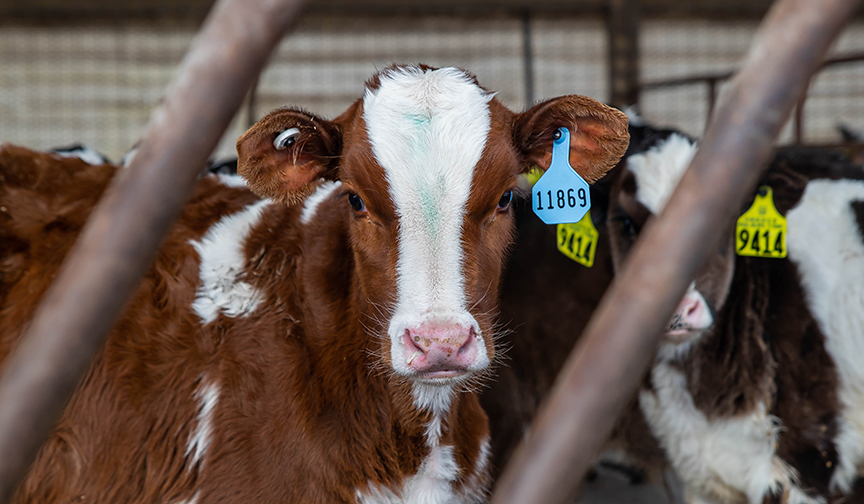
One key stressor in a calf’s life is the move from individual pens or hutches to group housing. It’s important to take precautions to reduce the stress that calves may experience at this time.
By implementing management practices to help reduce stress and optimize immune function, producers can help calves stay healthy through the transition to group housing. Key factors to consider are quality nutrition, optimal environment and effective immunization against disease.
1. Provide consistent, quality nutrition.
Calves need the right nutrients at the right time for optimum growth, health and temperature regulation. Since it’s typically easier to observe feed intake with individual housing, be sure to adjust your labor needs to monitor calf growth effectively in groups.
In terms of expected growth, the standard practice is to ensure >/= 1 lb average daily gain (ADG) in the first week of life,1 with a goal of doubling birth weight by 56 days of age.2
Digestive problems are a common challenge for young calves. To help reduce or prevent gastrointestinal issues, consistent feeding practices and proper rumen development are critical.
· Because calves prefer routine, significant variation in feeding practices can cause digestive issues or fatalities. Be consistent with feeding time and temperature, as well as percent solids in the milk replacer, to help prevent gastrointestinal issues.
· Calves need two to three weeks to develop their rumen in order to completely digest solid feed. Begin by providing a small amount (a handful) of starter, gradually increasing it as calves consume each day’s starter amount. When calves are eating at least two lbs of starter for two or three days in a row, they’re ready to be weaned.3
· A recent study showed that calves gradually weaned from day 49 to 54 of the preweaning phase can experience a less dramatic change in average daily gain after weaning (1.83 lbs/day vs. 0.49 lbs/day.)4
Work with your nutritionist and veterinarian to evaluate your program and address any health or feed concerns.
2. Ensure a clean, well-ventilated, comfortable environment.
If calves are cold and wet, they need more energy to maintain their body temperature. On the other hand, warm and well-bedded calves can use their energy from colostrum, milk and grain to grow and develop.
· Stocking density for grouped calves is an important risk factor for illness and diarrhea. Research shows that calves with less than 3.28 ft2 have a 74% greater risk of developing diarrhea.5 Typically, grouped calves do better in smaller groups of six to nine animals,6 but this number can be increased in well-managed herds.
· It’s also important to provide adequate time between pen moves, giving calves ample opportunity to adapt to the new environment and social situation.
· Adequate ventilation in both cold and hot weather is critical for removing organisms and humidity from the air. Allow adequate air movement in warmer weather to decrease heat stress. In cooler weather, reduce the airflow to maintain the calves’ body temperature while ensuring sufficient fresh airflow to remove humidity and pathogens associated with respiratory diseases.
· Moist bedding can harbor pathogens and attract flies, especially in warmer weather. Bedding should always be clean and dry to provide less opportunity for pathogen growth as well as add comfort for the calf and serve as a barrier from the ground.
· Post-weaned heifers should have at least 35-40 square feet of bedded space, at least 12-18 inches of bunk space and at least 2-3 inches of water space.7
3. Follow effective vaccination protocols.
In pre-weaned dairy calves, diarrhea and calfhood pneumonia account for the bulk of health challenges, and respiratory disease accounts for almost half the deaths in post-weaned calves.
When calves are healthy, comfortable in their environment and vaccinations are properly administered, they can be effectively immunized and prepared for the challenges of stress and harmful pathogens when moved to group pens. Remember, vaccination is the act of
administering a vaccine to the animal, while immunization is defined as building a proper immune response through vaccination.
Protection starts at birth by feeding calves adequate amounts of colostrum that’s fortified with specific antibodies against pathogenic organisms.
· Immunize late-gestation dry cows and replacement heifers with a scours vaccine to fortify colostrum with antigen-specific antibodies to help reduce diarrhea risks in neonatal calves. Look for a scours vaccine with a flexible dosing window that offers the broadest spectrum of antigens associated with major bacterial and viral causes of scours in young calves. This includes rotavirus types G6 & G10, coronavirus types 1 & 3, Clostridium perfringens types C & D and Escherichia coli type K99.
Intranasal vaccines are administered directly into the calf’s nostrils, creating a mucosal immunity in the respiratory tract, which is functional and not interfered with by maternal antibodies from colostrum.8 Quality intranasal vaccines will begin to create protective immunity within three to four days after vaccination.9
· Administer an intranasal respiratory vaccine to newborn calves that includes protection against the most common respiratory viruses and bacteria: IBR, BRSV, PI3, Pasteurella multocida and Mannheimia haemolytica.
· Bovine Coronavirus (BCV) is a major contributor to scours and can affect calves less than 10 days old. It is recommended to use an intranasal vaccine for young calves to aid in the reduction of enteric disease caused by BCV.
Ensuring that nutrition, comfort and immunization are aligned to help minimize stress results in healthier, more productive calves that are better able to meet the challenges of a group environment.
Talk to your veterinarian, nutritionist and animal health representative about your calf health protocols.
References:
1. Dr. Terri Ollivett, Department of Medical Sciences, University of Wisconsin-Madison School of Veterinary Medicine, presentation at the DCHA Annual Meeting, Minneapolis, Minnesota, 2022.
2. Van Amburgh, Mike. What have we learned about calf nutrition and management over the last 10 years: A lot! American Association of Bovine Practitioner, 2009.
3. Jones, C. M. & Heinrichs, J. Rumen Development, Don’t Wean Calves Without It! Penn State Extension. 2023. https://extension.psu.edu/rumen-development-dont-wean-calves-without-it.
4. M. A. Steele, J. H. Doelman, L. N. Leal, F. Soberon, M. Carson & J. A. Metcalf. Abrupt weaning reduces postweaning growth and is associated with alterations in
gastrointestinal markers of development in dairy calves fed an elevated plane of nutrition during the preweaning period. J. Dairy Sci. 2017. 100:5390-5399.
5. Bendali, F., Sanaa, M., Bichet, H. & Schelcher, F. Risk factors associated with diarrhea in newborn calves. Vet. Res. 1999. 30, 509‐522.
6. Svensson, C. & Liberg, P. The effect of group size on health and growth rate of Swedish dairy calves housed in pens with automatic milk‐feeders. Prev. Vet. Med. 2006. 73, 43‐53.
7. Cornell Cooperative Extension Southwest New York Dairy, Livestock & Field Crops Program. https://swnydlfc.cce.cornell.edu/submission.php?id=1491&crumb=dairy%7C1.
8. Osman, R., Malmuthuge, N., Gonzalez-Cano, P., Griebel, P. Development and Function of the Mucosal Immune System in the Upper Respiratory Tract of Neonatal Calves. Annual Review of Animal Biosciences. 2018.
9. Kesl, L., Saltsman, R., Burdett, B., Nordstrom, S., Xue, W. Determination of the Number of Days from Vaccination to Challenge Required for Protection from Infectious Bovine Rhinotracheitis (IBR) Virus Challenge Following Vaccination with Onset 5 IN and Vista 5 SQ in 13–30 Day Old Colostrum Deprived Calves. Publication pending. World Buiatrics. 2022.
© 2023 Merck & Co., Inc., Rahway, NJ, USA and its affiliates. All rights reserved.
Be the first to comment