
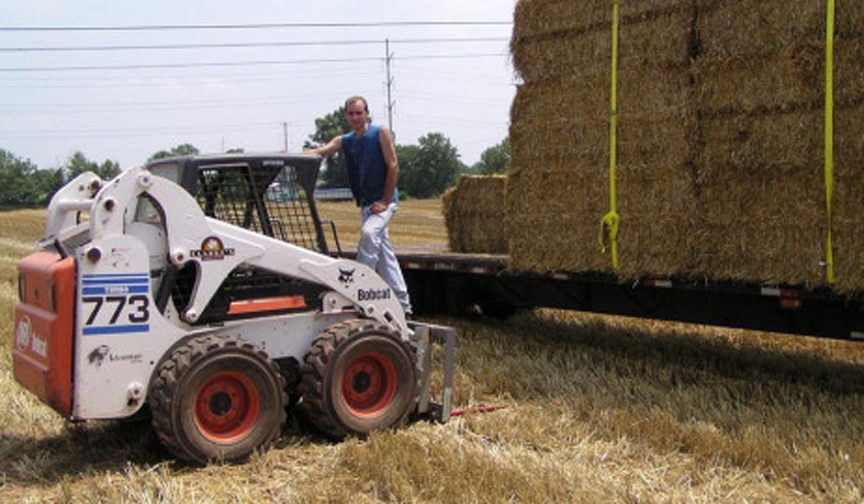
With fertilizer prices at near record levels the nutrients removed by baling straw is much more significant than it was in previous years. What’s your breakeven point for wheat straw?
If wheat straw is spread and not baled, each ton will return 11 pounds of N, 3 pounds of P2O5, and 20 pounds of K20. The nitrogen will not be immediately available for uptake, the P2O5 is not too significant, but the K20 certainly is. If two tons of straw is left on the field 40 pounds of K20 is returned to the field. At $0.75 per pound of K20 that is $30 per acre plus the organic value of the carbon going back on the field.
Another way to recover some of the K20 from the straw is to spread the straw out the back of the combine, allow it to rain on it, and leach some of the K20 from the straw into the soil then rake it up and bale it. Is that worth recovering some of the $15 per ton of K20? Not likely if you are planning to sell your straw, you will likely take a larger loss on your price per ton you receive, compared to the other farmer with bright yellow straw.
The take-home message is whether you bale your straw or not, make sure you have enough K20 for the next crop. Extension Educators have reported across the state it is not too uncommon to see K20 deficiencies in corn and soybeans.


Be the first to comment