

Heat and drought conditions have stunted the regrow of grass hay fields. What factors should a farmer consider before harvesting a short second cutting?
Some things to consider for drought-stressed grass hay fields are the type of grass, the estimated yield, the forecast, the value of the hay, the cost of making the hay and fertility. Orchardgrass and tall fescue are probably the most drought tolerant grass species grown in Pennsylvania. Their growth will slow down but when adequate moisture returns, they will regrow quickly with little stand loss. Just like grazing, be careful not to mow too short during a drought, leave 3-4” of stubble height so the plant has energy reserves to regrow. How much growth is too much to leave and impact the quality of the next cutting? That is a personal preference. Recently I baled a field of 2nd cutting orchardgrass that yielded 900 pounds of 10% moisture dry hay to the acre. We felt like that was enough yield of very good quality to justify cutting and baling. We felt it was too much to leave on the field for another week or two and see what happened with the weather and it was already starting to get a few brown tips on the leaves.
Consider a 1 ton yield (40# small bales and 667 pound large square bales)
Small bales – mow $20, rake $10, bale $62.5 (1.25 x 50) = $92/acre to harvest not including handling
Large Squares – mow $20, rake $10, bale $36 (3 x 12) = $66/acre to harvest not including handling
Consider a 1/2 ton yield (40# small bales and 667 pound large square bales)
Small bales – mow $20, rake $10, bale $31 (1.25 x 25) = $61 /acre to harvest not including handling
Large Squares mow $20, rake $10, bale $18 (1.5 x 12) = $48/acre to harvest not including handling
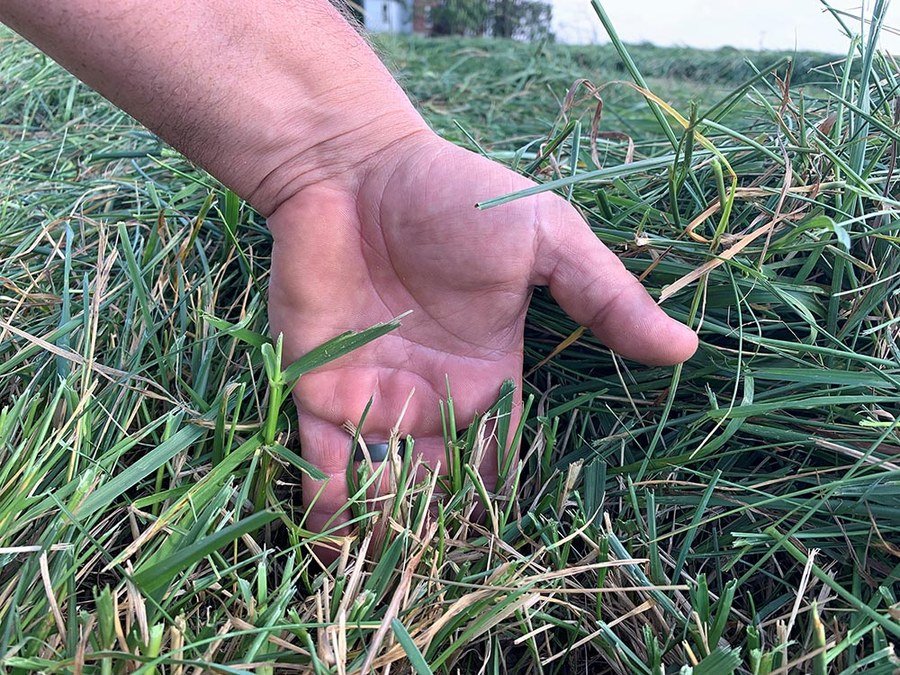
Good mowing height. Photo: Andrew Frankenfield
Fertility Considerations
One ton of grass hay removes 50 units of nitrogen, 15 units of phosphorus, 50 units of potassium from the soil. If you fertilized for a ton or 1.5 tons of hay and you harvest only half of that there will still be some residual fertility remaining for the next cutting. Take that into account when you fertilize for your next cutting. Fertilizer prices have come down some in the past couple months, but it still isn’t cheap. Applying fertilizer to a hay field that has mostly gone dormant due to drought is probably not a good idea. At this time, it is best to plan how much fertilizer you will apply when the rains return and apply that once we see the weather pattern change that brings more frequent rainfall.
Grass is very responsive to rainfall; we still have an opportunity for decent cutting in September if the rains return in August. Don’t lose hope. It will rain again before too long and the grass will regrow.

Be the first to comment