
According to the IFCN, feed cost is a major concern for most farmers in the world. Therefore, increasing efficiency in converting feed nutrients to milk, fertility, and health has never been of greater importance.
Reducing production cost does not always mean spending less, but rather spending smarter. Feed additives and services can help farmers to make smart decisions to enhance milk yield, feed efficiency, reproduction, and health, while reducing the incidence of diseases, which maximises productive life and reduces medication costs.
Precision nutrition
In the dairy business, precision nutrition has become essential to progressively increase production, without negatively impacting cows’ health. Knowledge of the rumen biochemical routes plays in favour of the nutritionist, who can understand which processes and factors can accelerate or limit ruminal fermentation.
Imagine the rumen fermentation process in a cow’s digestive system as a car engine. Just like pressing the accelerator pedal can rev up the engine and increase its speed, certain factors can maximise rumen fermentation. These factors act as the accelerator, fuelling the breakdown of feed and promoting efficient digestion.
However, just as it is important to release the handbrake before accelerating the car, there are processes that can limit or even halt rumen fermentation if not properly managed.
Neglecting these processes is like leaving the handbrake engaged while trying to speed up the car.
It creates resistance and prevents the engine from running smoothly.
Therefore, it is crucial to address these limiting factors, akin to releasing the handbrake, in order to maintain an optimal rumen fermentation rate.
This ensures efficient nutrient utilisation and maximises the cow’s digestive capabilities, similar to how releasing the handbrake allows the car to operate at its full potential.
Nitrogen use in nutrition
In dairy cows’ nutrition, efficiency in nitrogen use is an important topic. 75-95% of the dietary nitrogen consumed as feed protein is excreted. This nitrogen is wasted because ruminants are generally unable to use nitrogen efficiently, and this has a major impact on performance, profitability, and the environment.
The controlled and continual supply of ruminal ammonia provided by Optigen, a non-protein nitrogen source to the rumen over time, serves to meet the nitrogen needs of rumen microbes more effectively than other sources.
This ensures that rumen bacteria have continued access to this essential source, leading to a more efficient use of dietary nitrogen, an increase in the microbial protein supplied to the animal and reduced nitrogen excretion.
Reducing environmental impact
In addition, the ever-increasing pressure on farmers and the whole industry to meet the global commitment to reduce the environmental impact, results in us looking for solutions and technologies that can help us achieve this goal, while remaining financially viable.
To provide further clarity on this topic, a new ruminant meta-analysis addresses dietary protein use, carbon footprint and profitability.
The findings from the meta-analysis investigating the impacts of Optigen supplementation in dairy cows comprise data derived from 17 studies conducted across six countries.
Dairy research key findings included:
- Enhanced nitrogen capture in the rumen leading to a 4% increase in nitrogen utilisation efficiency.
- Reduction of nitrogen excretion in manure by 12-13g per cow/day.
- Meta-analysis based simulation: 1,000 cows supplemented with Optigen would increase income over feed costs by US$18,000 and reduce the carbon footprint by 657 tonnes of Co2e.
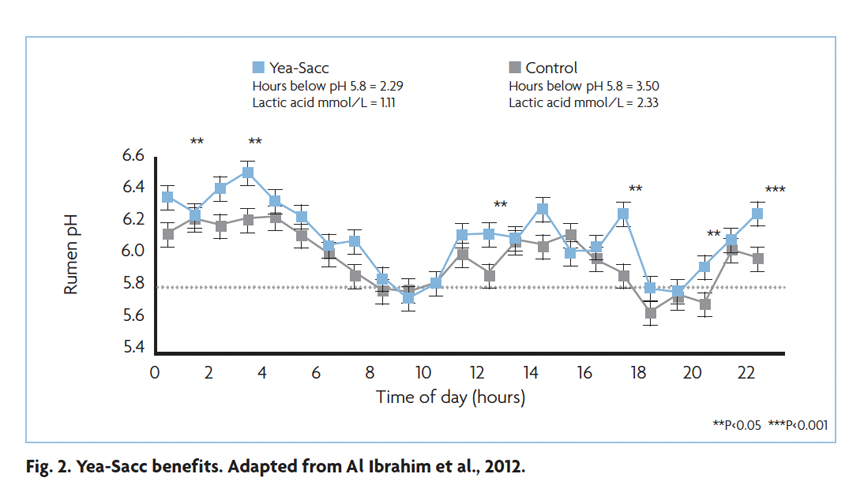
A digestive disorder that can limit and reduce nutrient utilisation efficiency is subacute acidosis (SARA), which acts as a rumen handbrake on microbial growth and feed digestibility.
This limiting process occurs when ruminal pH is not controlled, and the environment remains acidic for a long time. When the pH drops below 5.8, microbial life is under stress.
Using yeast for performance
Yea-Sacc is a yeast culture based on Saccharomyces cerevisiae strain 1026, a strain specifically selected for its influence on animal performance.
This feed additive contributes on the acrylate pathway to the formation of propionate from lactate in the rumen of cattle, which helps to control rumen pH and enhance milk yield.
The Alltech yeast strain can help producers to:
- Promote digestion and utilisation of nutrients.
- Sustain higher milk production.
- Reduces fluctuation in pH and keeps rumen microbes steadily active, which speeds feed digestion and rumen turnover, allowing greater intake.
- Promote the growth of fibre-digesting bacteria in the rumen, thereby supporting the rate of forage breakdown.
- Provide consistent and highly cost-effective returns through greater performance.
The Yea-Sacc Value Test is a valuable tool that allows us to compare a total mixed ration (TMR) both with and without Yea- Sacc. In addition, an in vitro fermentation model (Alltech IFM) for ruminants rations that simulates rumen fermentation and allows producers to receive a customised report assessing a ration’s digestibility and potential for optimal rumen function helps increase the precision of yeast supplementation.
This nutritional tool can allow to troubleshoot ration problems quickly and identify opportunities to improve efficiency, leading to improved ration formulation, better performance and increased profitability.
Other technologies
Recent studies show other technologies that can be worked on in the optimisation of rumen fermentation, such as the use of enzymes, such as Amaize, which increased 2.2lbs of milk yield in the latest assessment of Alltech enzyme use in dairy cows.
And the total replacement of inorganic trace minerals with Alltech organic trace minerals, even in reduced levels, increased milk yield in 7.2lbs between the weeks 5 to 8 after calving.
On the other hand, some technologies can help producers to avoid other limiting factors in rumen fermentation.
Mycotoxins are toxic compounds produced by moulds, and some of them have antimicrobial activity, such as toxins from Penicillium, which can reduce VFA concentration in the rumen.
Mycosorb A+ is the next generation of mycotoxin binder, offering superior binding capabilities, a broader adsorption profile and increased efficacy, which can help the rumen to avoid the negative impacts of this challenge.
The Carbon Trust, a carbon footprint authority, recently validated several Alltech products, including Optigen, Mycosorb A+ and Yea-Sacc, for their role in helping to reduce greenhouse gas emissions from livestock.
This validation can complement peer-reviewed research to support technical recommendations for the environmental benefits of the technologies.
Conclusion
In conclusion, the precision nutrition of dairy cows can rely on technologies and services available to improve formulations and ensure efficient production, animal health, profitability, and care for the environment.
Be the first to comment