
On Friday, November 20, Federal Crop Insurance Corporation Board of Directors approved changes to Dairy Revenue Protection that are very important for dairy producers in California, Texas, and Illinois.
The forecast model, used to project milk per cow yields, was updated to reflect recent structural changes in the dairy industry. In particular, we believe that three factors have led to accelerated growth in milk per cow yields in these states: genomic testing, sexed semen, and breeding program improvements which increased pregnancy rates. These innovations, working together, meant that producers could improve genetic potential of their herd at a faster pace. In California and Illinois environmental rules are presenting ever higher hurdles for dairy farm expansions. As such, it becomes even more important to increase cow productivity.
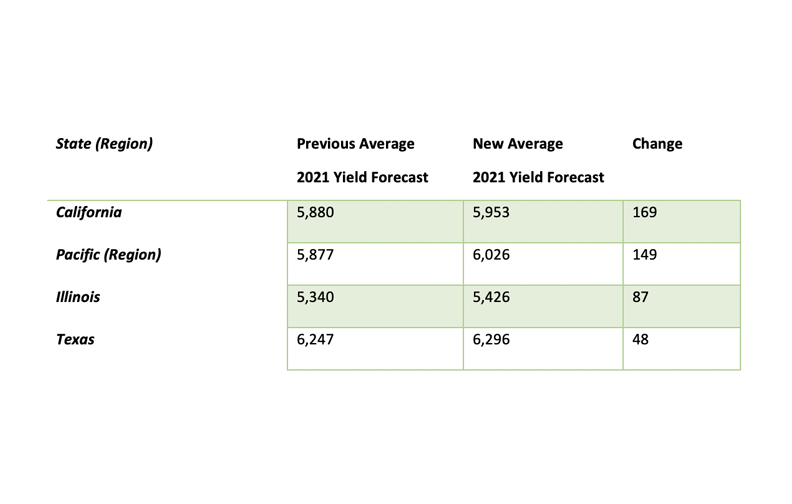
In other parts of the country, different dynamics can be observed. Milk per cow yields have been growing more slowly in Wisconsin over the last three years then in the preceding decade. Similar patterns characterize yield dynamics in Michigan, New York, and multiple other states. However, unlike California and Illinois, for states experiencing lower yield growth rates in recent years it is more challenging to disentangle structural factors from adverse transient factors.
Among structural factors we find a shift in producer mentality – away from chasing high yields, and with new focus on total milk solids shipped. As nutrition systems are reimagined to rely more on forages, producers find it possible to achieve higher income per cow, without strong growth in milk per cow. It is not clear, however, how much of the recent tempering in yield growth in Midwest and Northeast is due to those structural factors, and how much was simply a confluence of new regulations, market demand shocks and poor weather – problems with forages, removal of rBST, multiple consecutive years of low milk prices, and two-tier pricing systems introduced in 2020 due to COVID-19 and reduced market
demand. For all these reasons, we deemed it prudent to wait with pursuing any adjustments to yield forecast models for these states.
Dairy Revenue Protection delivered meaningful help to dairy producers in 2020. Based on the latest market data, I estimate that total gross indemnities will be higher than 490 million dollars, against 138 million dollars producers paid in premiums. Changes approved last week will ensure that DRP remains actuarially sound, and the most attractive tool for dairy producers seeking to secure their income in 2021 and beyond.
The author is Assistant Professor, Department of Applied Economics, University of Minnesota-Twin Cities. His work has been key to the development of the Dairy Revenue Protection Program. He can be contacted at mbozic@umn.edu or by phone at (612) 624-4746. For more information, see the website https://dairymarkets.org

Be the first to comment