
Unhappily, the short answer is “no”
Compared to Sept-2014, Class III milk price will likely increase a few cents. It is currently projected at +$0.13. This is supported by cheese as whey is down $0.27/lb which is a 40% reduction in value. Class IV price is $9 lower which is being driven by a 50% reduction in butter price and a 20% reduction in NFDM price compared to Sept-2014. So, the fundamentals for the Nov-2020 USDA prices are significantly different from Sept-2014.
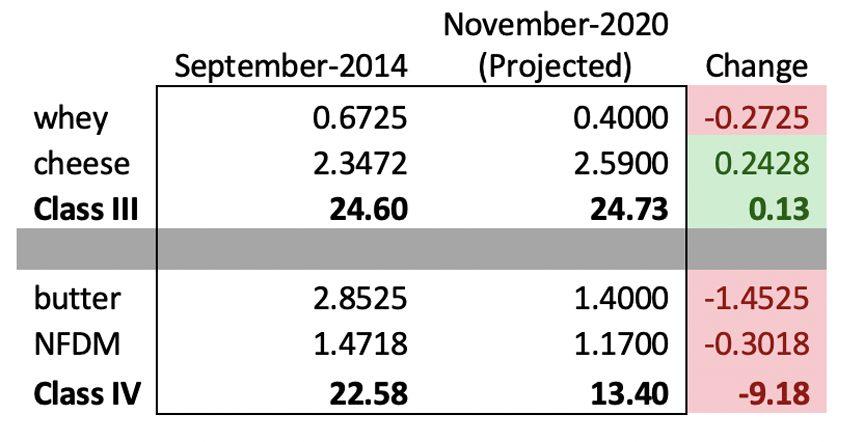
Each of the Federal Orders have different utilization of milk; therefore, there will be winners and losers in this analysis. Figure 1 contains an approximation of how the Nov-2020 USDA milk price for each Federal Order will compare to Sep-2014. Orders with high Class III utilization (e.g., 30, Upper Midwest) will have the smallest difference (-$3.60) while the orders with the highest Class IV utilization (e.g., 51, California; 33, Mideast; 126, Southwest; 131, Arizona) will have the largest difference ranging from -$6.56 to -$8.02 lower than Sept-2014.
There is an old saying in the dairy industry that “High prices lead to low prices”. There is a lot of anxiety around the high cheese prices leading to uncontrolled expansion. The USDA price for Order 1 (Boston) in Sept-2014 was $26.15 and $18.78 earlier this year for Jan-2020. Nov-2020 is projected about $21.00 which is strong, but only $1.20 above the pre-pandemic 2020 number. Most importantly, dairies need to consider the USDA price, not only the Class III price, when evaluating strategic plans.
November 2020 vs September 2014

Figure 1. Change in USDA milk price from Sept 14 to Nov-20
[1] Dr Jones operates theCWTgroup.com web site which has a weekly podcast on milk prices and milk pricing. He is also the vice-president of FARME Institute, Inc and employed by American Farm Products. He can be contacted at 607.591.9727 and ljones@afpltd.net.
Be the first to comment