

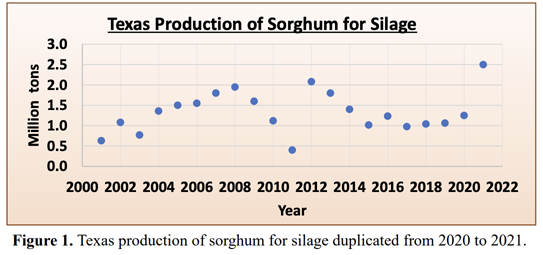
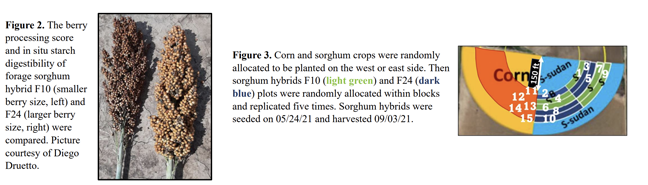
Corn and two forage sorghum hybrids were evaluated: 1) F24, larger berry size and 2) F10, smaller berry size (Fig. 2). Plots were blocked by irrigation section, and sorghum hybrids were randomly allocated within blocks and replicated five times (Fig. 3). Forage sorghum hybrids were harvested at soft dough stage, 30% dry matter and using kernel processors set 2 mm apart. Whole plant and chopped (processed) samples were obtained the day before and at harvest, respectively. Whole and processed grain samples were screened to determine particle size distribution.
Three important questions were answered with this study:
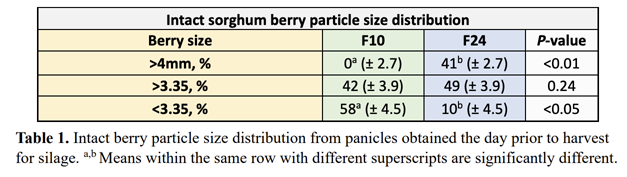
1) Were berries from forage sorghum F24 bigger than F10? Yes, we did a particle size separation of the intact berries (obtained one day before harvest) with two consecutive sieves (4 mm and 3.35 mm) and a pan. Before harvest, F24 had less intact berries passing the 3.35 mm sieve compared to F10, validating the larger berry size on F24.
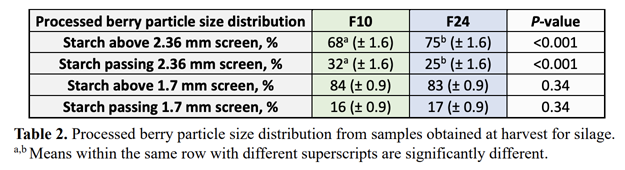
2) Did berry processing score of F24 and F10 differ? There was very little difference in favor of F10. Two different sieves were used: 1) 2.36 mm sieve: more starch from processed berries from F10 passed the sieve compared to F24; 2) 1.7 mm sieve: no difference. Considering the initial size of the F24 berry was significantly bigger and starch from processed berries passing the 1.7 mm screen did not differ between hybrids, this could indicate potentially more F24 berries were broken compared to F10.
3) Did F24 have better starch digestibility than F10, and how do they compare with corn? There was no difference in starch digestibility between F24 and F10. Corn had better starch digestibility compared to both forage sorghum hybrids.

Discussion and Future Directions
Results from this study suggest that increasing sorghum berry size, at least for the size difference of the two forage sorghum hybrids compared, might not increase in situ starch digestibility. Future research should evaluate the effect of using hybrids with larger berry size than F24. In addition, the ratio of the panicle to vegetative parts (leaves + stems) of sorghum vs. corn was very different (30:70 vs. 45:55), and this might have affected berry processing. Hence, future research should also assess the value of using a sorghum hybrid with a 45:55 panicle to vegetative parts ratio on starch digestibility.
Acknowledgements
Contribution from Drs. Luiz Ferrareto (U. of Wisconsin, Madison, WI), John Goeser and Elizabeth Coons (Rock River Laboratory, Inc., Watertown, WI) and Diego Druetto (Richardson Seeds Ltd., Vega, TX) is gratefully acknowledged. This work was supported in part by the United Sorghum Checkoff Program, Richardson Seeds Ltd. and Rock River Laboratory.
References
1 USDA-NASS. 2001-2022. Crop production 2001 to 2021 Summary reports. 1 J.M. Piñeiro, J. Bell, L.F. Ferraretto, D. Druetto, J. Goeser, E. Coons, A. Hart. 2022. The effects of increased sorghum berry size on berry processing score and starch digestibility. J. Dairy Sci. (accepted for publication)



Be the first to comment