

The prior post analyzed the exports of cheese. The largest importer of U.S. Cheese is Mexico. Mexico’s adjourning border makes deliveries no more expensive than deliveries to the U.S. But Mexico cannot continue to accept the large volumes sent in the first four months of 2026. If cheese production continues to exceed domestic consumption in the U.S., higher priced transportation customers will have to be used.
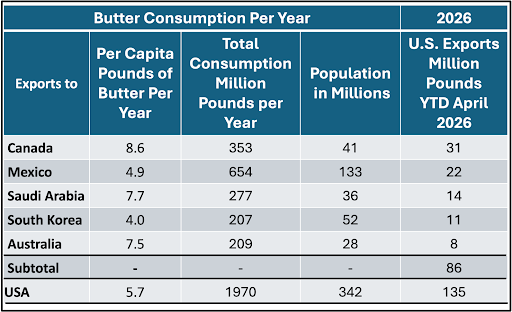
This post will analyze the exports of butter. Like cheese, the U.S. is producing more butter than domestic consumption. Table I at the bottom of this post shows the data used in this analysis.
Canada and Mexico are at the top of the list for U.S. exports of butter. Together they represent 39% of the U.S. butter exports in 2026 YTD through April.
U.S. exports of butter to Canada will remain stable.
Mexico produces approximately 558 million pounds of butter annually. Consumption is approximately 654 million pounds. The balance is primarily filled by imports from the U.S. Currently, at the 2026 rate, the U.S. will export approximately 66 million pounds of butter to Mexico which would cover approximately 10% of the domestic consumption.
Getting butter from the U.S. as compared to Europe or New Zealand is a good financial move for both the U.S. and Mexico.
U.S. exports of butter to Mexico will remain stable.
To continue the current pace of butter exports to Saudia Arabia, competitive prices including transportation costs will be necessary.
South Korea consumes approximately 210 million pounds and produces approximately 132 million pounds of butter, that leaves a void of approximately 78 million pounds which must be imported. New Zealand is close and is a major exporter of dairy products. The U.S. must be a low-cost supplier and absorb the high transportation costs.
Australia represents only 6% of the U.S. exports of butter and 4% of their consumption. In terms of size, the export/import amounts sold to Australia begin the long list of small importers. Imports to Australia and the other 75 small butter importers have a minimal influence on butter and butterfat pricing in the U.S.
Butter exports to Canada and Mexico can be profitable as competition from New Zealand and Europe require significant transportation costs. Other U.S. exports of butter must face competition primarily from New Zealand. The one advantage the U.S. has is that California produces approximately 30% of U.S. butter and that does shorten the distance to some of the current butter importers.
Data in the Table below was used for the above analysis.


Be the first to comment