
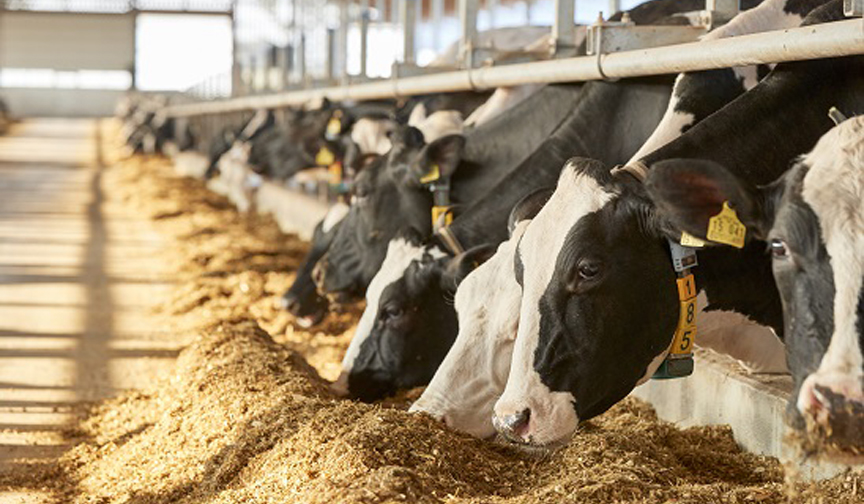
Evonik was first to introduce the amino acid balancing concept in the animal nutrition market. It consists of matching livestock feed to exact physiological needs by precisely supplementing amino acids rather than overfeeding crude protein. How do cows fulfill their protein requirements? How do protein feeding strategies impact animal health, farm profitability and sustainability?
Metabolic amino acid sources and requirements for lactating dairy cows
Cows do not have a requirement for crude protein (CP), but for amino acids (AA). The supply of these AA comes from the rumen microbial protein outflow and the rumen undegradable feed protein (RUP; bypass). To ensure proper metabolic functions, the proportion of these two
Among all the essential AA required for the maintenance, growth, pregnancy and lactation of the cow, methionine (Met) and Lysine (Lys) were shown to be the most limiting ones, due to their low concentrations in the main feed proteins and high concentration in milk. To fulfill their requirements, several dietary strategies can be used on farms.
Dietary strategies to ensure proper metabolic AA supply
Feeding high protein diets is one dietary strategy that can ensure nutritionists fulfill all AA requirements of the dairy cow. However, such strategy comes with several drawbacks. First, there is a high risk that the proportion of rumen-degradable protein (RDP) and/or non-protein nitrogen becomes excessive, leading to high rumen ammonia concentrations. To evacuate this excess, ammonia will be converted into urea before being excreted via the urine. This process has a high energetic cost! As a consequence, the metabolizable energy balance can be impacted, which can be even more dramatic in regions of the world where energy availability is already limited. Beyond this metabolic inconvenience, excessive urinary nitrogen excretion leads to environmental issues: overloading aquatic systems with urea and ammonia drives rapid eutrophication, severe oxygen depletion and hazardous nitrate contamination in drinking water.
Illustration of the amino acid balancing concept
Using NDS formulation software (nutritional model based on CNCPS recommendations), let’s compare two rations (Table 1) fed to multiparous Holstein cows weighing 703 kg, eating 26 kg/d of dry matter, and producing 39.0 kg/d of milk (3.98% milk fat, 3.48% milk total protein) at 120 DIM. These two rations were designed to ensure:
- similar supply of fiber and starch (in terms of quantity and fermentability);
- a sufficient metabolizable energy (ME) and protein (MP) supply, meeting at least 100% of the animal requirements;
- similar levels of rumen ammonia load and proportion of MP from microbial origin;
- similar levels of metabolizable Met and Lys.
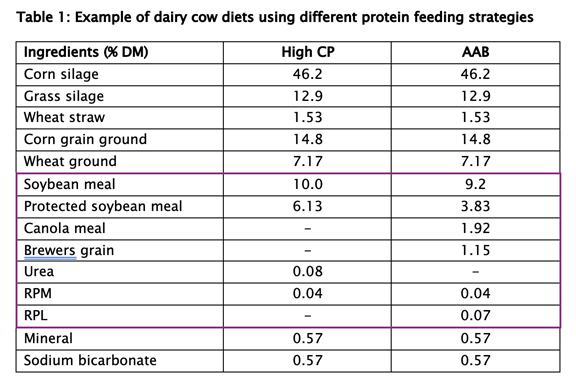
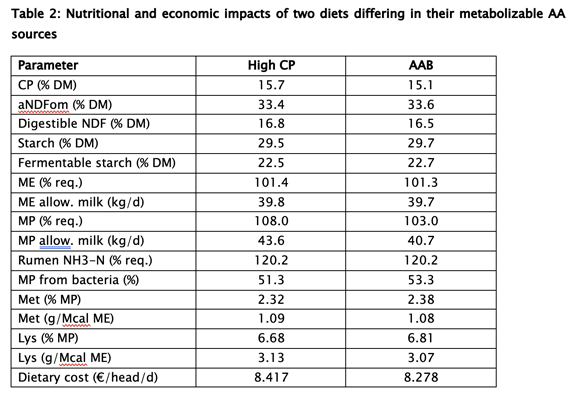
These two diets differ in their AA sources, with the high CP diet (15.7% CP in DM) meeting the metabolizable Met and Lys requirements thanks to a high inclusion rate of soybean-based proteins and RPM. Oppositely, the CP level of the AAB diet was reduced by 0.6 percentage points (15.1% CP in the DM) while nutritional targets were met with RPL addition (Table 2). Interestingly, the AAB diet was 0.139€ cheaper than the high CP diet. Despite the estimated small difference in milk yield (0.1 kg/d, equivalent to a loss of 0.04€/d assuming a milk price at 400€/T), the AAB diet brings an additional revenue of 0.099€/d. For a 500-cow farm, this would represent an additional revenue of more than 1,400€/month.
How to choose your rumen-protected amino acids?
Another important criteria is the stability of the rumen-protected AA in feed. Mixing in minerals or silage might create abrasion and/or damage the coating, impacting the rumen bypass of the product. Finally, product costs should be compared on a metabolizable AA content. A cheap product with a low metabolizable AA content might not be a profitable solution compared to using a more expensive product with a high load of metabolizable AA. Evonik has extensive expertise in amino acid balancing for ruminants. For instance, the formulation of Mepron®, Evonik’s RPM, is designed to maximize methionine bioavailability, helping dairy producers improve nutrient efficiency and optimize feed costs.
In conclusion, the AAB concept for dairy cows supports the profitability of dairy farmers while increasing the sustainability of livestock farming. However, this feeding strategy can only be applied with accurate diet formulation and reliable rumen-protected AA.
Discover more about Evonik’s offering for ruminants here.

Be the first to comment