
Research and practical feeding programs support higher milk response, improved protein efficiency and flexible inclusion levels throughout the lactation cycle.
Milk response and protein efficiency
University research consistently shows that canola meal increases milk production compared with other vegetable proteins, with expected milk responses of 1.5 to 5.3 pounds per cow per day. Field trials have also shown improved income over feed cost (IOFC), demonstrating canola meal’s value as a practical protein source.
“When rations are balanced for amino acids along with overall nutrient needs, canola meal gives dairy producers and nutritionists flexibility throughout lactation,” says Essi Evans, Ph.D., E+E Technical Advisory Services. “Its consistent protein contribution and balanced amino acid profile readily support milk production and efficient protein use, and field results often show a stronger cow response than standard feed formulation models predict.”
Exceeding model expectations
Newer methods for measuring rumen undegradable protein (RUP) indicate that canola meal has a higher RUP value than older feed tables suggest, providing a more accurate estimate of its metabolizable protein contribution. This helps explain why dairy herds often produce more milk than standard nutrient models predict.
Canola meal can help dairy producers:
- Increase milk production using the same or lower protein input as other meals
- Improve protein efficiency
- Reduce nitrogen waste
- Support environmental sustainability
- Boost profitability
Flexible inclusion across lactation stages
“The optimal inclusion level depends on the complete ration,” says Dr. Evans. “Research and practical feeding programs show that canola meal can make up as much as 20% of diet dry matter when rations are properly balanced for intake, protein, amino acids and overall nutrient supply. This flexibility allows dairy producers and nutritionists to adjust inclusion throughout lactation while supporting cow health, reproduction and milk production.”
Putting research into practice
The following practical feeding guidelines summarize common inclusion levels based on stage of lactation and production goals.
Fresh cows (0 to 21 days in milk)
- Goal: Support rumen health, reduce metabolic disorders and encourage dry matter intake.
- Suggested inclusion: 5.5 to 7.5 lb/cow/day (typically 12% to 16% of the ration dry matter).
- Outcome: Canola meal’s excellent palatability can help support feed intake during the fresh period, while its high RUP and balanced amino acid profile help meet early lactation protein needs without overfeeding total protein.
- Goal: Maximize intake, milk yield, persistency and protein yield.
- Suggested inclusion: 7.5 to 10 lb/cow/day (up to 20% of the ration dry matter, depending on protein needs).
- Outcome: Canola meal provides high levels of RUP and a balanced amino acid profile to support high-producing cows, potentially reducing the need for treated protein sources or protected amino acid supplements.
Mid lactation (121 to 220 days in milk)
- Goal: Maintain high production while improving feed efficiency.
- Suggested inclusion: 5.5 to 7.5 lb/cow/day (10 to 15% of the ration dry matter).
- Outcome: These inclusion levels can help sustain milk production, support efficient protein use and maintain body condition.
Late lactation (221 days in milk to dry off)
- Goal: Support body condition gain and prepare cows for dry off.
- Suggested inclusion: 3.5 to 5.5 lb/cow/day (8 to 12% of the ration dry matter).
- Outcome: At this stage, canola meal can help maintain rumen health and stable intake while supporting body condition.
Dry cows
- Goal: Support a smooth transition.
- Suggested inclusion: 1 to 3 lb/cow/day (6 to 10% of the ration dry matter).
- Outcome: With its low potassium level, favorable dietary cation-anion difference (DCAD) profile and balanced amino acid supply, canola meal can be a practical protein source in dry cow diets when incorporated into properly balanced rations.
Recommended canola meal inclusion levels
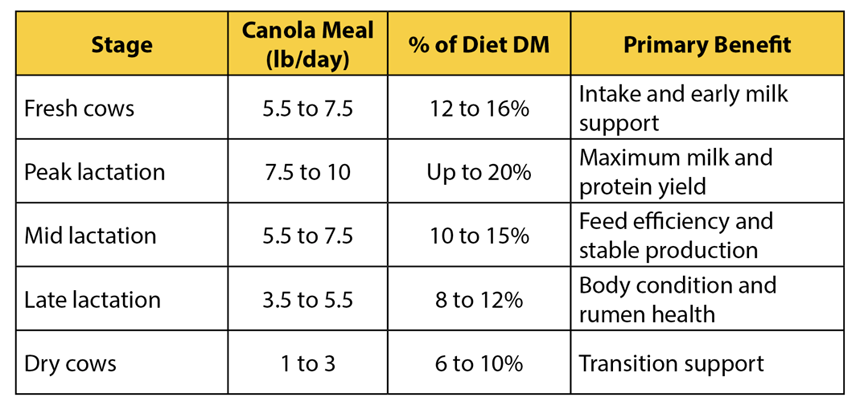
Research-based feeding strategies can help dairy producers improve feed efficiency, milk production and profitability. When incorporated into properly balanced rations, canola meal offers producers and nutritionists flexibility to adjust inclusion levels throughout the lactation cycle while meeting production goals.
To explore the research and learn more about how canola meal can support dairy performance, visit canolamazing.com.
Canola meal is a coproduct of canola processing and is approximately 42% crude protein on a dry matter basis, with a high bypass protein value and amino acid profile well-suited for milk production. Because of its high protein content, canola meal is often used as a protein supplement for animal feeds, including dairy rations. Visit canolamazing.com to learn more.

Be the first to comment