

Farm Real Estate Value
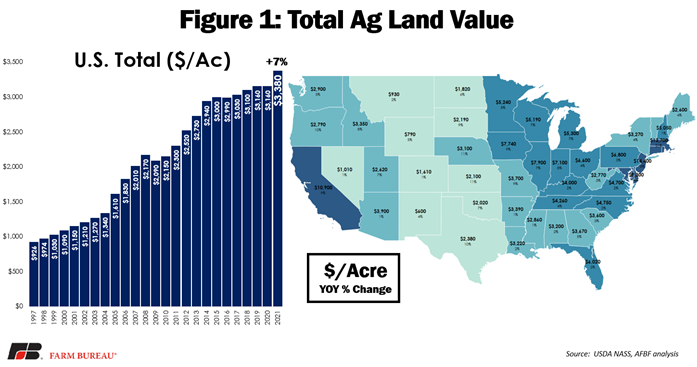
The U.S. average farm real estate value, a measurement that includes the value of all land and buildings on farms, clocked in at a record $3,380/acre. This 7% increase over last year represents a percentage change not seen since 2014 when values increased 8% over the previous year. In looking at the dollar value of the change, this is a $220/acre increase over 2020, a level not seen since 2012. These levels vary significantly throughout the country, with the highest real estate values concentrated in areas of the country with larger volumes of high-value crops (think wine grapes and tree nuts in California), as well as areas experiencing upward pressure due to proximity to urban areas. Much of the Midwest experiences higher levels of real estate values, followed by the South and Pacific Northwest, and finally the Plains and Mountain states. On a state-by-state basis, (excluding Northeast states with urban pressure), Nebraska, Kansas and Oregon all posted double-digit percentage changes over last year. These were followed by Texas, Iowa, California and South Dakota, each posting over 9% year-over-year growth.
Cropland Value
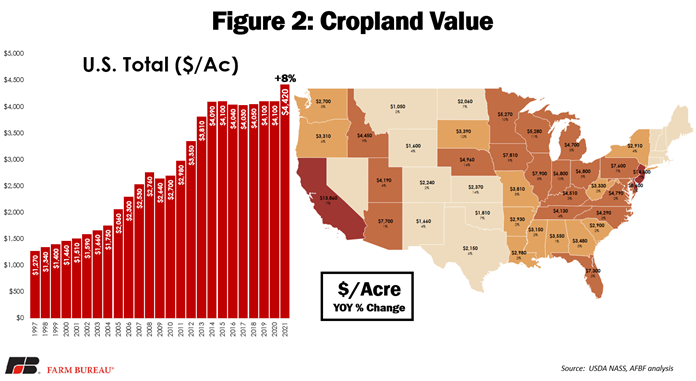
Like the overall real estate value, average U.S. cropland values posted sharp increases in 2021, rising to $4,420/acre. This increase came in as an 8% jump
Pastureland Value
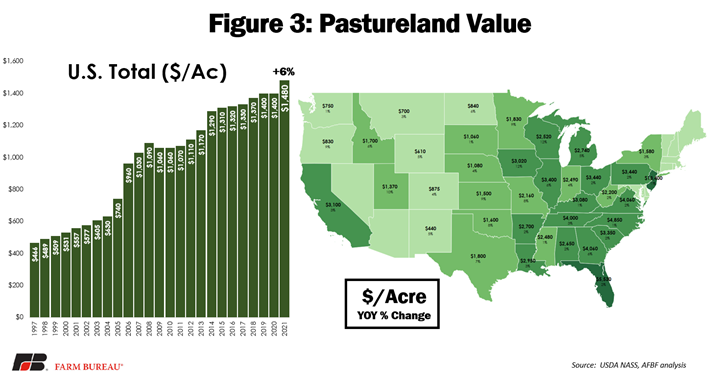
Similar to overall real estate values and cropland values, pastureland values posted strong gains from the previous year, coming in at $1,480/acre on average for the U.S. This is an increase of 6% over 2020, the highest increase since 2014, and follows six years of little to no increases in value. However, the distribution of pastureland values across the country differs from the cropland value and real estate values. Instead of the Midwest and California, some of the more valuable state averages are concentrated in the South and the mid-South, with the Midwest and the Plains states making up the next group of higher average values.
Cash Rent Increases
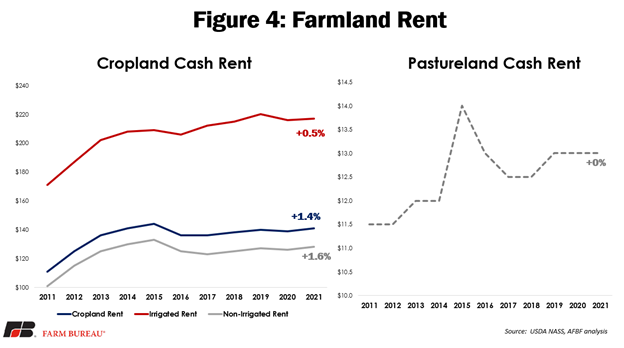
NASS also recently released data on cash rents that farmers pay, and so far the strong increases in land values have not trickled down to cash rents. This tends to be more of a lagging indicator, and likely will be reflected in future negotiations that producers have with their landlords. Average U.S. cropland rent increased to $141/acre this year, an increase of 1.4% over 2020. Irrigated cropland rents increased 0.5% to $217/acre, while non-irrigated cropland rents increased 1.6% to $128/acre. Cash rents for pastureland held steady from 2020 to 2021, coming in at $13/acre this year.
Summary
Friday’s land value report from NASS showed sharp increases across the board in agricultural real estate values, cropland values and pastureland values. The average U.S. farm real estate value increased by 7% over 2020, while the cropland value and pastureland value increased by 8% and 6%, respectively. These increases are the sharpest in six or seven years, with little to no year-over-year increases in the last several years. The same pressures that are affecting many sectors of the U.S. economy appear to be impacting farmland values as well. These levels vary significantly throughout the country, with the highest real estate values concentrated in areas with larger volumes of high-value crops, as well as areas experiencing upward pressure due to proximity to urban areas. So far, the increases in land values have not yet been reflected in cash rents, with the national average cropland rent increasing by 1.4% compared to last year.
Be the first to comment