
The T.C. Jacoby Weekly Market Report Week Ending August 13, 2021
The spot Cheddar block market found the gas pedal this week, moving convincingly upward. Spot block prices closed higher than the previous session on four out of the week’s five trading days. Yet, as cheese prices moved up at the CME this week, dry whey prices moved down.
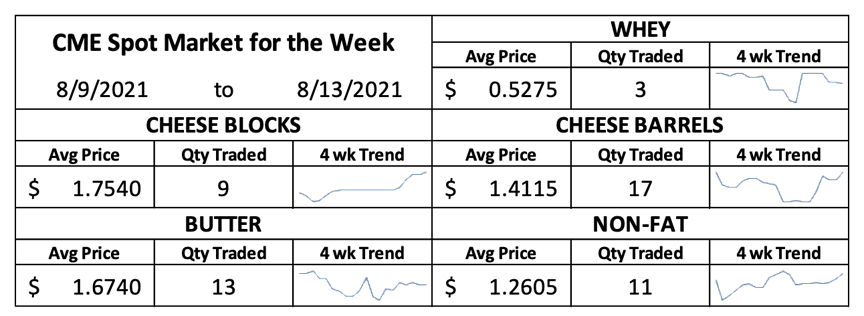
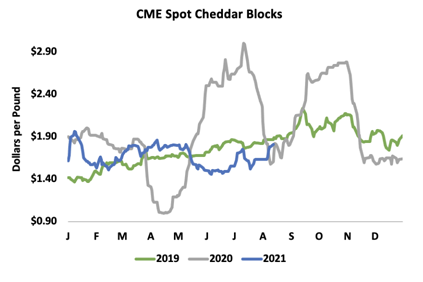 After remaining unchanged at $1.635/lb. for nine consecutive sessions, the spot Cheddar block market found the gas pedal this week, moving convincingly upward. Spot block prices closed higher than the previous session on four out of the week’s five trading days, ultimately settling on Friday at $1.8125/lb. This represents the highest price since mid-May and is a full 17.75¢ above last Friday’s price. After no product moved last week, nine loads traded hands this week. Not to be left behind, Cheddar barrels
According to market participants, cheese demand has remained robust from both domestic and international sources. Even as the Delta variant threatens to bring about new restrictions, consumers have continued to visit foodservice outlets while the return of summer fairs and festivals has also boosted demand. At the same time, a seasonal decline in milk production combined with increased demand from bottlers has left less milk available for cheese manufacturers. Dairy Market News cites that barrels are relatively more available than blocks, contributing to the widening spread.
Yet, as cheese prices moved up at the CME this week, dry whey prices moved down. Though nowhere near as dramatic as the precipitous drop seen last week, the spot market 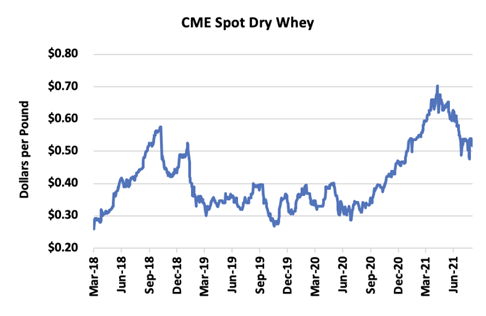 gave up 2¢ on Wednesday and another quarter cent on Friday to end the week at 51.75¢/lb., a decline of 2.25¢ compared to last Friday. Spot loads of dry whey are purportedly available for purchase and raw whey is still accessible, but dryers are noticing a decline in supplies as milk production contracts seasonally. Furthermore, robust demand from abroad and a continued pull of the whey stream toward higher value products could reduce the availability of dry whey, keeping upward price pressure on the market in the coming weeks.
 Movements among the Class IV products were more subdued. Cream availability has waned, but as ice cream production has also declined, butter churns are still able to get their hands on necessary cream supplies, albeit at higher multiples. Foodservice demand for butter has remained steady in spite of building concern around the Delta variant. Retail sales have also remained reasonable for the time of year and are expected to increase in the coming weeks as home bakers turn their ovens back on for the autumn season. During Monday’s spot session, butter rose by 3.25¢ as 11 loads traded hands. The spot price bobbled between $1.67/lb. and $1.68/lb. over the rest of the week, finally closing Friday’s trade at $1.67/lb., up 2.25¢ from last Friday.
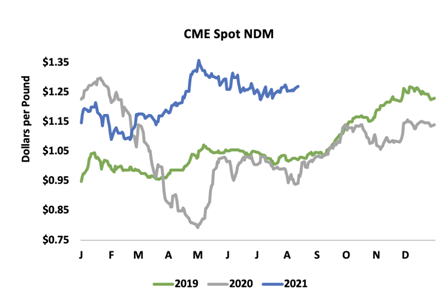 Nonfat dry milk (NDM) markets also found a nugget of strength over the course of the week, adding a penny and a half to end the week at $1.27/lb. with 11 loads moving. Domestic demand for NDM has improved, particularly from cheesemakers who are fortifying as milk supplies drop. International interest has been mixed as logistics issues continue to hound exporters of NDM and other dairy ingredients.
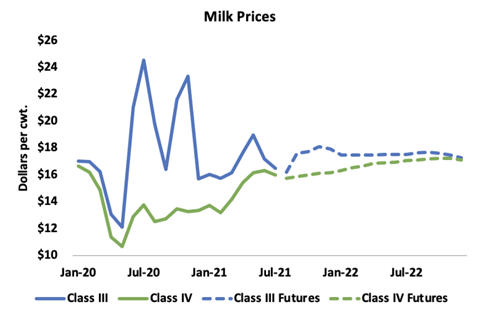
The tranquility of the butter and NDM markets translated into a relatively quiet week for Class IV futures. By the end of the week, most nearby contracts had shifted just a few cents with SEP21 seeing the largest gain, an increase of 24¢ on Friday versus Monday’s
settlement. The Class III markets were full of action, however, as dramatic movements in the spot Cheddar price played out in the milk futures market. Remaining 2021 contracts moved decisively upward on Monday and Tuesday with SEP21 rising by the 70¢ limit on Tuesday. Wednesday and Thursday brought price moderation but another upward leap on Friday led nearby contracts to settle substantively higher on Friday. For example, the SEP21 contract added $1.04 over the week to settle on Friday at $17.62/cwt.
Across the country milk volumes are declining seasonally. At the same time, students are returning to school, increasing demand from Class I, especially in the Southeast. Taken together, this has meant less spot milk available for manufacturing needs. Although cheese manufacturers and balancing plants are no longer running such full schedules, market participants comment that the break has taken some pressure off operators who have been coping with labor shortages, logistical challenges, and other Covid related issues for months now.
On Thursday the USDA released its World Agricultural Supply and Demand Estimates report infusing some excitement into the grain markets. On the corn balance sheet, USDA reduced the expectation for U.S. corn yields by 2.7% versus last month’s estimate to 174.6 bushels per acre. The decrease was greater than what most analysts had expected and led to a 415-million-bushel decline in U.S. corn production. Even as some use categories were also decreased the balance pushed ending stocks down by 190 million bushels and caused futures prices to rally.
The estimates released for soybeans were significantly more measured. Yield expectations were also lowered, but by just 1.6% to 50 bushels per acre. The resulting 66 million bushel drop in production was partially offset by a larger carryover increase in beginning stocks. A lower crush estimate and slower exports reduced estimated use, ultimately leaving ending stocks unchanged at 155 million bushels. The soybean futures markets failed to get too excited over the report with only minimal changes in the nearby contracts.
Original report at: https://www.jacoby.com/market-report/the-spot-cheddar-block-market-found-the-gas-pedal-this-week/



Be the first to comment