
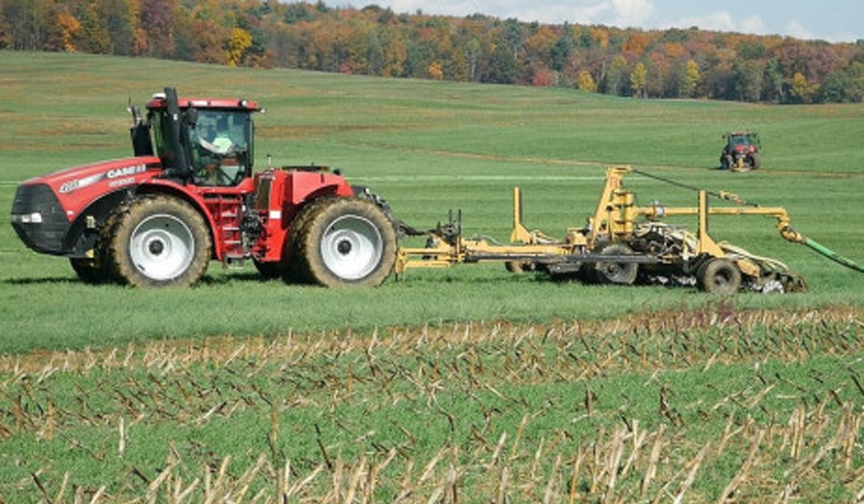
Quickly incorporating manure, particularly through low-disturbance injection, can dramatically increase the value of manure nitrogen.
To determine the additional value of the N that can be conserved through immediate manure incorporation/injection, you need to consider what the N content of the manure is, particularly the relative proportion of ammonium N and organic N in the manure, and what the availability of the ammonium N fraction is when you change from no incorporation to immediate incorporation. Typical values for these components of swine manure, dairy slurry, and poultry litter are listed in Table 1.
Table 1. Manure ammonium N and organic N content and availability factors for immediate and no incorporation when applied in spring for a summer crop.
| Manure Type | Analysis Units | Ammonium N Analysis | Organic N Analysis | Ammonium N Availability Factor for Immediate Incorp. | Ammonium N Availability Factor for No Incorp. | Organic N Availability Factor |
|---|---|---|---|---|---|---|
| Dairy slurry (lactating cows) | lb/1,000 gal | 14 | 14 | 0.8 | 0.1 | 0.35 |
| Swine (grow to finish) | lb/1,000 gal | 20 | 11 | 0.8 | 0.1 | 0.5 |
| Poultry (broiler) | lb/ton | 9 | 49 | 0.9 | 0.2 | 0.6 |
Adapted from Penn State Agronomy Guide tables 1.2-10 and 1.2-12.
To calculate available N in manure, multiply the ammonium N analysis by the ammonium N availability factor based on time of incorporation and add this to the organic N analysis multiplied by the organic N availability factor, as in the following equation.
Manure Available N = (Ammonium N Analysis x Ammonium N Availability Factor) + (Organic N Analysis x Organic N Availability Factor)
The result from this calculation is the available N per 1,000 gallons of liquid manure or per ton of solid manure. Multiply this available N by the planned application rate to determine the total available N applied. Alternatively, you can use the manure available N to calculate the application rate needed to achieve a target N rate by dividing the target N rate by the manure available N content. Table 2 illustrates the available N content in dairy, swine, and poultry litter based on immediate incorporation versus no incorporation on a per 1,000 gallon or per ton basis, as well as at typical application rates of 7,000 gal/ac for liquid manures or 3 T/ac of poultry litter.
Table 2. Manure available N calculated for immediate incorporation or no incorporation when applied in spring for a summer crop, calculated from manure N analysis and availability factors in Table 1. Typical application rates are shown for demonstration purposes. Actual rates to use should be based on your manure management plan, nutrient management plan, or nutrient balance sheets.
| Manure Type | Available N Immediate Incorp.(lb/1,000 gal or lb/ton) | Available N No Incorp. (lb/1,000 gal or lb/ton) | Typical Application Rate | Available N at Typical Application Rate Immediate Incorp.(lb/acre) | Available N at Typical Application Rate No Incorp. (lb/acre) | Increased value due to immediate incorp. with typical application rate at $1/lb N($/ac) |
|---|---|---|---|---|---|---|
| Dairy slurry (lactating cows) | 16.1 | 6.3 | 7,000 gal/ac | 113 | 44 | $69 |
| Swine (grow to finish) | 21.5 | 7.5 | 7,000 gal/ac | 150 | 52 | $98 |
| Poultry (broiler) | 37.5 | 31.2 | 3 T/ac | 112 | 94 | $18 |
Of the dairy, swine, and poultry manures used in the example above, swine manure showed the greatest increase in value from immediate incorporation. At a rate of 7,000 gal/ac and valuing the increased availability of nitrogen using a current nitrogen fertilizer price of $1/lb N, immediate incorporation of swine manure increased the manure value $98/ac compared to no incorporation. This value is derived from the fact that 98 lbs/ac less N fertilizer will need to be used because of the increase in available N from the manure. Dairy manure applied at a rate of 7,000 gal/ac showed a somewhat less, but still impressive, increase in value due to immediate incorporation of $69/ac. Poultry manure applied at 3 T/ac had a relatively small increase in value from immediate incorporation of only $18/ac.
The differences in results for the different manure types has to do with the relative proportions of ammonium N and organic N content in each manure type. Swine manure has the greatest ammonium N content of the manures shown here, so shows the greatest increase in value due to immediate incorporation. Typically, 65% of the total N in swine manure is in the ammonium form. Dairy slurry tends to have the N evenly split 50%/50% between ammonium N and organic N, while dry poultry litter is often only 15% ammonium N. Most labs providing manure analyses report the separate content of ammonium N and organic N, so more accurate calculations can be made for your specific manure based on the actual analysis.
Given the current record-breaking prices of commercial N fertilizer, the value of immediate incorporation of manure has never been as great as it is today. The
Solid manures, which are difficult to mechanically inject into the soil, still pose a challenge for immediate incorporation without the use of full-width tillage. Luckily, the ammonium N content of most solid manures is relatively low, and as the example above demonstrates, there is relatively little increase in value from immediate incorporation of manures with a low ammonium N analysis. For those farmers committed to no-till systems who are working with solid manures, it is unlikely that the benefit from immediate tillage incorporation of solid manures is worth the cost of the tillage operation, both from a fuel usage and soil conservation perspective. However, care should still be taken with solid manures to apply them at times of year and in landscape positions where runoff losses of phosphorus can be minimized.
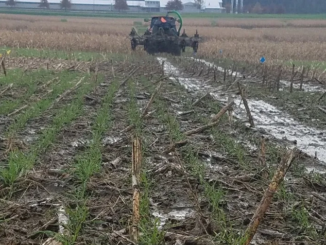
Low-disturbance injection of liquid manures can dramatically increase the value of manure N, easily paying for the cost of injection when N fertilizer prices are as high as they are today. Manure injection has several other benefits as well, including reducing soluble P losses in runoff and reducing odors and air pollution. Now is the perfect time to consider adopting this valuable manure management strategy.
Be the first to comment