

Water scarcity is a major limitation for forage production in the Southern High Plains, making sorghum a forage alternative to corn silage. However, concerns remain about sorghum silage fiber digestibility, which is critical for enhancing dry matter intake and milk production in dairy cows. Several factors may influence fiber digestibility in sorghum silage, including plant genetics, maturity at harvest, cutting height and processing during harvest. This first article will discuss how sorghum type, brown midrib, BMR, and dwarf traits can affect sorghum silage fiber digestibility.
Brown midrib trait increases fiber digestibility
A total of 12 years of data from the Texas A&M AgriLife Bushland Forage Sorghum Trials showed that BMR sorghum hybrids significantly increased fiber digestibility compared with non-BMR sorghum hybrids by roughly 4 percentage units (Bell et al., 2014 to 2025). The BMR trait increased fiber digestibility in both forage sorghum and sorghum-sudangrass hybrids. This increase in NDFD is mostly explained by the lower lignin concentration in BMR compared with non-BMR sorghum hybrids. The effect of the BMR trait decreasing lignin was greater in BMR sorghum-sudangrass than forage sorghum hybrids (Table 1).
Similarly, Pupo et al. (2022) reported that predicted fiber digestibility for forage sorghum and sorghum-sudangrass BMR hybrids compared with non-BMR hybrids was greater in the spring compared to the increase in the summer. The greater response of sorghum during the spring conditions might be explained by higher precipitation, lower temperatures and higher humidity, resulting in reduced heat stress and lower lignification. Moreover, in a meta-analysis of nine experiments, cows fed BMR sorghum silage had a 1.8 pound increase in dry matter intake and 3.6 pound increase in milk production compared to cows fed non-BMR sorghum silage (Sánchez-Duarte et al., 2019). These improvements can be explained by the lower lignin concentration and greater fiber digestibility of BMR sorghum silage.
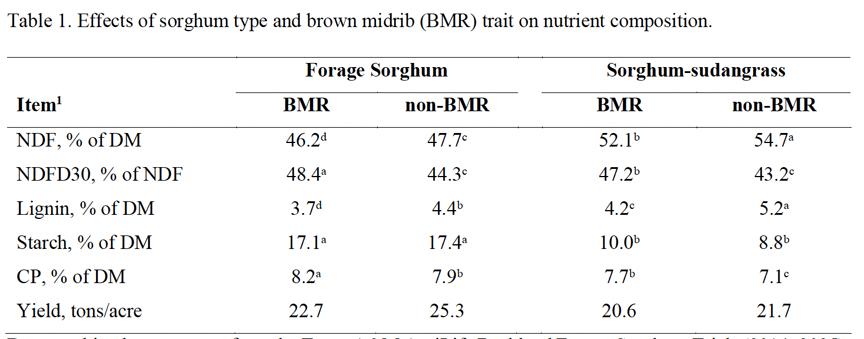
Data combined across years from the Texas A&M AgriLife Bushland Forage Sorghum Trials (2014–2025). 1BMR = brown midrib; DM = dry matter; CP = crude protein; NDF = neutral detergent fiber; NDFD30 = neutral detergent fiber digestibility after 30 hours incubation in rumen fluid. Yield values were adjusted to 65% moisture. Means that do not share a common superscript within rows differ significantly (P < 0.05).
Effect of sorghum type and plant structure on fiber digestibility
In general, forage sorghum hybrids have greater starch content and fiber digestibility and lower NDF and lignin concentrations than sorghum-sudangrass hybrids (Bell et al., 2014 to 2025, Table 1). Similarly, Pupo et al. (2022) found higher fiber digestibility in forage sorghum compared with sorghum-sudangrass (48.4 vs. 45.9% of NDF, respectively). These differences may be partially explained by plant structure because forage sorghum has a greater proportion of grain than sorghum-sudangrass (Fig. 1).
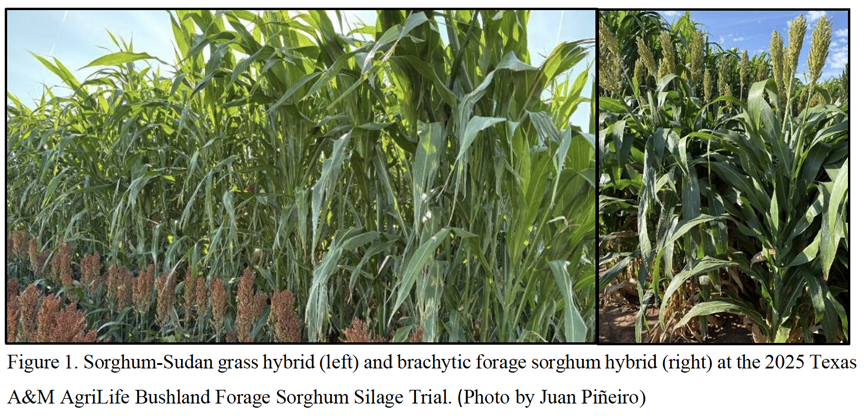
Plant structural characteristics such as plant height, stem proportion, and stem lignification may influence fiber digestibility in sorghum silage. Dwarf sorghum hybrids have shorter internodes and reduced plant height compared with tall sorghum hybrids, while keeping similar leaf area but producing fewer leaves per main stem (20-23 vs. 28-30), they maintain a similar leaf area while reducing the internode elongation may explain the lower stem biomass accumulation in dwarf genotypes, which may contribute to greater fiber digestibility because stem tissues are less digestible than leaf tissues (Kouressy et al., 2008; Aii, 1976; Fig. 1). In addition, if dwarf hybrids increase stem diameter and the pith-to-stem ratio, fiber digestibility should also increase. Akin et al. (1993) found that, within the stem, pith tissue is more digestible than rind tissue, the outer portion of the stem. Similarly, short-stature corn hybrids carrying the brachytic2 mutation have higher fiber digestibility and lower lignin concentration compared with tall-stature corn hybrids (Mastroeni et al., 2026). Plant structural characteristics may influence fiber digestibility in sorghum, although additional research is still needed.
References
Aii, T. 1976. Feeding value of forage sorghum. Japan Agricultural Research Quarterly 10:33–36.
Akin, D.E., L.L. Rigsby, W.W. Hanna, and C.E. Lyon. 1993. In vitro digestion and textural strength of rind and pith of normal and brown midrib stems. Anim. Feed Sci. Technol. 43:303–314.
Bell J. 2014-2025. Texas A&M AgriLife Bushland Forage Sorghum Silage Trial.
Kouressy, M., M. Dingkuhn, M. Vaksmann, and A. B. Heinemann. 2008. Adaptation to diverse semi-arid environments of sorghum genotypes having different plant type and sensitivity to photoperiod. Agric. For. Meteorol. 148:357–371. https://doi.org/10.1016/j.agrformet.2007.09.009
Mastroeni, C., A. Catellani, E. C. Diepersloot, M. R. Pupo, L. F. Ferraretto, J. L. Pellet, E. Badalotti, M. Battisti, and A. Gallo. 2026. Assessing yield and nutritive value of corn varieties for silage production carrying the brachytic2 mutation harvested at different stages of maturity. J. Dairy Sci. 109:1386–1398. https://doi.org/10.3168/jds.2025-26982
Pupo, M. R., M. O. Wallau, and L. F. Ferraretto. 2022. Effects of season, variety type, and trait on dry matter yield, nutrient composition, and predicted intake and milk yield of whole-plant sorghum forage. J. Dairy Sci. 105:5776–5785. https://doi.org/10.3168/jds.2021-21706
Sánchez-Duarte, J. I., K. F. Kalscheur, A. D. García, and F. E. Contreras-Govea. 2019. Short communication: Meta-analysis of dairy cows fed conventional sorghum or corn silages compared with brown midrib sorghum silage. J. Dairy Sci. 102:419–425. https://doi.org/10.3168/jds.2018-14552


Be the first to comment