Full year 2020 fluid milk sales are now available. While 2020 milk sales had a bright spot for a few months when quarantining for COVID began, in the fourth quarter, even though nothing had really changed with COVID and quarantining, milk sales began to fall behind the prior year. Whole milk and two percent milk continue to hold their own while one percent fat and no fat milk sales continue to plummet. Organic milk fell in 2019 from the prior year but made a major comeback in 2020.
Chart I below shows the monthly progression of milk sales. While milk sales have been falling for many years, in March 2020 as COVID showed its face and quarantining kept people at home, milk sales bloomed to a three-year high. Perhaps a part of this was hoarding, as consumer shelves were often bare. However, the milk increases which occurred in March 2020 and continued for a few months are one-time events, not lasting trends.
Chart I – Monthly Milk Sales for 2018, 2019, and 2020
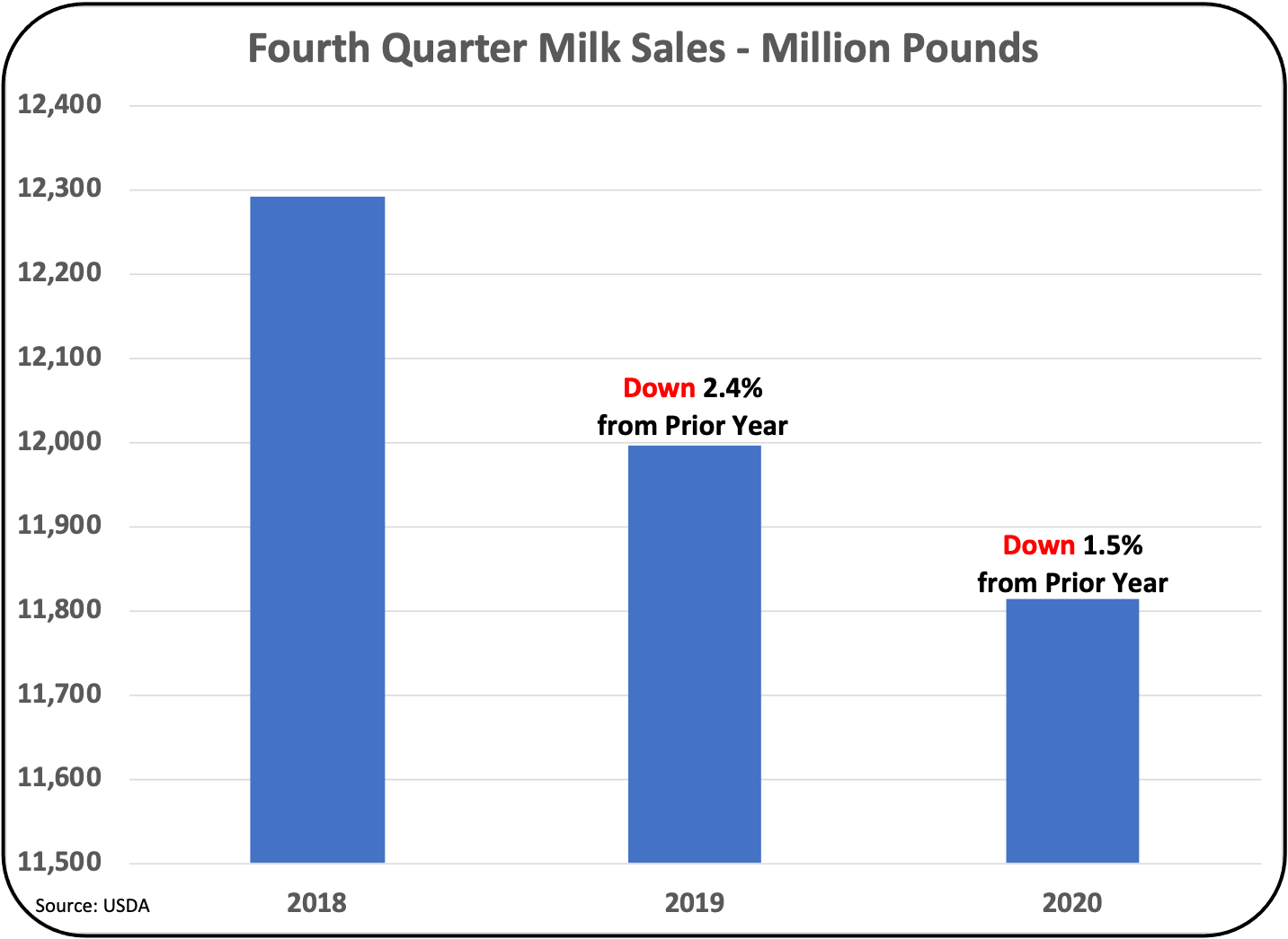
The next four charts show the changes by quarter in 2020. The blip that increased sales in quarters one and two, evaporated in quarters three and four. In both the third and fourth quarters, milk sales fell by 1.5 percent from the prior year. Considering that COVID was still in full swing in quarters three and four, the decrease from the prior year would likely be in the range of 2 to 2.5 percent if COVID quarantining was not in effect.
Chart II – First Quarter Milk Sales for 2018, 2019, and 2020
Chart III – Second Quarter Milk Sales for 2018, 2019, and 2020
Chart IV – Third Quarter Milk Sales for 2018, 2019, and 2020
Chart V – Fourth Quarter Milk Sales for 2018, 2019, and 2020
Whole milk and two percent fat milk held up well in 2020. Whole milk sales, Chart VI, increased by 1.2 percent and 2.5 percent respectively in 2019 and 2020. The greater increase in 2020 was primarily due to the pandemic buying spree which started in March 2020. The whole milk gains in 2020 included the one-time event of COVID and without the pandemic the whole milk sales would likely be closer to the 2019 gain of 1.2 percent.
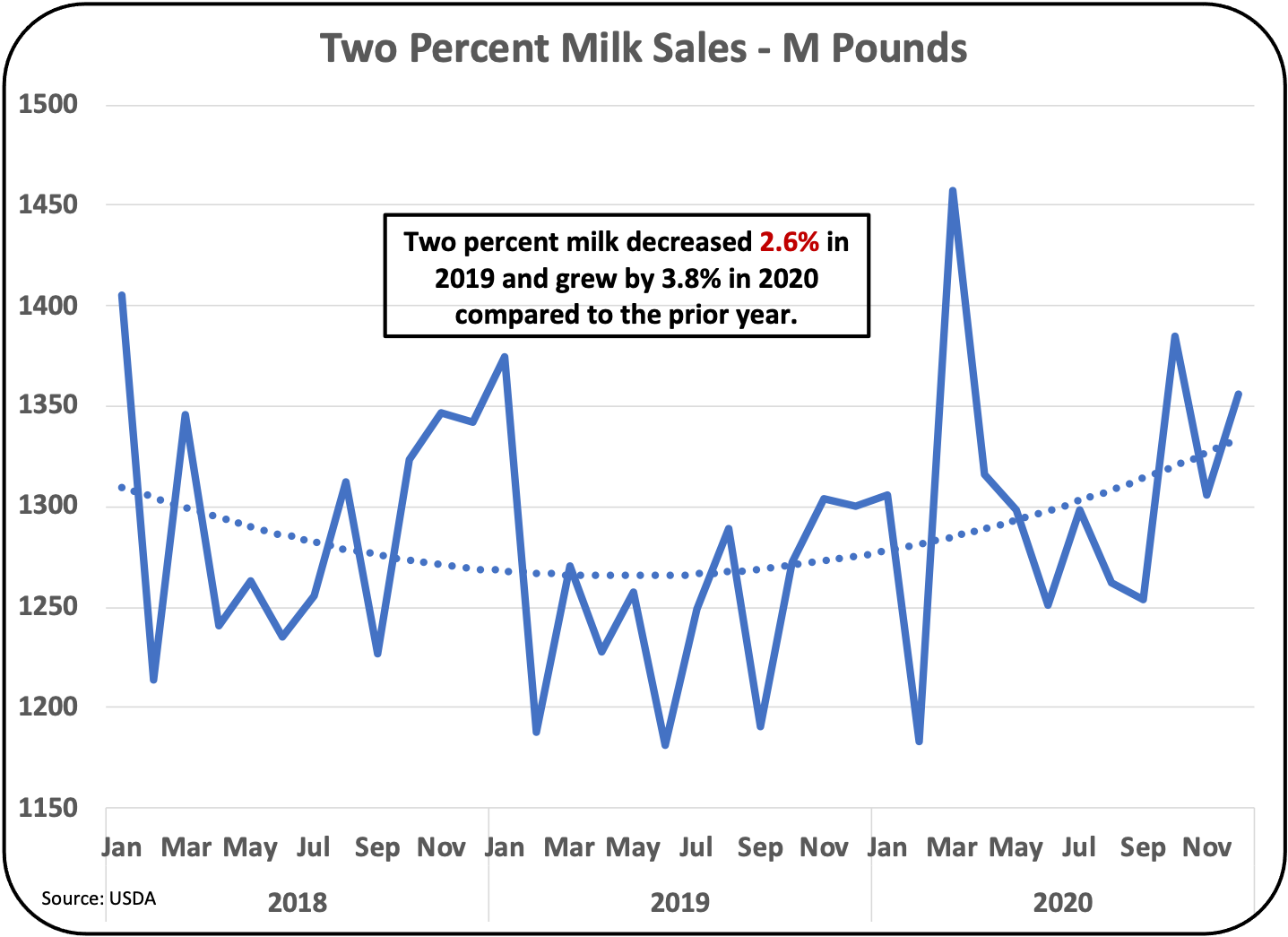
Two percent fat milk sales, Chart VII, decreased by 2.6 percent in 2019 and grew by 3.8 percent in 2020. Again, the 2020 increase can mostly be attributed to the quarantining impact of COVID. It is difficult to say how much of the 2020 gain is related directly to COVID quarantining.
Chart VI – Monthly Whole Milk Sales for 2018, 2019, and 2020
Chart VII – Monthly 2% Fat Milk Sales for 2018, 2019, and 2020
One percent milk and fat free milk, Charts VIII and IX, continued their decent. One percent milk fell by 6.1 percent in 2019 and four percent in 2020. Fat free milk fell even faster, down 11 percent in 2019 and 13.5 percent in 2020.
Chart VIII – Monthly One Percent Sales in 2018, 2019, and 2020
Chart IX – Monthly Fat Free Sales in 2018, 2019, and 2020
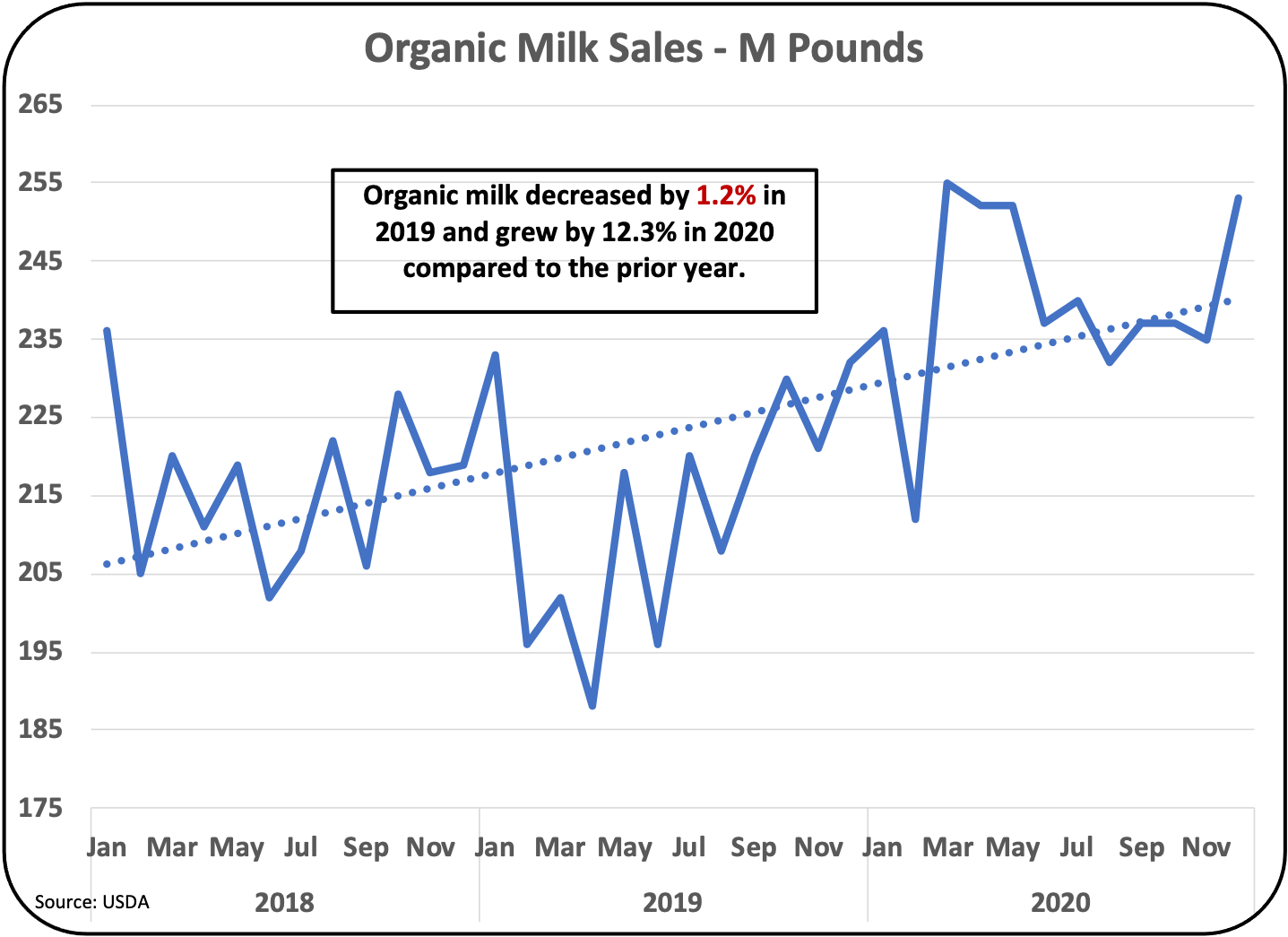
Organic milk sales did show strength. Charts X and XI measure the impact of organic milk in two different ways. Chart X shows the monthly sales in 2018, 2019, and 2020. The sales of organic milk fell by 1.2 percent in 2019 but grew by 12.3 percent in 2020.
Chart XI shows the percentage of total milk that is organic. Fluid milk sales are declining and have been for a number of years. However, the percent of total milk that is organic has consistently grown. It grew from 5.5 percent in 2018, to 5.6 percent in 2019, and 12.2 percent in 2020. At 12.2 percent of the milk sold, organic milk is clearly more than just a niche product.
Chart X – Total Organic Milk Sales in 2018, 2019, and 2020
Chart XI – Percent of Total Milk Sales That Were Organic
SUMMARY
In the September 11, 2020 post to this blog, the per capita consumption of milk was decreasing at 2.6 percent annually. With the current U.S. population increase of about .6 percent, that would make total U.S. demand of fluid milk decreasing at about two percent. The current data for the third and fourth quarters show a 1.5 precent decrease during COVID lockdowns.
It is reasonable that without the one-time influence of COVID, that domestic milk sales and consumption are still declining at about around two percent or slightly more annually.
Editor’s Note: John Geuss is a dairy consultant based in Florida. This information appears in his Milk Price blog column sponsored by Addiseo and is published here with permission. He may be contacted at johngeuss@gmail.com
The farmer-managed Cooperatives Working Together (CWT) export assistance program, has helped its member dairy cooperatives sell over 50 million pounds of America-type cheeses and 50 million pounds of whole milk powder overseas so far in [Read More …]
There are many types of milk in the store — 1%, 2%, skim milk, whole milk, the list goes on. You might have even heard someone refer to skim milk as “watered-down milk.” But is [Read More …]
The Dairy Bar: China COVID Policies Further Snarl Supply Chains; Soaring Fuel Prices Hit Pocketbooks; and Global Milk Production in a Minute! Quick Bites: Shanghai Shipping Snarls China’s zero tolerance policies on COVID policy are creating [Read More …]
Copyright 2026 DairyBusiness, LLC. All Rights Reserved.
We use cookies to ensure that we give you the best experience on our website. If you continue to use this site we will assume that you are happy with it.








Be the first to comment