
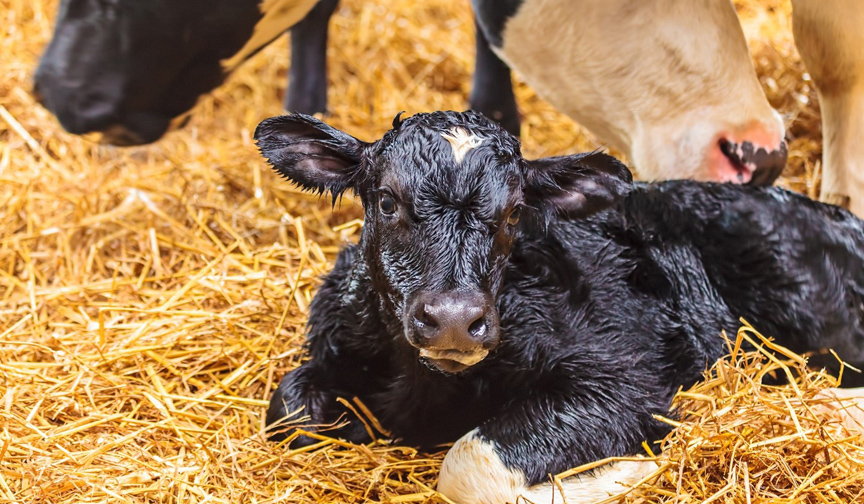

Now, more than ever, it’s important to protect your investment in your heifer. We tend to put a lot of emphasis on genetic progress with our breeding programs but often fail to partner that with a quality heifer management program to allow our heifers to express their full genetic potential. Selection, development, and protection of your next generation will lead to improved productivity and profitability of your dairy operation. Here are some steps you can take to help your program succeed.
Help calves and heifers stay healthy by building early immunity:
Baby calves are born without antibodies and need to receive them through colostrum. Because of this, quality nutrition and proactive management are vital from day one. A good starting point for evaluating the effectiveness of the colostrum program is measuring serum total proteins in the blood of calves. Improved passive transfer correlates with healthier calves.
In 2019, a group of calf experts updated the industry guidelines to a tiered system for adequate passive transfer. Definitions under these guidelines are:
-
Excellent – >40% of calves on farm with a serum total proteins (TP)>6.2 grams per deciliter (dl)
- Good – ~30% of calves with serum TP 5.8-6.1g/dl
- Fair – ~20% of calves with a serum TP 5.1-5.7 g/dl
- Poor – ~10% of calves with serum TP <5.1g/dl.
Farms with the most success will meet or exceed these standards. Achieving these goals starts with the care of the dry cow to produce quality colostrum, clean harvest, quick cooling, and storage of colostrum at calving.
Transitioning from milk to starter, promote rumen development early to enhance growth and set her up for future success:
Getting calves off to a good start during the first few weeks can be a challenge. Consistently feeding the same quantity, temperature and total solids of milk or milk replacer will help alleviate most of these challenges. Once past this, the next big task is weaning calves off milk and making a seamless transition from individual to group
Create a nutrition program for your pregnant heifers that maintains immunity and growth, so she is closer to mature size with her first calf:
Establish a relationship with a nutritionist knowledgeable in feeding heifers to create a program that’s ideal for your herd. It’s important to keep in mind that post weaned calves are still developing their rumens and their diets need to account for this continued development. Traditionally, we switch heifers to more of a TMR type ration around 300 lbs. However, feeding higher grain diets (60:40 grain to forage) longer can improve average daily gain while reducing the cost of gain. In many situations, this may mean just pushing out the timeframe for switching heifers to a pre-breeding ration. Be sure to work with a nutritionist to formulate specific rations catering to your ingredient availability and heifer growth goals. We can grow quality, mature heifers without creating fat heifers in the process.
Use metrics to guide success throughout the life stages:
Calves should double birth weight by 60 days and heifers should weigh 55% of herd mature body weight at breeding. Mature body weight is established by weighing a subset of third plus lactation animals between 80-120 days in milk. The goal is to have heifers at 85% of mature body weight when they calve in. The cost of one pound of growth in a lactating animal is energetically equivalent to seven pounds of milk. Many people believe that smaller heifers will eventually “catch-up” once they calve in. However, average annual herd production will be within one to two pounds of what the first lactation animals are producing during week 10 of lactation. These heifers set the ceiling for the herd. As an industry, we have well-established guidelines for setting growth goals in heifers, but unfortunately many producers don’t record enough measurements to know if they are close to achieving these goals. It can be overwhelming to think about adding these tasks, but adding a few data points like weaning and pre-breeding, on a subset of animals, even seasonally, can help you evaluate if you are missing out on growth opportunity.
These are the main critical control points you should focus on when looking to improve your heifer program. Working with industry professionals, such as your nutritionist and veterinarian, can help you to identify the biggest bottlenecks limiting your calf and heifer performance. Your management team should collaborate to determine what strategies will work best as well as available resources. Even the best programs will still have day to day challenges, but immune support products can help minimize the impact of stress, maintain gut integrity, and promote rumen development. In the end, this can help your program, and your herd, prosper.
Editor’s Note: Kelly Reed, DVM is a Ruminant Field Technical Specialist with Diamond V and can be reached at kbreed@diamondv.com

Be the first to comment