
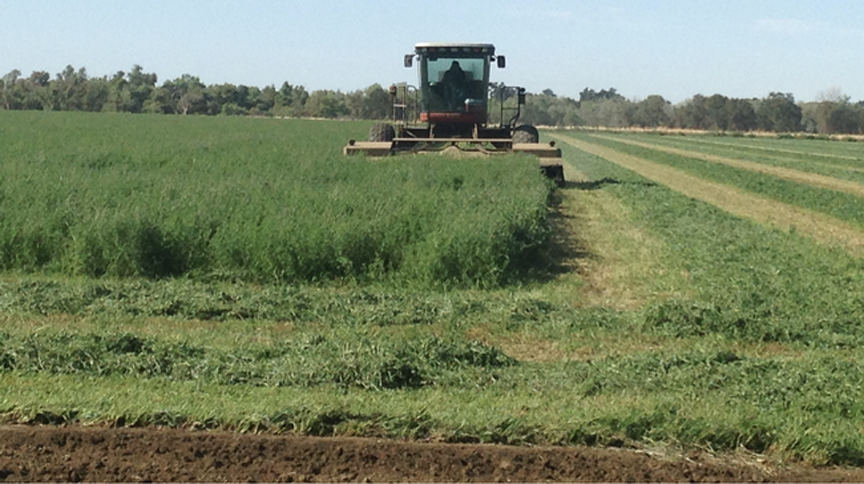
In studies, alfalfa tonnage increased by the addition of sulfur fertilizer
That’s why we sought funding from Minnesota’s Agricultural Fertilizer Research and Education Council (AFREC) for a multi-year study on sulfur fertilizer sources and application rates. The project, at the Rosemount Research and Outreach Center, is currently in its third year. Combined with another trial in Rosemount from the 2019 growing season, Minnesota-based sulfur fertilizer research has yielded some impressive results.
The 2019 trial kicked off our exploration of sulfur for alfalfa. In that study, we compared several sources of sulfur, both sulfate and elemental sulfur sources, at rates of 0, 7.5, and 15 pounds of sulfur per acre (lbs S/ac) on plots with higher soil OM concentrations and lower OM concentrations. The AFREC study is looking at fewer sources of sulfur but more rates (0, 10, 20, and 30 lbs S/ac). Sulfur fertilizer was applied twice each year in both studies: first, just before seeding and, second, after the first cutting of alfalfa was taken off.
Study results
For the AFREC study, forage yield was increased by 1,000 pounds over two harvests in 2019 and 2020 when a sulfate form of sulfur was applied. The elemental sulfur treatment resulted in less yield than the sulfate sulfur. A second cutting taken around July 1 of this year (2021) also showed a positive impact of sulfur on forage yield.
While we are still in the early stages of this study, the data seems to confirm the current U of M alfalfa fertilizer guidelines for sulfur application, which suggests applying 10 to 25 lbs S/ac depending on overall production and soil OM concentration in the top six inches of soil. Application rates higher than 25 lbs S/ac are not currently suggested even though removal may be greater for fields where more cuttings are taken in a year.
—
For the latest nutrient management information, subscribe to Minnesota Crop News email alerts, like UMN Extension Nutrient Management on Facebook, follow us on Twitter, and visit our website.
Support for Minnesota Crop News nutrient management blog posts is provided in part by the Agricultural Fertilizer Research & Education Council (AFREC).

Be the first to comment