
A new mini-review in JDS Communications® breaks down how timely pregnancies can lead to better body condition, fewer health issues, and a sustained healthy cycle of fertility
Richard Pursley, PhD, of Michigan State University, one of the co-authors, initially coined the term “high fertility cycle” to describe this understanding of the interrelated factors on a dairy farm that interact to create fertility success.
“After the last two or more decades of research,” explained Pursley, “we now know that reproductive success is tied to other health markers in a dairy herd, and we set out to show how this knowledge can be utilized to maximize a herd’s fertility rate through easy, applicable changes in production management on the farm.”
The authors combed back through three decades of dairy research to present the essential knowledge on this topic in their mini-review. They start by establishing the relationship between fertility and the body condition score (BCS)—a consistent 5-point scoring system in .25 increments long used as a practical management tool for Holstein cows to understand their body fat or energy stores.
“Healthier postpartum cows we know from the research have improved embryo quality, have greater fertility at first insemination, and see fewer early pregnancy losses after becoming pregnant,” said co-author Paul Fricke, PhD, of the University of Wisconsin–Madison. In addition, BCS loss after calving was associated with increased health issues, whereas maintaining or gaining BCS after calving was connected to fewer recorded health events, including metritis, mastitis, ketosis, and pneumonia.
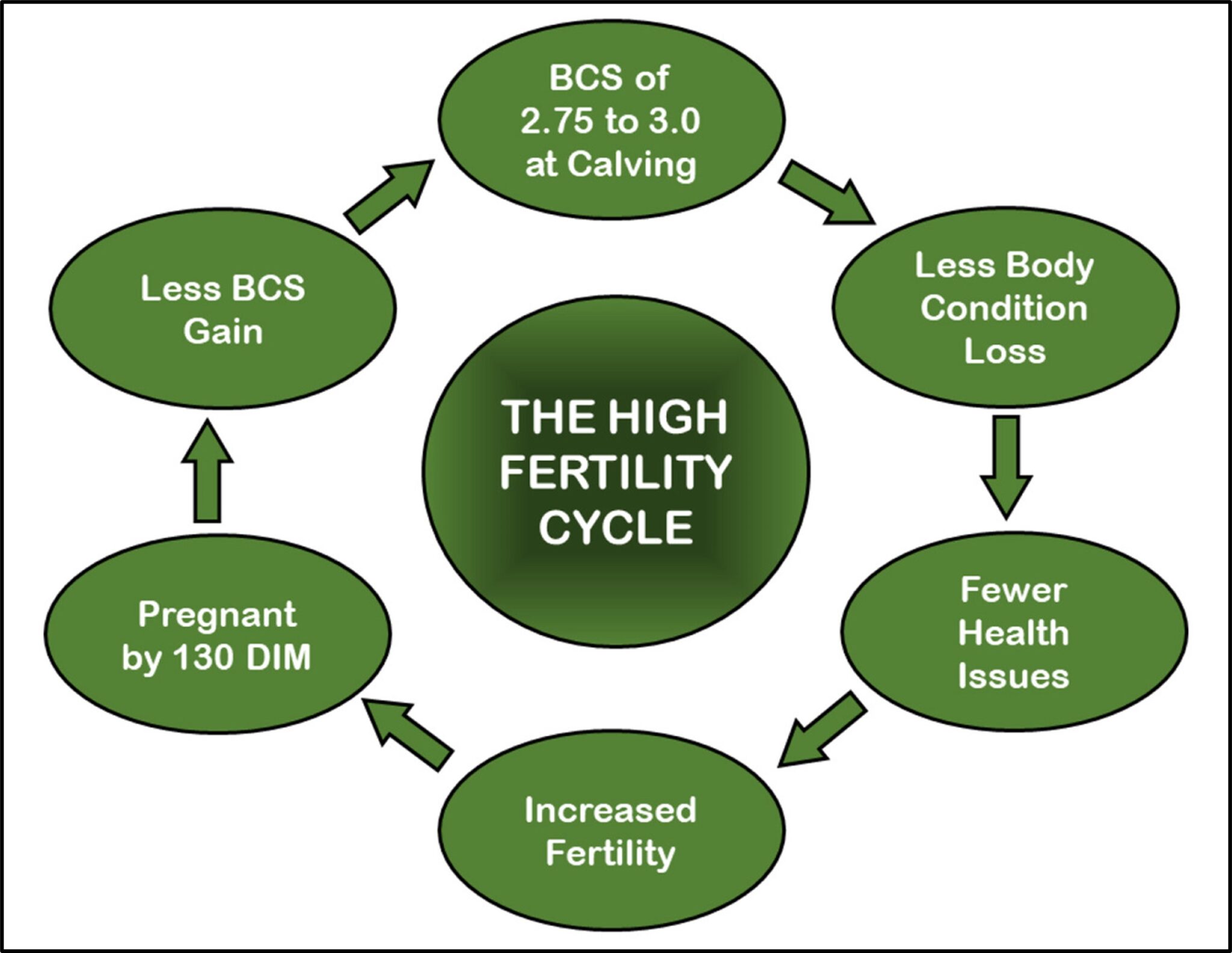 Caption: The high fertility cycle describes the relationship among body condition score (BCS) change, health, and overall fertility (Credit: Paul M. Fricke, Milo C. Wiltbank, and J. Richard Pursley).
So, how can dairy farms ensure their herds maintain or gain BCS after calving to achieve healthy cows and high rates of fertility? The research shows that the critical factor is calving cows at a lower BCS between 2.75 and 3.0,which can be achieved by implementing an aggressive reproductive management program. Getting cows pregnant quickly after the end of the voluntary waiting period ensures a lower BCS at calving, which leads to less body condition loss after calving, and therefore healthier cows that are more fertile and better able to become pregnant again, restarting the cycle.
“The goal of every farm should be to strive to get as many cows as possible pregnant by 130 days in milk in order to achieve and maintain this critical high fertility cycle,” explained Fricke.
After reviewing the data, the team pinpointed key considerations for achieving and maintaining a high fertility cycle:
- Implement BCS monitoring for transition cows 3 weeks before calving, at calving, and 3 weeks after calving, as well as at artificial insemination,
- Use fertility programs to help establish pregnancy quickly after the end of the voluntary waiting period,
- Set a cutoff for the number of times individual cows will be inseminated, and
- Consider nutritional strategies to prevent late-lactation cows from gaining too much body condition.
The authors were careful to clarify that more research is needed to more directly link these relationships between BCS change and fertility in lactating dairy cows. The dairy science community is always striving to discover management techniques that continuously improve profitability as well as the health, longevity, and wellbeing of dairy cows.
For those interested in the discussion, co-author Paul Fricke, PhD, will be presenting on reproductive decision making at the American Dairy Science Association’s 45th Discover Conference taking place on October 23–26, 2023. In the meantime, these insights and the key takeaways for the high fertility cycle offer a new management paradigm that that can be easily implemented and monitored on commercial dairy farms and have an immediate impact on reproduction and lactation success.

Be the first to comment