
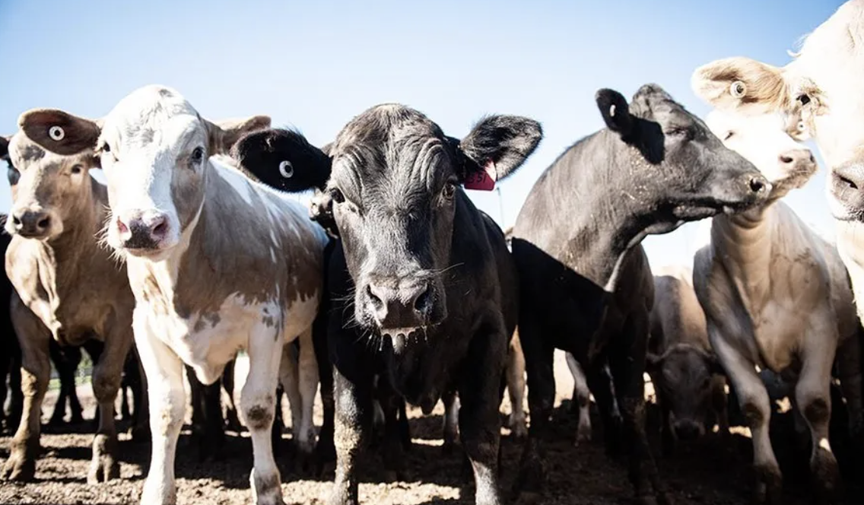
While Angus sires continue to dominate beef x dairy matings, the frequency of other beef sire breeds in beef x dairy matings is increasing. Penn State just completed a third year investigating optimal sire breeds for beef x dairy mating.
Research efforts are supported by the USDA Critical Agricultural Research and Extension (CARE) with additional support from JBS and Premier Select Sires. Research animals were finished at the Pennsylvania Department of Agriculture’s Livestock Evaluation Center (LEC) feedlot in Pennsylvania Furnace. Beef × Holstein bull calves sired by Angus, Charolais, SimAngus, and Wagyu bulls and born on PA dairy farms from May to August 2021 were transported to one of two commercial calf growing facilities within 1 week of birth. Calves were fed milk replacer and free choice starter grain until weaning at 7 ± 2 weeks of age. Following weaning, calves were consolidated to one facility and fed a growing ration (~56 Mcal NEg). Calves were implanted with Synovex-C in November and implanted with Synovex-S in February.
Following the initial grow out, 19 Angus × Holstein, 79 Charolais × Holstein, 16 SimAngus × Holstein, and 10 Wagyu × Holstein steers were brought to the LEC. Steers were fed a common corn and corn silage-based diet (~63 Mcal NEg) and slaughtered after 90, 118, or 153 days on feed at the LEC. Groups were selected for slaughter based on a combination of visual appraisal and body weight. Daily feed intake of individual steers was recorded using the GrowSafe Feed Intake Monitoring System. Initial and final weights are reported as a 2-day average body weight at the beginning and end of the LEC feeding period, respectively. Average daily gain was calculated as the difference between initial and final average body weight divided by the total days on feed.
Growth performance of the steers by sire breed are reported in Table 1. Angus-sired steers were heaviest at feedlot entry (966 lbs) and were fed at the LEC for the fewest (112) days. SimAngus and Wagyu-sired steers were the lightest at feedlot entry (783 and 738 lbs, respectively) and on feed for the most days (144 and 161 days, respectively). Charolais-sired steers outperformed the Wagyu and SimAngus-sired steers but were still inferior to Angus. Angus × Holsten steers were heavier at slaughter than SimAngus and Wagyu-sired steers. The disadvantage Wagyu-sired steers had in feedlot growth performance was due in part to their reduced dry matter intake (DMI) and average daily gain (ADG) when compared to progeny of other sire breeds. Because the cattle that consumed less feed grew slower, no breed differences existed in feed conversion to gain (~8 lbs of feed were required for 1 lb of gain). Additionally, there were no differences between sire breeds in hip height at harvest. Yearling height is included in the $AxH index. While the Angus sires used in this project were not specifically selected using the $AxH index, height has been of interest to ensure that beef x dairy crossbreds are not too large for meatpackers to accommodate.
Table 1: Feedlot performance of beef x Holstein steers by sire breed
| Trait | Sire breed | SEM | P-Value | |||
|---|---|---|---|---|---|---|
| Angus | Charolais | SimAngus | Wagyu | |||
| n steers (n sires) | 19 (7) | 79 (3) | 16 (3) | 10 (2) | – | – |
| Initial body weight, lbs | 966a | 855b | 783c | 738c | 38 | <0.01 |
| Final body weight1, lbs | 1425a | 1369ab | 1335b | 1260c | 31 | <0.01 |
| Average daily gain, lbs/day | 4.18a | 4.03ab | 3.82b | 3.20c | 0.15 | <0.01 |
| Dry matter intake, lbs/day | 33.9a | 32.4ab | 31.0b | 26.7c | 1.1 | <0.01 |
| Feed:gain, lb/lb | 8.16 | 8.06 | 8.15 | 8.42 | 0.29 | 0.70 |
| NEg, Mcal/cwt | 45.5 | 42.4 | 40.2 | 43.0 | 5.0 | 0.70 |
| Days on feed, days | 112c | 129b | 144a | 161a | 8 | <0.01 |
| Hip height, in | 55.2 | 54.6 | 53.9 | 54.4 | 0.5 | 0.14 |
1Final body weights are shrunk by 2.5%
a,b,c Values within row with different superscript are significantly different at P < 0.05.
Despite the growing popularity of Wagyu genetics in the United States, carcasses from Wagyu × Holstein steers were the lightest and had the least amount of backfat of any sire breed used (Table 2). Dressing percentage tended to be least in carcasses from Charolais × Holstein steers (60.5%) and greatest in carcasses from SimAngus × Holstein steers (61.7%); carcasses from Angus and Wagyu-sired steers were intermediate and not different. About 84% of carcasses from Angus × Holstein steers graded Choice while only 31% of carcasses from SimAngus × Holstein steers graded Choice. However, there were no differences in marbling scores between sire breeds. The majority of carcasses from beef x Holstein steers were Yield Grade 2.
Table 2: Carcass performance of beef x Holstein steers by sire breed.
| Trait | Sire breed | SEM | P-Value | |||
|---|---|---|---|---|---|---|
| Angus | Charolais | SimAngus | Wagyu | |||
| n steers (n sires) | 19 (7) | 78 (3) | 16 (3) | 10 (2) | – | – |
| Hot carcass weight1, lbs | 873a | 828b | 824ab | 766c | 22 | <0.01 |
| Dressing percentage, % | 61.2 | 60.5 | 61.7 | 60.8 | 0.006 | 0.10 |
| Ribeye area, in2 | 13.3 | 12.7 | 13.2 | 12.5 | 0.4 | 0.13 |
| Backfat, in | 0.28a | 0.28a | 0.29a | 0.17b | 0.03 | 0.01 |
| Marbling score | 461 | 422 | 393 | 415 | 26 | 0.15 |
| Quality Grade | ||||||
| Prime | 0 | 0 | 0 | 0 | – | |
| Choice | 84.2a | 65.4a | 31.3b | 70.0ab | 0.1 | 0.03 |
| Select | 15.8 | 28.2 | 50.0 | 20.0 | 0.1 | 0.17 |
| No roll | 0 | 6.4 | 18.8 | 10.0 | 0.1 | 0.50 |
| Yield Grade2 | ||||||
| 1 | 0 | 3.8 | 18.8 | 30.0 | 0.2 | 0.06 |
| 2 | 73.7 | 75.6 | 56.3 | 60.0 | 0.2 | 0.38 |
| 3 | 26.3 | 19.2 | 25.0 | 10.0 | 0.1 | 0.73 |
| 4 | 0 | 0 | 0 | 0 | – | |
| 5 | 0 | 0 | 0 | 0 | – | |
1A 2.5% KPH was added to hot carcass weight because KPH was removed prior to weighing
2USDA Yield Grade calculation was used where KPH was assumed to be 2.5%
a,b,cValues within row with different superscript are significantly different at P < 0.05.
Many of the questions still surrounding beef x dairy production are regarding the economics of the system. Economics were evaluated by sire breed (Table 3); however, it is important to recognize that this research system represents a snapshot in time, rather than a continuous production system. Because death loss represent a treamendous expense that is highly variable between farms, economics are presented in two ways: 1) with the costs associated with calves that died accounted for (deads in), and 2) with the costs associated with calves that died removed (deads out). Input costs included wet calf price, which ranged from $200 to $250, calf grower costs, and feedlot feed and yardage expenses. Gross profit was calculated using Quality and Yield Grade grid pricing at time of harvest, based off of the distribution presented in Table 2. Grades were called by trained research staff at the plant. Finally, net profit was calculated as the difference between gross profit and inputs. In both analyses, net profit was negative for all sire breeds and Wagyu x Holstein steers resulted in the greatest economic losses. Despite the majority of Wagyu x Holstein carcasses avoiding Quality Grade discounts and achieving Yield Grade premiums, reduced carcass weight compared with other beef x Holstein breeds significantly impacted gross profit. Conversely, despite the majority of SimAngus x Holstein carcasses receiving Quality Grade discounts their gross profit did not differ from that of Charolais x Holstein carcasses or Angus x Holstein carcasses. While statistically, losses were not different across cattle sired by Angus, Charolais, or SimAngus, Angus x Holstein steers numerically lost the least amount of money. It should be iterated that because this was a research project, some input costs may be artificially inflated. The lack of profit among all groups of steers suggests that the profit margin for beef x Holstein calves was slim in 2022. However, caution should be taken that cost reduction does not impact growth efficiency or carcass performance. Calf grower costs represent the largest input cost and contributed to variation between sire breeds in the deads in model because a greater proportion of Angus, SimAngus, and Wagyu-sired calves died at the calf grower than Charolais-sired calves did and therefore had fewer calf grower feed and labor expenses. It is possible costs could be reduced on the dairy or in commercial settings if access to more affordable inputs, such as waste milk, are available.
Table 3: Economics of beef x dairy crossbred steers by sire breed
| Trait, US $ | Sire breed | SEM | P-Value | |||
|---|---|---|---|---|---|---|
| Angus | Charolais | SimAngus | Wagyu | |||
| Deads in | ||||||
| n, steers | 25 | 82 | 19 | 15 | – | – |
| Wet calf cost | 206.25 | 206.25 | 206.25 | 206.25 | 0 | 1 |
| Calf grower costs | 1,457.02ab | 1,562.86b | 1,382.52a | 1,306.11a | 79.33 | <0.01 |
| Feedlot costs | 369.53 | 408.52 | 352.64 | 330.93 | 44.65 | 0.26 |
| Total inputs | 2032.8ab | 2177.63b | 1941.41a | 1843.29a | 119.29 | 0.02 |
| Gross profit | 1,756.29a | 1,857.54a | 1,529.75ab | 1,187.54b | 179.99 | <0.01 |
| Net profit | -276.51a | -320.09a | -411.66a | -655.75b | 89.75 | <0.01 |
| Deads out | ||||||
| n, steers | 21 | 79 | 16 | 11 | – | – |
| Wet calf cost | 207.14 | 207.14 | 207.14 | 207.14 | 0 | 1 |
| Calf grower costs | 1,497.73 | 1,509.89 | 1,506.37 | 1,512.7 | 6.66 | 0.21 |
| Feedlot costs | 381.51a | 384.07a | 411.50ab | 434.59b | 20.05 | 0.07 |
| Total inputs | 2,086.38a | 2,101.10a | 2,125.01ab | 2,154.43b | 20.88 | 0.04 |
| Gross profit | 1,874.56a | 1,804.11a | 1,778.76ab | 1,647.52b | 57.89 | 0.02 |
| Net profit | -211.82a | -297.00a | -346.25a | -506.91b | 60.13 | <0.01 |
a,bValues within row with different superscript are significantly different at P < 0.05.
Of the beef x Holstein steers fed out for this project in 2022, Wagyu × Holstein steers resulted in the greatest economic losses due to their inferior ADG and DMI on the feedlot, greater days on feed, and reduced carcass weights in comparison with steers of other sire breeds. Angus x Holstein and Charolais x Holstein steers had the greatest ADG and DMI and Angus x Holstein steers were on feed for the fewest days when compared with steers sired by other beef breeds.
The final group of beef x Holstein steers for this research project will be finished in the summer of 2023. The results of their performance will be combined with the results from the cattle fed out in 2020, 2021, and 2022 and a final comparison of beef sire breeds will be made.
This work was supported by a Critical Agriculture Research and Extension grant (no. 12923008) from the USDA National Institute of Food and Agriculture.

Be the first to comment