
The T.C. Jacoby Weekly Market Report Week Ending September 25, 2026
Protein reigns supreme over the dairy complex. In the GLP-1 era, consumers are hungry for protein in all forms, and dairy delivers. Whey proteins are particularly desirable thanks to their neutral flavor. Food processors covet whey powders, protein concentrates (WPCs), and 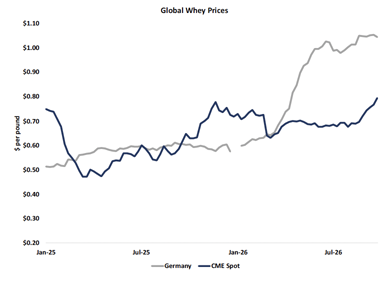 protein isolates (WPIs) as they seek to improve nutritional labels without sacrificing on taste or texture. Demand for WPC with at least 80% protein has faded as prices have climbed high enough to push buyers to alternative sources, including milk protein concentrate. But food makers continue to snap up WPC-34 and WPIs.
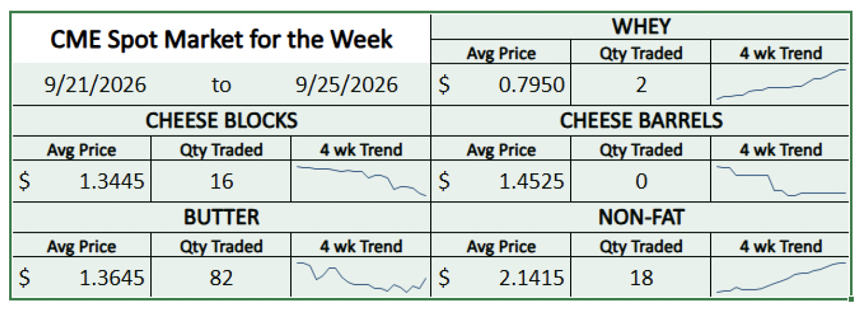
Whey processors can’t concentrate the entire whey stream, and dry whey output is up 8.3% for the year to date. Whey powder isn’t tight, per se. Manufacturers’ stocks of food-grade whey powder reached 67.4 million pounds on July 31, up 37.4% from the year before. But demand is massive at home and abroad. Prices are rising in the U.S., but they’ve climbed faster in Europe, and the U.S. is winning exports. Impressive demand pushed CME spot whey powder to 80.5ȼ per pound, up 2.5ȼ on the week. That marks the highest spot whey powder value since February 2022, and it’s within a hairsbreadth of the highest price ever in whey’s eight-year tenure on the CME spot market.
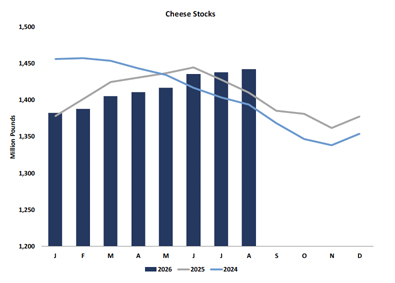 Cheese processors are keeping their vats full in order to run their plants efficiently and to capitalize on whey sales. Whey prices are so high that potential market signals to produce less cheese are muted. For many cheese varieties – especially mozzarella – demand is keeping pace with output. But Cheddar blocks are abundant. Despite record-shattering exports, cheese stocks climbed counter-seasonally in August. They reached 1.44 billion pounds, up 2.3% from the year before.
And buyers are wary of bidding on cheese in Chicago, lest they unwittingly commit to hauling cheese from destinations far from the heartland. CME spot market specifications require buyers to pay the freight, less a hauling adjustment. That adjustment is set on a sliding scale based on the sellers’ distance from Green Bay, Wisconsin. But the maximum freight allowance of 4.93ȼ per 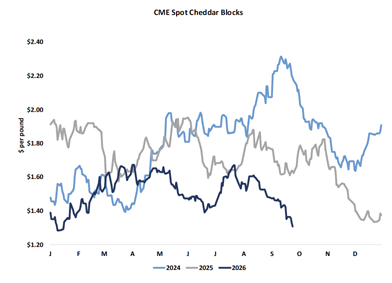 pound is far higher than the cost to haul cheese from the West Coast. With diesel prices at all-time highs, would-be buyers at the CME spot market assume that they’re going to be on the hook for at least 10ȼ of additional freight, so they back their bids down accordingly. With that, CME spot Cheddar blocks slumped 4.25ȼ to $1.3075, a fresh eight-month low.
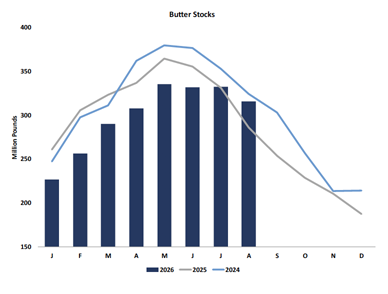
Butter inventories declined from July to August, but the month-to-month drop was less than half the typical August drawdown. At the end of last month, inventories were 10.3% above year-ago volumes. Demand is good, and many butter churns are focusing on making product for the international market, helping to move supplies offshore. But with a comfortable stockpile and record-breaking butterfat output, butter prices can do little more than bounce off the bottom. This week CME spot butter rallied 3ȼ to $1.40.
 In the West, dryers are running hard. But in the East, Midwest, and Southwest, other dairy processors are using up most of the milk, and there are very few trucks lined up at milk powder facilities. Meanwhile, demand for dairy protein remains strong and buyers are apparently undeterred as prices near the eye-popping spring highs. CME spot nonfat dry milk (NDM) jumped 9ȼ this week to $2.17.
The ascendant powder market helped Class IV futures to another strong finish. The October and November contracts topped $20 per cwt. And nearly all contracts posted double-digit gains. But the anemic cheese market weighed on Class III futures once again. Most contracts posted modest losses 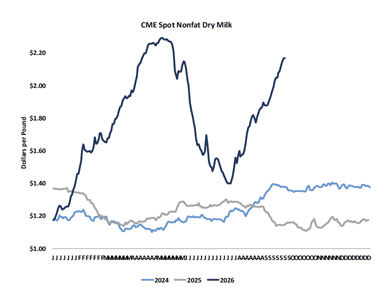 and October Class III dropped 44ȼ to $15.23. Dairy producers who rely entirely on Class III revenue will find it difficult to pay all their bills at these prices.
The grain markets whipsawed back and forth on Friday as traders tried to discern the impact the U.S.-China summit might have on U.S. agricultural exports. Corn, soybeans, and soybean meal traded deep in the red Friday morning after the White House offered little more than vague plaudits about successful talks between Presidents Trump and Xi. December corn futures tested one-month lows on the assumption that China would not make any extra effort to buy U.S. grains. U.S. corn is not competitive to China, especially once the 11% tariff is applied. China has not imported any corn from the United States so far in 2026.
Meanwhile, harvest is underway in the eastern Corn Belt, but combines are stalled in the western Corn Belt and the Northern Plains. It simply won’t stop raining. That’s created an unexpected shortage of corn and soybeans in the region as livestock feeders, grain elevators, ethanol plants, and soy crushers await new crop supplies. The basis is unusually high for late-September, and, in the most extreme cases, grain elevators and soy crushers have no ground corn or soybean meal to offer. Eventually, farmers will get back in the field, and the harvest will pressure the basis and possibly the underlying futures prices as well. But for now, the unfortunate pause is supporting prices, particularly for soybean meal. This week December soybean meal jumped another $12 to $370.60 per ton. After some wild ups and downs, December corn settled at $5.2875 per bushel, up 1.75ȼ for the week.
Original Report At: https://www.jacoby.com/market-report/protein-reigns-supreme-in-the-glp-1-era/

Be the first to comment