
There are four important drivers in the current dairy market outlook.

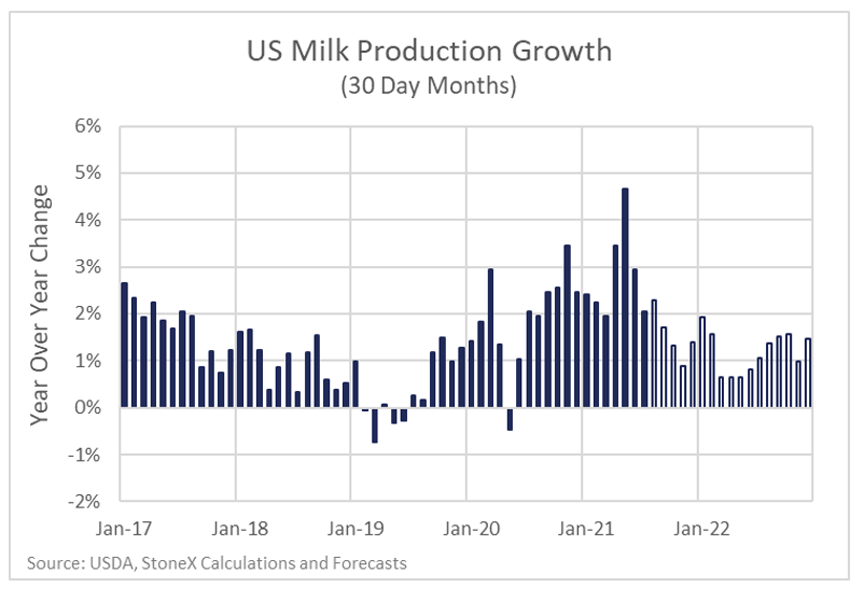
Slowing U.S. milk production growth, Chinese import demand, government programs, and the ongoing pandemic. I’m going to start with the most bullish, which is slowing production growth. The spike in feed costs earlier this year, along with milk prices moving lower has pushed the U.S. dairy cow herd into contraction. The USDA estimates that we lost 6,000 head in June and another 2,000 head in July. Comparing milk production against last year is fraught with problems given all the disruptions last year, but production did slow from 4.7% year-over-year growth in May to just 2.0% in July. Production growth should continue to slow and we could be in the 1.0 to 1.5% range by the fourth quarter which is a much more sustainable pace than the 2.9% growth that we saw in the first half of 2021.
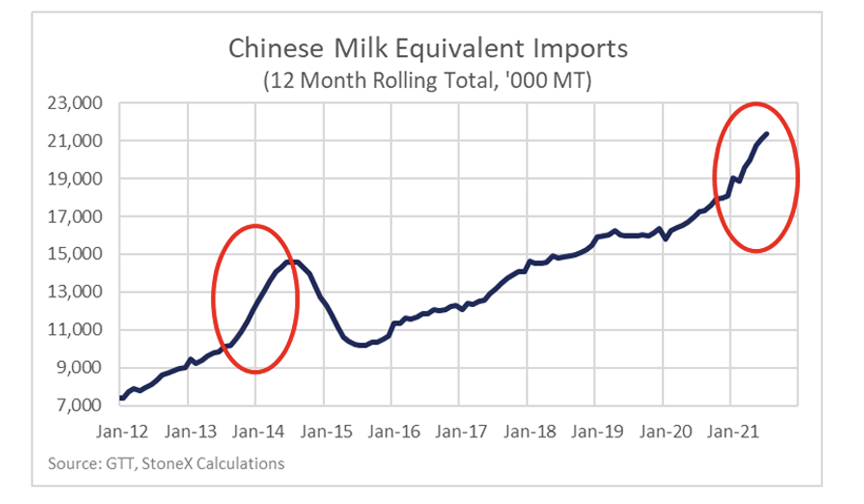
I feel like it hasn’t received the headlines it deserves, but Chinese import demand has been spectacular. The last time we saw an import surge like this was 2013/2014 when it pushed global dairy prices to new record highs. Milk equivalent Imports over the past 12 months are up 23.8%, which equates to an additional 9 billion (with a “B”) pounds of demand. That is equal to the product from 378,000 U.S. cows, and remember, that is just the increase in imports over the past 12 months. Their total imports are equivalent to the production from 1.96 million U.S. cows. Some of the import growth has been
driven by growing consumption, but it also looks like some of the imports, particularly WMP, are sitting in inventory inside of China and that has pulled global prices off their recent highs. It is hard to say which direction Chinese imports are headed. I expect they will slow down and run close to year ago levels for the remainder of 2021 and only grow by about 3% next year. If I’m wrong, every 1% change in Chinese imports drives about a 1.4% change in global dairy prices and I could make an argument for their imports to increase 10% next year or fall by 10% next year.
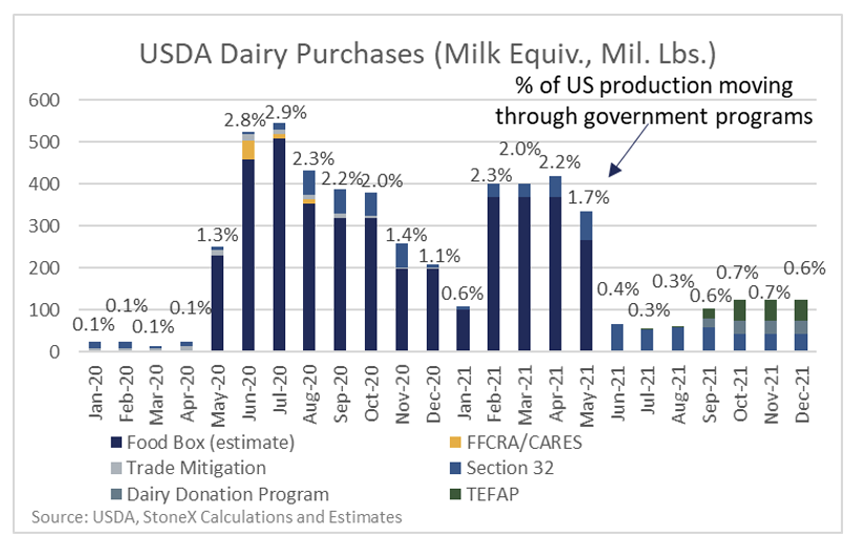
My best estimate is that the U.S. government has spent $1.9 billion buying dairy products since the start of the pandemic, up from $109 million in 2019. They purchased about 2.0% of milk production through various programs in the second half of 2020, and about 1.5% of production in the first half of 2021. But when the Farmers to Families Food Box program ended in May, government dairy purchases dropped off to the lowest we’ve seen in the pandemic era. The new Dairy Donation Program should be ramping up during the remainder of this year, and the USDA is also getting ready to issue new solicitations for purchases with money allocated to The Emergency Food Assistance Program (TEFAP). So we should see a little more product moving through government programs in the fourth quarter, but the volumes look relatively low compared to earlier this year and they will be well below year ago levels.
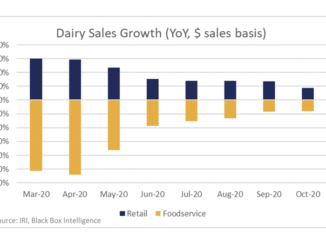
The last variable is the ongoing pandemic. The pandemic has been a global phenomenon that plays out at the local level. As the first wave was spreading in China, and then northern Italy, it was hard to imagine it hitting the U.S. and causing the same problems. And then it was here. Then we watched the second wave hit Europe, and of course it
I think it all nets out to a neutral to slightly bullish outlook. Milk production growth has slowed significantly in Europe too, which is helping to tighten global supply. Chinese demand may be slowing down, but smaller importers have been sitting on the sidelines
Editor’s Note: Nate Donnay is the Director of Dairy Market Insight at StoneX Financial Inc. and has been applying his interest in large complicated systems and statistical analysis to the international and U.S. dairy markets since 2005. He can be contacted at Nate.Donnay@StoneX.com
Be the first to comment